Context management

Context Engineering in 2026 — Louis-François Bouchard, Omar Solano & Samridhi Vaid, Towards AI

Context Engineering in 2026 — Louis-François Bouchard, Omar Solano & Samridhi Vaid, Towards AI

Experiments with an AI tutor reveal that not compacting context often outperforms summarization, leading to better recall, lower cost, and faster responses, primarily due to LLM API prompt caching. Compaction invalidates the cache, making it unexpectedly expensive. While cloud environments benefit from full history, local hardware limits necessitate compaction, highlighting the need to prioritize actual constraints over default compaction strategies.

Exo: Harnesses should see their own code and logs — Alex Krentsel

Exo: Harnesses should see their own code and logs — Alex Krentsel

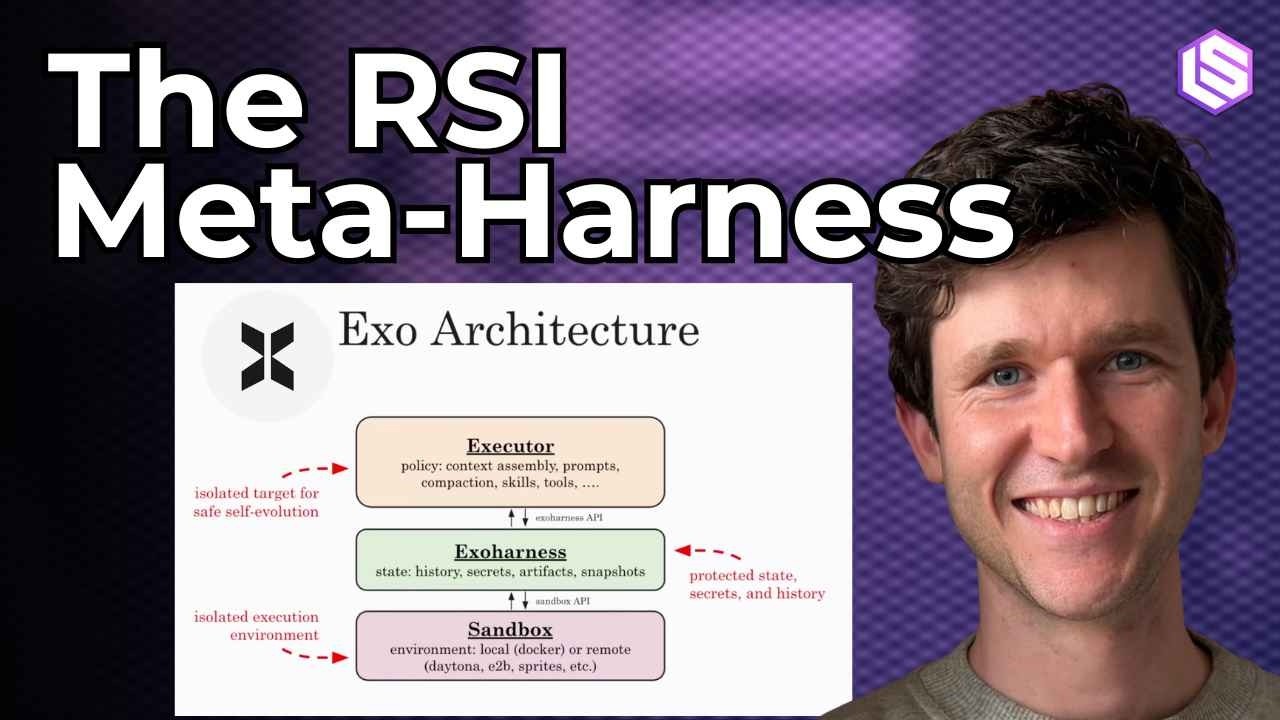
An introduction to Exo, a fully recursive AI agent harnessing a novel three-layer architecture (Executor, Harness, Sandbox) designed for autonomous self-improvement. It delves into how Exo surpasses current agent limitations by allowing the agent to edit its own code and policy at runtime, ensuring protected state and isolated execution, and discusses practical implications and the underlying systems philosophy enabling this paradigm shift.

When to Build Your Own Agent Harness | Harrison Chase, LangChain

When to Build Your Own Agent Harness | Harrison Chase, LangChain

Harrison Chase, co-founder of LangChain, delves into the critical role of the 'harness' in LLM agents, explaining how it orchestrates models and context. He covers customizing harnesses with middleware and sub-agents, the trade-offs between off-the-shelf and custom solutions for in- and out-of-distribution tasks, and the importance of evaluations and observability for continuous agent improvement. The discussion culminates in the 'data flywheel' concept and the `LangSmith Engine` for automating agent intelligence through iterative refinement.

Evolution of agentic surfaces — Gagan Bhat & Isabella Kai He, Anthropic

Evolution of agentic surfaces — Gagan Bhat & Isabella Kai He, Anthropic

Anthropic's Gagan Bhat and Isabella Kai He discuss how agent harnesses must evolve rapidly to keep pace with fast-improving LLMs. They introduce Claude Managed Agents, an architecture that decouples the agent's 'brain' (reasoning) from its 'hands' (tool execution) to address issues like stale assumptions, latency, and reliability. This approach enables dynamic adaptation, secure tool execution, and features like 'dreaming' for self-improving agents and 'outcomes' for goal-oriented task completion, ultimately aiming to close the gap between model capabilities and product offerings.

Codex, Behind the Harness — Dominik Kundel, OpenAI

Codex, Behind the Harness — Dominik Kundel, OpenAI

Once GPT 5.3 Codex Spark achieved 1000 tokens/sec on Cerebras, network latency superseded inference as the bottleneck for agents. This talk details how the Codex harness addresses this and other agentic challenges through innovations like WebSocket mode for stateful context, deferred tools for efficient context construction, robust sandboxing (Seatbelt, Bubblewrap, custom Windows solution), and an auto-review subagent to mitigate approval fatigue while ensuring security. It also covers structured actions via 'apply patch' for file edits, shell tools for system interaction, and sophisticated long-horizon goal management, with most distinct features exposed through the open Responses API.

5 Best Practices for Building AI Agent Skills

5 Best Practices for Building AI Agent Skills

This video outlines five essential best practices for developing reliable, secure, and effective AI agent skills. It covers optimizing skill triggering through descriptive metadata, leveraging real-world domain expertise over generic LLM output, managing context windows efficiently by writing lean skills and using progressive disclosure, implementing deterministic logic with scripts for fragile operations, and critically vetting all skills for security vulnerabilities before deployment. These practices are crucial for professionals building robust agentic systems.