Context management

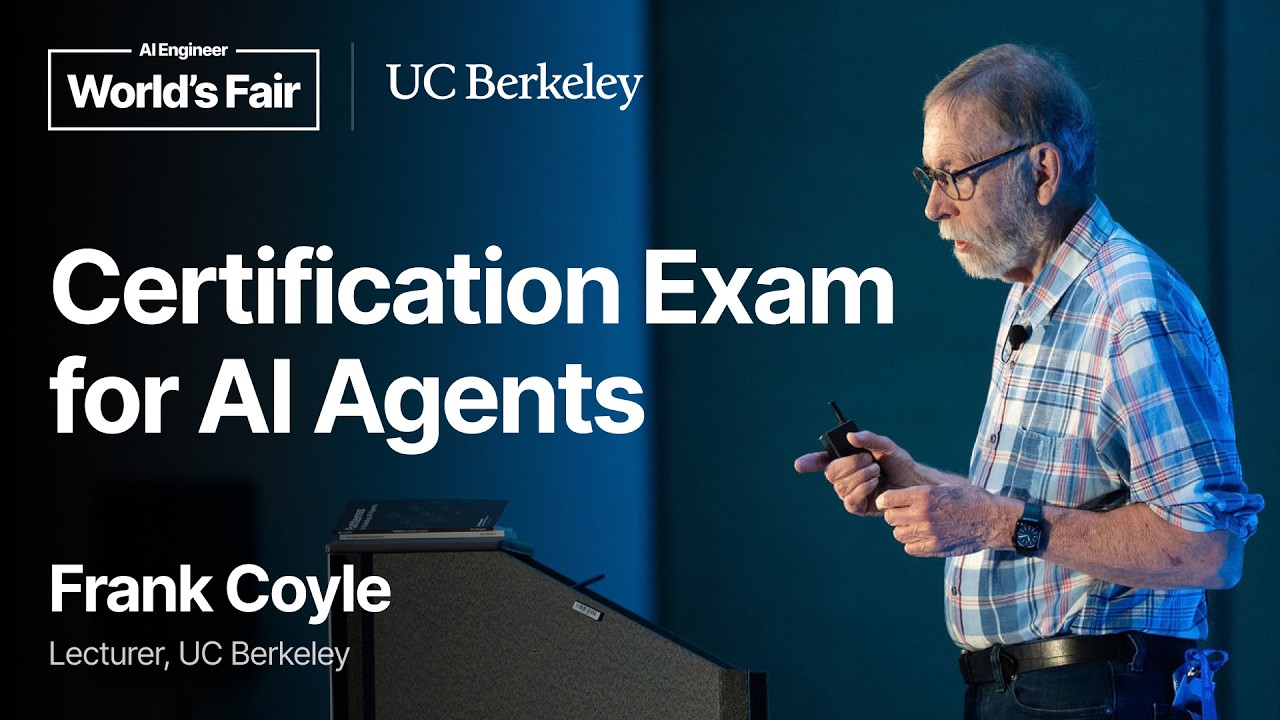
Anthropic's CCA Exam as a Field-Guide for Agentic Engineering — Frank Coyle, UC Berkeley

Anthropic's CCA Exam as a Field-Guide for Agentic Engineering — Frank Coyle, UC Berkeley

Frank Coyle demystifies the Claude Certified Architect exam by dissecting key scenarios and highlighting common anti-patterns in Agentic AI design. He provides actionable best practices, emphasizing effective tool use, context management, specialized agent architectures, and cost-saving techniques, all centered on understanding what to avoid to build robust LLM applications.

The State of Model Routing — NVIDIA, Cognition, OpenRouter

The State of Model Routing — NVIDIA, Cognition, OpenRouter

A deep dive into model routing strategies for AI/ML production, featuring experts from Cognition, OpenRouter, and NVIDIA. Key topics include optimizing costs with multi-model systems, delegating tasks between frontier and smaller models, managing context efficiently (sidekicks, compaction), and adapting to dynamic task complexities. The panel discusses the fragility of naive routing, the cost implications of in-distribution vs. out-of-distribution tasks, and the evolution of auto-routers driven by real-world usage patterns like OpenClaw's heartbeats. Insights also cover NVIDIA's Flex Run for dynamic model sizing, hallucination probes for detecting model limitations, and the future of hybrid local/cloud routing and model collaboration.

Enterprise Agents Have a Structure Problem - Ishita Daga, Tesla

Enterprise Agents Have a Structure Problem - Ishita Daga, Tesla

Ishita Daga, a Senior ML Engineer at Tesla, explains why enterprise AI agents fail, highlighting that current fixes like larger models or more RAG are insufficient. She identifies ambiguity, staleness, and user preference as key structural problems. Daga proposes a solution built on semantic retrieval infrastructure: a hierarchical approach to knowledge sources, including a curated semantic layer and metadata graphs. She also details a robust context life cycle with live data sources and continuous feedback loops to combat staleness. The challenge of integrating individual preferences, requiring agents to reason over business concepts rather than raw schemas, is also discussed.

Anthropic's Katelyn Lesse & Angela Jiang: Building an Ecosystem, not a Walled Garden

Anthropic's Katelyn Lesse & Angela Jiang: Building an Ecosystem, not a Walled Garden

Katelyn Lesse and Angela Jiang, leaders of Anthropic's developer platform, outline their strategy built on a "three-layer cake": knowledge, execution, and coordination. They emphasize moving towards advanced "strategies" or meta-harnesses that assign distinct jobs to tokens, fostering a robust and open AI ecosystem. The discussion covers empowering builders, setting industry standards, and Anthropic's nuanced approach to an open platform versus a walled garden, focusing on architectural soundness over infrastructure ownership.

RLM: Recursive Language Models for Large Codebases - Shashi, Superagentic AI

RLM: Recursive Language Models for Large Codebases - Shashi, Superagentic AI

This talk introduces Recursive Language Models (RLM) as a solution for coding agents struggling with large codebases. RLM externalizes context management into a programmable REPL, allowing the model to write code, inspect the repository, and recursively delegate sub-questions via `llm_query` to curate relevant context. The speaker demonstrates `RLM Code`, an independent implementation, showcasing its operational loop, observability features, and practical applications for AI engineers dealing with complex software projects.

We Cut 94% of AI Coding Tokens With a Local Code Index - Rajkumar Sakthivel, Tesco

We Cut 94% of AI Coding Tokens With a Local Code Index - Rajkumar Sakthivel, Tesco

Rajkumar Sakthivel details how an unexpected surge in AI coding tool costs led to the discovery that sending excessive, irrelevant context was the primary culprit. He introduces the Code Context Engine (CCE), a local retrieval layer that intelligently prunes context using AST-aware chunks, hybrid search, and relevance scoring, resulting in up to 94% token reduction and significant cost savings. The talk emphasizes that optimizing input context, not just the AI model, is paramount for efficient and accurate AI-assisted coding.