Piero Molino, CEO of Studio Atelico, argues that AI should be a foundational game mechanic enabling new experiences rather than a cost-cutting shortcut. He covers on-device multimodal engines built on small fine-tuned models, the economics of cloud inference, artist rights, open source in the game stack, and what skill means in an era of coding agents.
Dedicated Inference
A walkthrough of CoreWeave's three inference paths (Serverless, Dedicated, and Inference on CKS), covering when each fits, how a multi-agent research assistant uses OpenAI-compatible endpoints across model types, and live demos of gateways, deployments, and Kubernetes-based vLLM, Dynamo, and LLM-D serving.
Large clusters for small models — Daniel Svonava, Superlinked
Daniel Svonava argues that small open-source models, when specialized and properly served, can achieve frontier performance for specific tasks, offering significant cost savings and latency improvements over large, generalized models or managed endpoints. He highlights challenges with existing serving infrastructure for a fleet of diverse small models and introduces Superlinked's open-source solution, which leverages a pull-based, centralized queuing system, a Rust sidecar for runtime abstraction, and an autoresearch loop for automated model tuning, enabling high throughput (e.g., half a million embedding tokens/sec on one GPU) and efficient deployment of specialized models and LoRAs.
Is Fine-Tuning Still Needed? LLMs, RAG, & LoRA
This summary explores the evolving role of fine-tuning in modern AI workflows, comparing it with advanced techniques like RAG, LoRA, and enhanced generative AI capabilities. It discusses the historical benefits, current limitations due to rapidly advancing frontier models, and outlines a practical decision framework for customizing machine learning models and designing efficient AI systems.
The Prime Intellect Stack — Will Brown, Prime Intellect
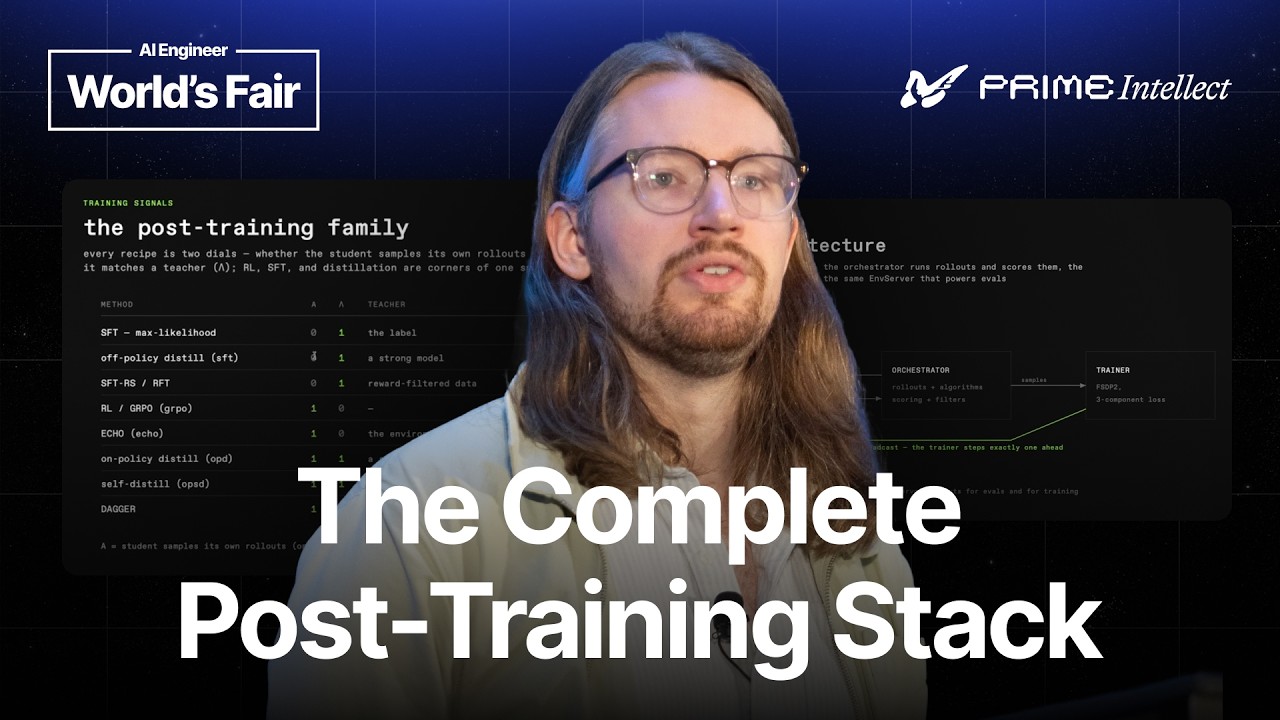
Deep dive into Prime Intellect's open-source ecosystem for post-training LLMs, covering the modular Verifiers V1 environment design, the asynchronous and scalable Primer RL training framework, and the Lab platform for hosted training and fine-tuning. Learn about advanced reward systems, the interception server pattern, and tokenization control with the Renderers library, all designed to enable frontier agentic model development.
Introducing Our Approach to Design Document Review Using Business-Specific Large Language Models
Hitachi's Financial Business Unit developed a specialized LLM to automate the review of system design documents, addressing the inadequacy of general-purpose AI for mission-critical systems. This presentation details the model's development using Continued Pre-training and LoRA on proprietary data, its integration into a multi-agent architecture, and the use of Weights & Biases for MLOps, which led to a 70% reduction in manual review workload.