How Outset Turned AI Interviews Into a New Category
Outset's CEO Aaron Cannon discusses pioneering AI-moderated customer research, detailing the challenges of building a new market category, the transformative impact of advancing AI models on product capabilities and customer insights, and their new Simulations Lab featuring "digital twins" for predicting human behavior and unblocking enterprise creativity.
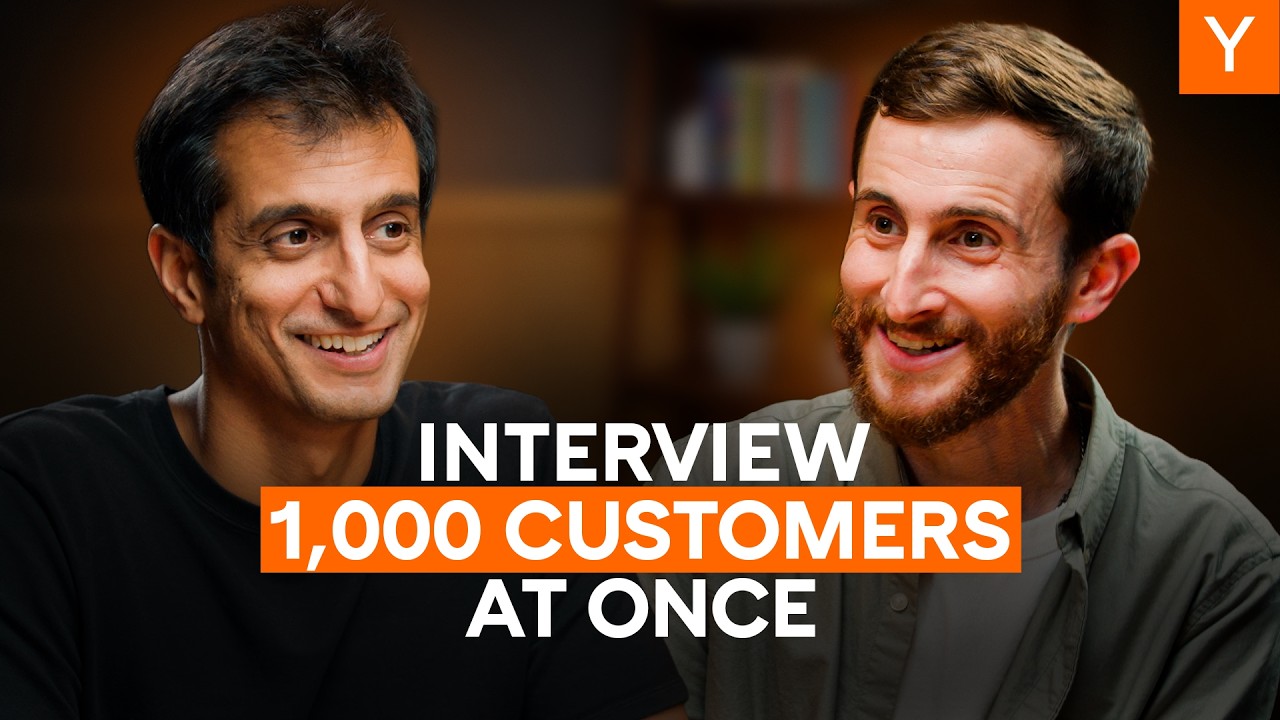
Outset, founded by Aaron Cannon, addresses a critical gap in customer research: bridging the shallow data of traditional surveys with the expensive, time-consuming depth of one-on-one human interviews. Their core product leverages AI to conduct deep, back-and-forth conversations with real people, offering the scale and speed of a survey combined with the qualitative depth of an interview. To date, Outset’s AI interviewers have conducted millions of conversations for major global brands like Google, Microsoft, and Nestlé.
When Outset launched during YC Winter 2023, the concept of AI-led customer interviews was non-obvious, as the market was still nascent in understanding AI’s potential. Aaron, drawing from his background in ethnographic research, envisioned AI (powered by early GPT models) as an interviewer capable of eliciting deep insights through conversation. However, initial demos, despite high interest, saw low conversion rates among enterprise clients. The primary challenge was that these clients lacked existing budget line items for such a novel solution, requiring Outset to effectively “will a new category into existence.” They found that their offering didn’t neatly fit into established categories of quantitative surveys (like Qualtrics) or qualitative research (like focus groups), necessitating extensive market education rather than conventional sales.
To overcome this, Outset prioritized gaining validation through early case studies. Their first enterprise contract, with Weight Watchers, was secured with a significant discount ($10,000 for the year at 75% off) solely for the purpose of generating a successful case study. This involved “an irrational amount of time” working closely with the client until a particular project demonstrated the AI’s efficacy, creating a blueprint for future adoption.
The company’s growth has been profoundly impacted by advancements in underlying AI models. Outset views customer insights as an “insatiable demand” and positions itself not merely as automating an existing workflow, but as enabling entirely new levels of insight that drive product improvement, marketing efficacy, and business growth. Beginning with “Da Vinci” models, they now integrate various frontier models. This continuous improvement means “the more the models get better, the more insight you are going to get.” A compelling example comes from the Weight Watchers pilot, where AI conducted 100 interviews in hours (a task that would traditionally take months) and, crucially, found that “people shared more with AI than they would otherwise with humans.” This highlights the AI’s ability to uncover “ground truth” due to the perceived lack of judgment, akin to anonymous online platforms.
Over the last 18 months, Outset has experienced a significant inflection point. The market shifted from viewing AI-moderated research as an “experimental thing” to a “consensus” approach. By having established mind share and being synonymous with this new category, Outset was ideally positioned for massive growth as the market caught up.
Looking ahead, Outset is expanding beyond interviews with its new Simulations Lab and Digital Twins. These “digital twins” are synthesized representations of actual customers, meticulously developed through hour-long, AI-run “grounding interviews” that delve into personality, values, and motivations to create a comprehensive “persona core.” The strategic objective is to help businesses “predict human behavior.” Unlike traditional research, which is costly and time-consuming, digital twins allow any department within a company to interact with these simulated customers at any time—e.g., marketers testing messaging or finance modeling pricing changes. This unblocks a “huge amount of creativity” by allowing rapid, low-cost testing of ideas that might otherwise be dismissed, moving beyond decisions made by “gut or instinct.” This capability aims to accelerate insight gathering and facilitate a deeper understanding of human behavior.
Aaron Cannon’s journey to entrepreneurship involved working in product roles at various startups, including Triplebyte (where he was Harj Taggar’s first product hire). This experience provided valuable exposure to the founder’s path. His advice to aspiring founders is succinct: “life is short and do it now,” emphasizing the importance of starting and iterating rather than waiting for the perfect idea.