Llm applications

How Outset Turned AI Interviews Into a New Category

How Outset Turned AI Interviews Into a New Category

Outset's CEO Aaron Cannon discusses pioneering AI-moderated customer research, detailing the challenges of building a new market category, the transformative impact of advancing AI models on product capabilities and customer insights, and their new Simulations Lab featuring "digital twins" for predicting human behavior and unblocking enterprise creativity.

The Model-Agnostic AI Platform Betting That No Single Lab Will Win

The Model-Agnostic AI Platform Betting That No Single Lab Will Win

Stanislas Polu, co-founder of Dust, shares his journey from Stripe to OpenAI and his motivations for building Dust. He discusses Dust's model-agnostic approach, the challenges of fundraising in an environment dominated by Frontier Labs, the strategic decision to build in France, and critical insights into pricing models and defensibility for AI product companies amidst commoditized intelligence.

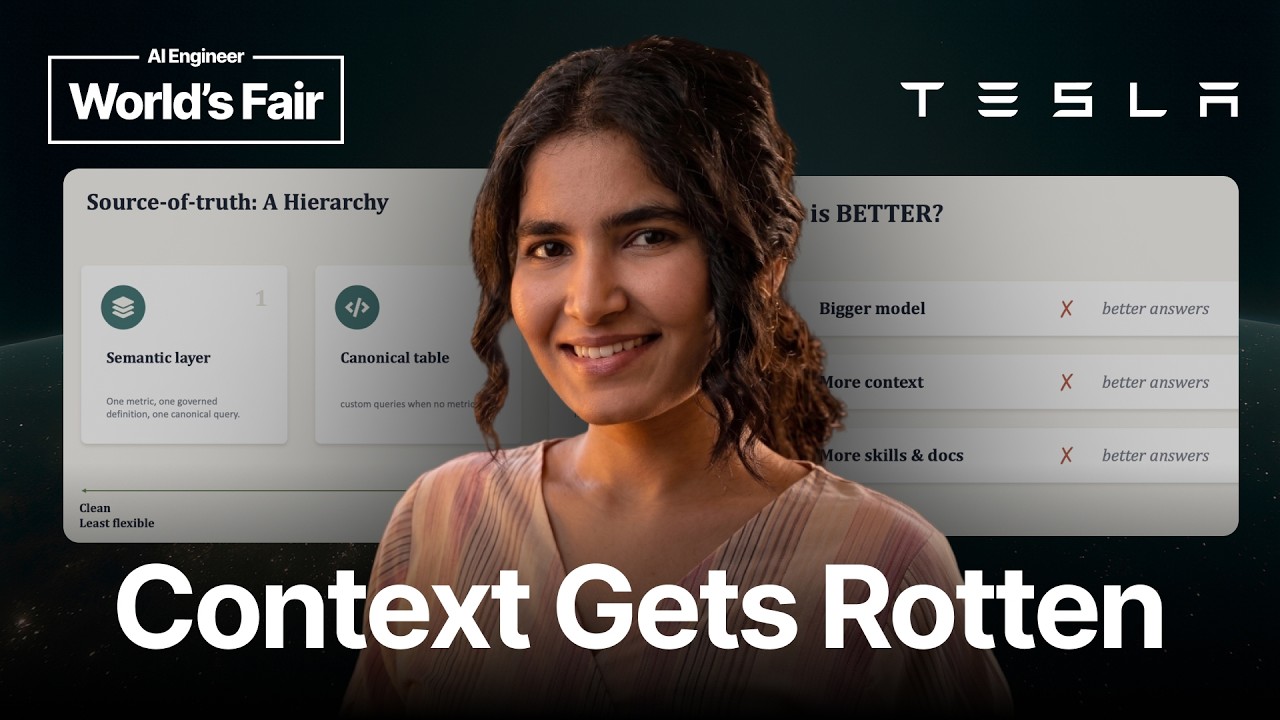
Enterprise Agents Have a Structure Problem - Ishita Daga, Tesla

Enterprise Agents Have a Structure Problem - Ishita Daga, Tesla

Ishita Daga, a Senior ML Engineer at Tesla, explains why enterprise AI agents fail, highlighting that current fixes like larger models or more RAG are insufficient. She identifies ambiguity, staleness, and user preference as key structural problems. Daga proposes a solution built on semantic retrieval infrastructure: a hierarchical approach to knowledge sources, including a curated semantic layer and metadata graphs. She also details a robust context life cycle with live data sources and continuous feedback loops to combat staleness. The challenge of integrating individual preferences, requiring agents to reason over business concepts rather than raw schemas, is also discussed.

Closing Keynote: Garry Tan, Y Combinator

Closing Keynote: Garry Tan, Y Combinator

Garry Tan, President of Y Combinator, details how AI-native companies are achieving unprecedented productivity and scale with lean teams. He introduces the concept of "wiring the work" by treating AI as a workforce where organizational components are encoded into markdown "skill files." Tan explains how "company brains" act as a library and librarian, managing institutional knowledge to overcome human memory limits. He emphasizes the discipline of "skillifying" every task to ensure continuous learning and calls on founders to build these new AI-native infrastructures to "boil the ocean"—tackling previously insurmountable problems.

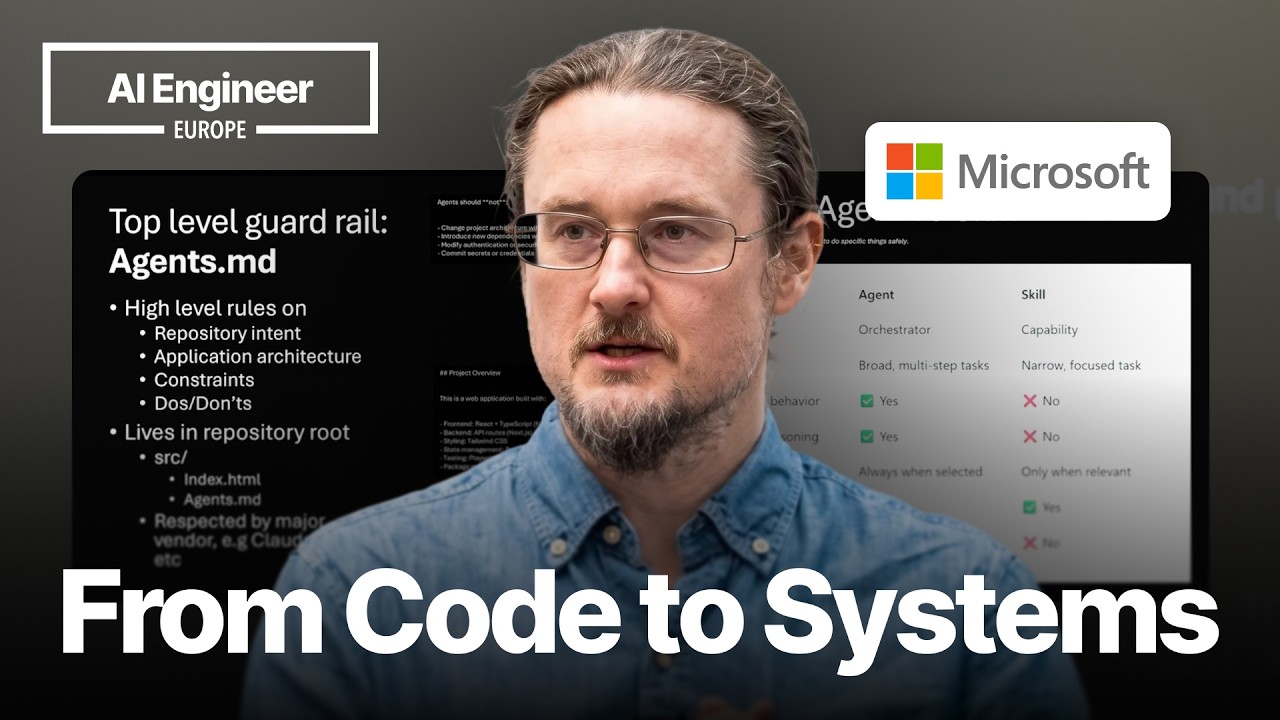
From Writing Code to Designing Systems: How the Developer Role is Changing — Chris Noring, Microsoft

From Writing Code to Designing Systems: How the Developer Role is Changing — Chris Noring, Microsoft

This talk introduces a paradigm shift in software development, moving developers from pure code producers to system designers and agent orchestrators. It details a new workflow leveraging GitHub Copilot CLI, custom Copilot agents, and explicit guardrails like `agents.md` and skills. The focus is on how to decompose complex problems, delegate implementation to AI, and encode architectural standards and constraints directly, enabling higher consistency, quality, and accelerated delivery through a "human-in-the-loop" delegation model.

How Block is becoming the most AI-native enterprise in the world | Dhanji R. Prasanna

How Block is becoming the most AI-native enterprise in the world | Dhanji R. Prasanna

Block CTO Dhanji R. Prasanna shares how the company is becoming AI-native. He discusses their internal open-source AI agent, Goose, which saves employees 8-10 hours weekly, how they measure productivity gains, and the organizational changes that have had an even greater impact than AI tooling.