Closing Keynote: Garry Tan, Y Combinator
Garry Tan, President of Y Combinator, details how AI-native companies are achieving unprecedented productivity and scale with lean teams. He introduces the concept of "wiring the work" by treating AI as a workforce where organizational components are encoded into markdown "skill files." Tan explains how "company brains" act as a library and librarian, managing institutional knowledge to overcome human memory limits. He emphasizes the discipline of "skillifying" every task to ensure continuous learning and calls on founders to build these new AI-native infrastructures to "boil the ocean"—tackling previously insurmountable problems.
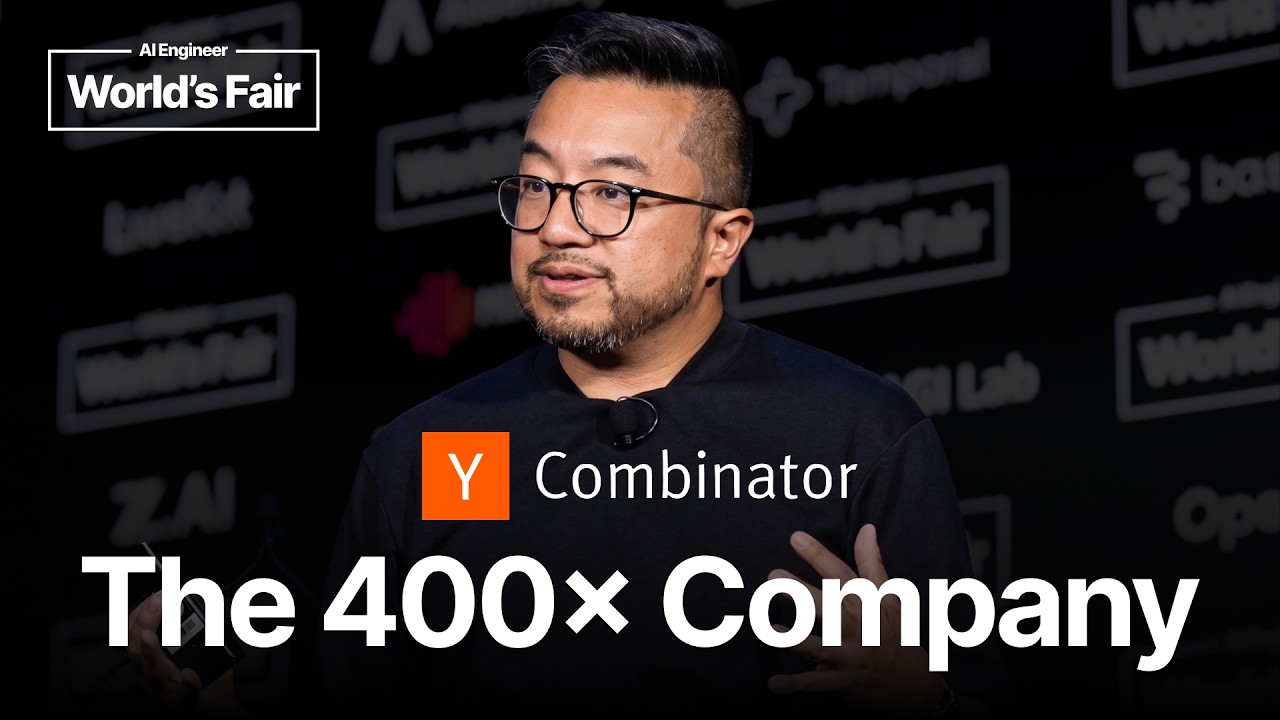
Garry Tan, President of Y Combinator, argues that the rise of AI-native companies is fundamentally transforming organizational productivity, enabling lean teams to achieve scale previously requiring hundreds or thousands of employees. He states this is not a metaphor but a mechanical reality, asserting that “what is possible now is much much bigger than what people believe.”
The “400x” Productivity Leap and Its Implications
Tan quantifies his personal engineering output as having increased by approximately 400x compared to 2013, even conservative estimates put this at “8x at the floor and 80x in the middle.” He crucially emphasizes that “the leverage is not in the weights, it’s in how you wire the work,” as both low- and high-performing individuals use the same AI models. He cites YC data where a quarter of the Winter 25 batch companies, with 95% AI-generated code, became the fastest-growing and most profitable in YC’s history. These successful founders treat AI not as an autocomplete tool but as a “workforce.”
Wiring the Work: The Anatomy of an AI-Native Organization
The core of Tan’s argument lies in “wiring the work” by treating AI as a workforce. He explains that traditional organizational components can now be encoded as markdown files:
- Skill files serve as individual employees, each with “one capability, one job written down clearly enough that someone can execute it.”
- Resolver tables function as an org chart, directing tasks to the appropriate skill file.
- Filing rules embody internal processes and compliance.
- Trigger evals act as performance reviews, verifying the correct execution of skills. Tan asserts, “You’re hiring, training, and managing a workforce made of markdown.” This new paradigm leads to unprecedented revenue-per-head ratios, citing examples like Emergence (nine figures ARR in 8 months with 15 people) and Retail (60M ARR with 40 people). AI-native companies encode sales, support, operations, and finance functions as skills, hiring engineers primarily to maintain and expand these skills.
Latent Space vs. Deterministic Space
Tan distinguishes between two computational spaces:
- Latent space (LLM): This is where non-deterministic calls occur, handling “taste, judgment, understanding what a human actually wants when they say something vague.” The LLM’s behavior is steered by markdown prompts.
- Deterministic space: This is where agents execute code (e.g., TypeScript) for precise, predictable tasks. He illustrates this with the challenge of seating 800 people optimally at an event: the LLM handles the “human part” of judgment, while deterministic space manages the complex logistical computation. This combination allows tasks that once took months to be completed in minutes, at minimal cost.
Overcoming Memory Limits: The Company Brain
Humans are limited to about “seven plus or minus two” items in working memory. In contrast, an AI agent can hold “a million tokens,” equivalent to “a thousand pages” or “three Harry Potter books sitting open in its head all at once.” To leverage this, Tan introduces the concept of a “company brain” – a system acting as “the library plus the librarian.” This brain manages institutional knowledge, ensuring agents have access to the right context at the right time.
Tan’s open-source project, GBrain, serves as a “Postgres for agents”—a retrieval layer that determines “what three books should be loaded into the agent’s head” for any given task. His personal GBrain, with 220,000 pages of his life’s experience, allows his agent to instantly retrieve relevant past interactions and solutions when addressing a crisis, effectively transforming an assistant into a “colleague.” He cautions that a company brain requires constant curation and hygiene, with “provenance on every fact, contradiction checks… and a librarian human plus agent whose actual job is pruning” to prevent it from becoming a “garbage dump.”
The Discipline of “Skillifying” Your Work
Tan’s core advice is to “never do one-off work.” After an AI agent produces satisfactory output, the task must be “skillified”—converted into a reusable skill file. He states, “If you have to ask for something twice, you failed.” This discipline ensures the organization continuously learns and “gets smarter every single day,” avoiding “waking up every morning with amnesia.”
Call to Action: Build AI-Native Companies and “Boil the Ocean”
Tan’s ultimate call to action is to build AI-native companies “from day one,” characterized by thin teams, comprehensive skill files, and a compounding “company brain.” He urges founders to build the underlying “memory layer” that will make subsequent companies easier to create. Dismissing fears about job loss as a “failure of imagination,” he asserts that “abundance is not a policy paper. It is shipped software.” He concludes with the powerful statement: “Every archive too big to read, every data set too gnarly to clean, every ocean you were told not to boil. We can boil the ocean now.” This new paradigm empowers individuals and companies to mechanically achieve previously impossible feats, allowing everyone to “fly, not metaphorically, mechanically.”