Productivity

Why Your Agent Evals Are Missing the Real Failures (with Aishwarya Srinivasan)

Why Your Agent Evals Are Missing the Real Failures (with Aishwarya Srinivasan)

Aishwarya Srinivasan, co-founder of The Gen Academy, discusses the shift in AI and software engineering, highlighting how "cheap code" necessitates strong engineering judgment and a "whole-system eval" approach for agentic AI. She explains the resurgence of reinforcement learning for fine-tuning, the evolution from prompt to loop engineering, and introduces her MIND framework for living with AI. Srinivasan emphasizes experimentation as the most critical career skill and offers insights into what differentiates successful AI startups in today's competitive landscape.
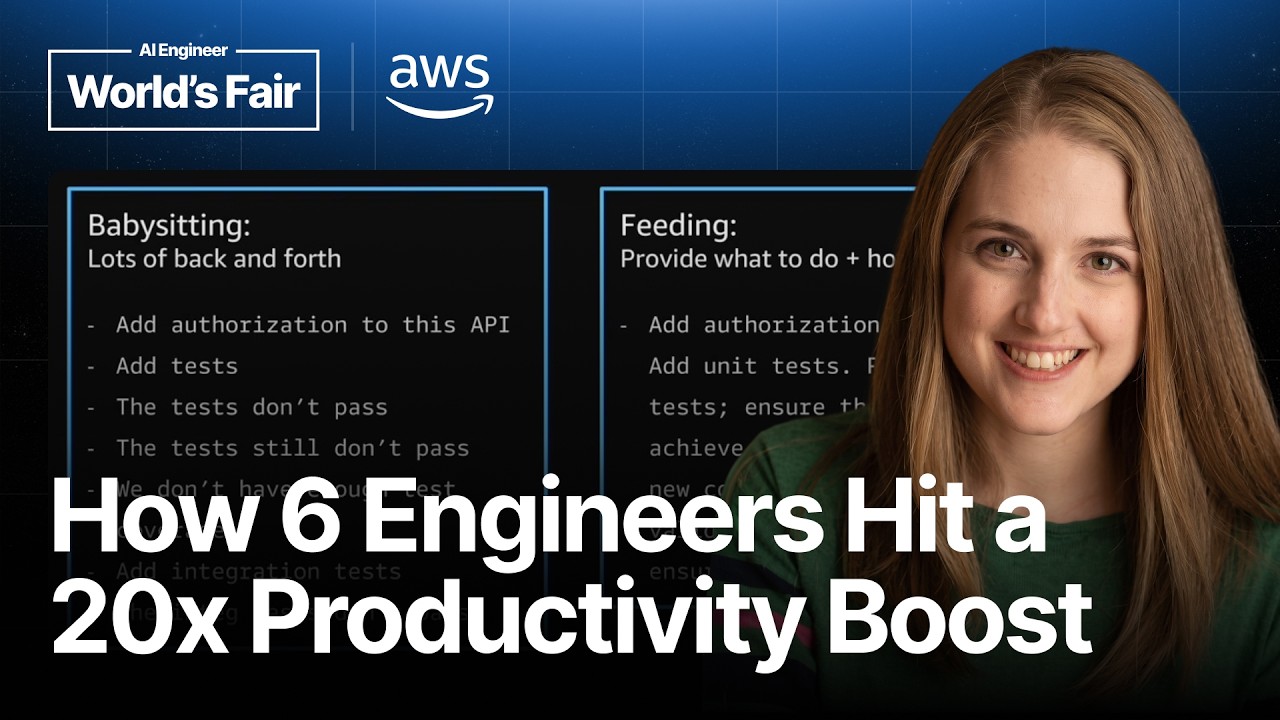

From AI-Assisted to AI-Native: Building a Frontier Development Team — Clare Liguori, AWS

From AI-Assisted to AI-Native: Building a Frontier Development Team — Clare Liguori, AWS

Clare Liguori, a Senior Principal Engineer at AWS, reveals how Amazon teams are achieving 4.5x to 10x productivity gains through 'frontier development' with AI coding assistants like Kuro. She emphasizes that success isn't about the tools, but about fundamentally changing how engineers work, outlining five core habits: investing in agent context, embracing an initial slowdown for long-term speedup, feeding agents comprehensive instructions instead of micromanaging, making design intent explicit before coding, and shifting left with local, deterministic testing. Liguori also addresses new challenges like burnout and decision-making becoming the primary bottleneck in highly accelerated development cycles.

Inside Stripe's AI Strategy with Will Gaybrick

Inside Stripe's AI Strategy with Will Gaybrick

Stripe's President of Product & Business, Will Gaybrick, discusses how AI is transforming Stripe from a payments company into a multi-product financial infrastructure platform. He highlights AI's role in boosting product development velocity through internal tools like "Stripe Minions," which generate thousands of pull requests weekly, enabling a "build everything" philosophy rather than cost-cutting. The conversation also explores the future of "agentic commerce," the potential return of micropayments enabled by stablecoins, and how Stripe empowers internal "founder-like agency" while maintaining high product quality in an increasingly AI-driven software landscape.

Y Combinator CEO on Founder Psychology in the Age of AI

Y Combinator CEO on Founder Psychology in the Age of AI

Garry Tan, President and CEO of Y Combinator, discusses how AI is fundamentally reshaping the startup landscape. He covers the evolution of Silicon Valley culture, the lessons learned from two decades of tech cycles, and why earnestness and courage trump chasing trends. The conversation delves into the transformative power of AI agents in creating "400x" founders, the obsolescence of traditional SaaS, and how small, agent-powered teams can achieve unprecedented scale. Tan also explores the future of consumer AI, the impact of AI on organizational bureaucracy, and the "white pill" perspective on AI adoption, concluding with thoughts on local politics and community engagement.

Circleback CEO Ali Haghani: Recording Company Meetings Will Become The Norm

Circleback CEO Ali Haghani: Recording Company Meetings Will Become The Norm

Ali Haghani, co-founder of CircleBack, shares his unique hardware setup and delves into how his AI notetaker streamlines business operations, from interview tracking to customer support. He discusses the shift from manual coding to AI-orchestrated development, the nuances of prompt engineering, and his vision for why recording meetings with AI is becoming essential for leveraging LLMs and agents effectively in enterprises, ultimately reshaping the future of software engineering.

Benchmarking Coding Agents on New vs Legacy Codebases — Denys Linkov, Wisedocs

Benchmarking Coding Agents on New vs Legacy Codebases — Denys Linkov, Wisedocs

Denys Linkov details Wisedocs' journey of refactoring a complex, distributed ML pipeline into a monorepo, benchmarking the process against evolving AI coding tools. He honestly audits whether the six-month effort was justified, or if waiting for more advanced AI would have been better, ultimately concluding that the significant social and technical benefits made the refactor a successful strategic move despite current LLM limitations.