Why Your Agent Evals Are Missing the Real Failures (with Aishwarya Srinivasan)
Aishwarya Srinivasan, co-founder of The Gen Academy, discusses the shift in AI and software engineering, highlighting how "cheap code" necessitates strong engineering judgment and a "whole-system eval" approach for agentic AI. She explains the resurgence of reinforcement learning for fine-tuning, the evolution from prompt to loop engineering, and introduces her MIND framework for living with AI. Srinivasan emphasizes experimentation as the most critical career skill and offers insights into what differentiates successful AI startups in today's competitive landscape.
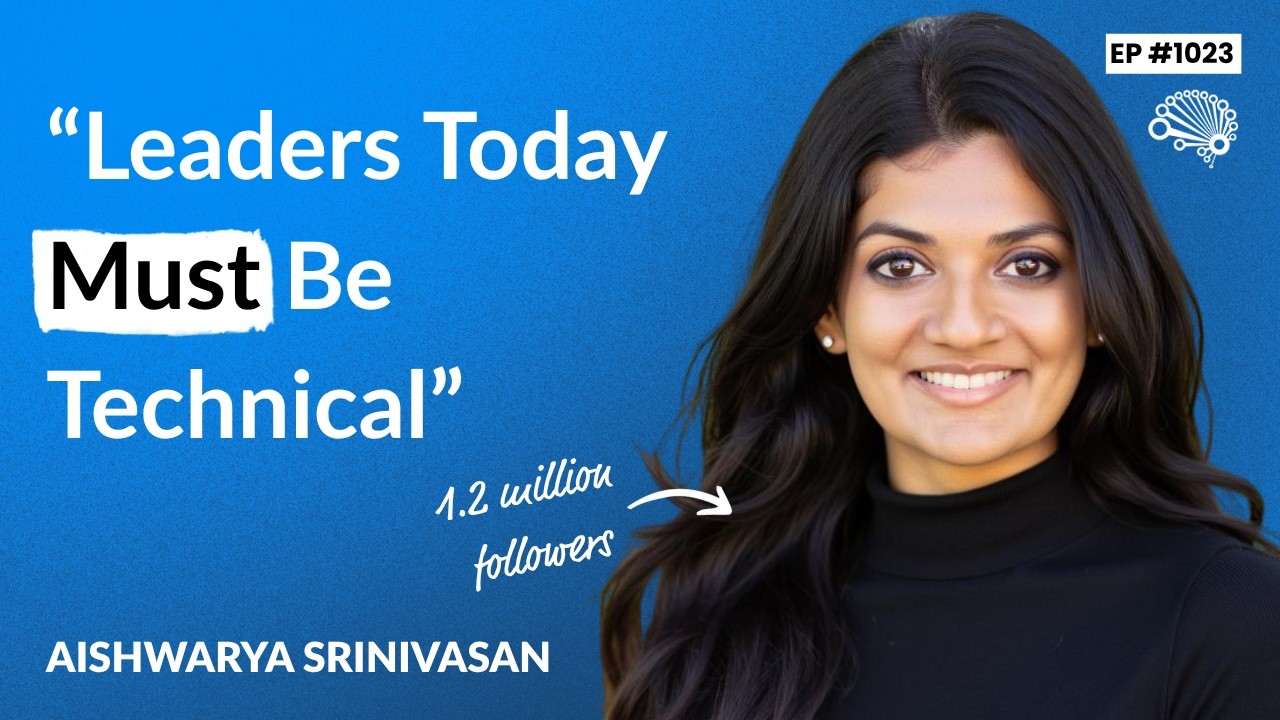
Aishwarya Srinivasan, co-founder of The Gen Academy, discusses the evolving landscape of AI and software engineering, emphasizing that ‘vibe coding’ and ‘cheap code’ shift the bottleneck from execution to judgment. While it lowers the barrier to entry, it also increases the need for robust engineering fundamentals and intentionality in building to create a competitive moat. Without a mindful approach, what one person builds in 10 minutes, another can replicate just as quickly, leading to ‘AI slob’ or ‘spaghetti code’ lacking thoughtfulness.
AI Evaluations and Whole-System Approaches
Srinivasan highlights the critical importance of AI evaluations for agentic systems, which are inherently non-deterministic. Unlike traditional model evaluations that just assess output, whole-system evaluations consider the entire process, from user input to final response, including tool calls, API failures, and other breaking points. This comprehensive approach is vital because agentic systems introduce infinite pathways due to LLM decision-making at every step (intent, tool selection, parameter passing, database interactions). She stresses that these systems are the ’new software,’ requiring a return to traditional software security and safety considerations, such as DOS attacks, unauthorized access, and prompt injection, rather than just focusing on AI-specific challenges.
Reinforcement Learning Resurgence
Reinforcement Learning (RL), which Srinivasan researched and patented at IBM years ago, has seen a significant resurgence in agentic AI. This is primarily due to its ability to handle the non-deterministic nature and infinite action spaces of agentic applications. Instead of relying on exhaustive, curated supervised datasets for fine-tuning, RL allows agents to learn and self-improve by exploring environments, reacting to diverse user inputs, and adjusting alignment based on verifiable rewards or human feedback.
From Prompt to Loop Engineering
There’s a notable shift from prompt engineering to loop engineering. This evolution moves beyond crafting individual instructions to defining overarching goals, success conditions, and feedback systems. The philosophy of loop engineering enables the model to pursue a goal autonomously, reviewing its own output, identifying areas for improvement, patching itself, and comparing its performance against the set goal without constant human intervention. The key challenge lies in defining qualitative goals that the model can effectively assess.
The MIND Framework for Living with AI
Srinivasan introduced the MIND framework in her TED Talk, ‘Reinventing Our Life in the Age of Intelligent Companions,’ to guide mindful interaction with AI as a catalyst, not a crutch:
- Mindful Use: Using AI intentionally to improve the quality of life, leveraging its ability to lower the entry floor and infinitely raise the ceiling of what’s achievable.
- Integration: Overcoming intimidation and actively integrating AI tools into daily routines, recognizing that it’s a tool whose impact depends on how it’s used.
- Navigating Change: Embracing AI as a compass to plan and execute goals, exploring its capabilities rather than resisting its inevitable integration into society.
- Daily Familiarity: Consistent engagement with AI tools to discover new applications and capabilities, fostering comfort and creative use.
Essential Career Skills
The single most important skill for a successful career in the coming years is experimentation. This involves being open to learning new models and frameworks, failing fast, and applying them to personal use cases rather than solely relying on benchmarks. It’s crucial to discern what’s genuinely important amidst the ’noise’ and to actively engage in hands-on work, a necessity even for leaders who must understand technical feasibility to effectively guide their teams.
AI Startup Success in a Hyper-Competitive Market
Srinivasan, an early-stage investor, identifies key differentiators for AI startups:
- Technology & Product: Founders must have a deep understanding of the product and its target user base, conducting thorough market research. Healthy competition signals market demand. A successful startup needs a defensible moat (e.g., data from early users) that prevents larger companies from easily replicating their product.
- Founder Mindset: Founders need to be flexible, embodying the principle of ‘strong opinions loosely held.’ Passion for an idea is good, but the ability to pivot, adapt, and make swift changes to the product roadmap is paramount, avoiding ego-driven persistence in failing ventures.