The Model-Agnostic AI Platform Betting That No Single Lab Will Win
Stanislas Polu, co-founder of Dust, shares his journey from Stripe to OpenAI and his motivations for building Dust. He discusses Dust's model-agnostic approach, the challenges of fundraising in an environment dominated by Frontier Labs, the strategic decision to build in France, and critical insights into pricing models and defensibility for AI product companies amidst commoditized intelligence.
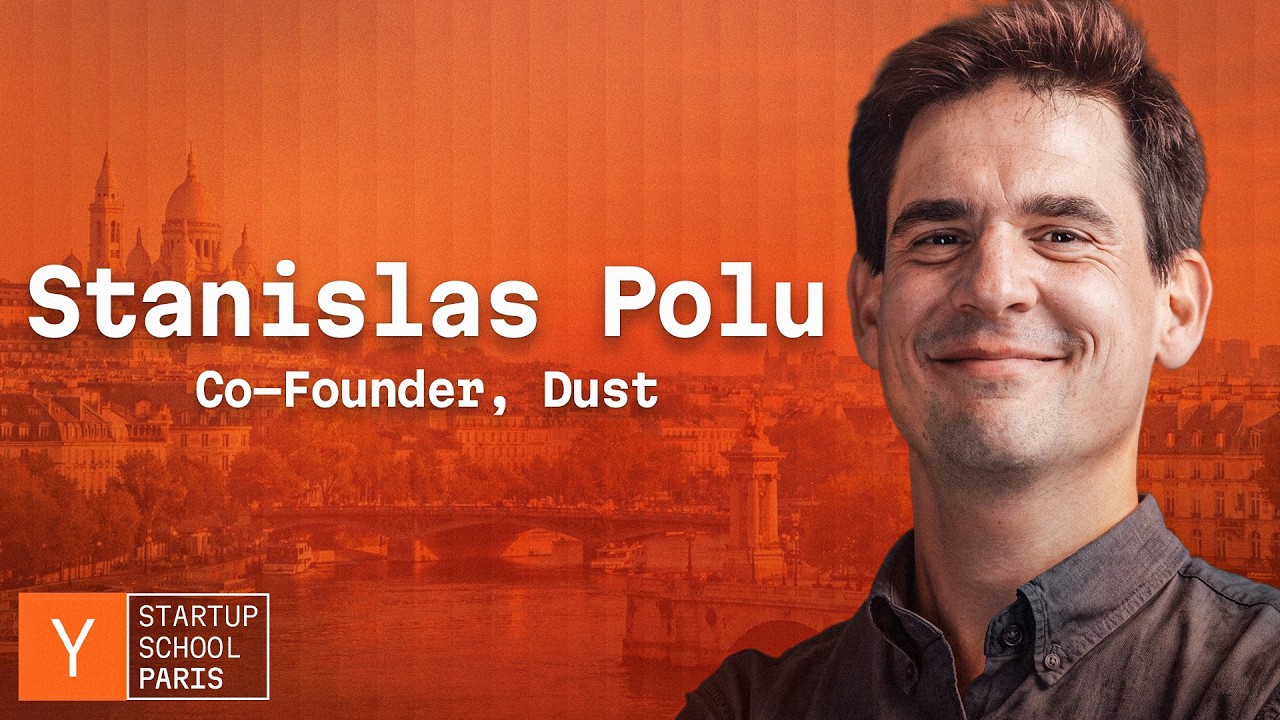
Stan Polu’s Journey: From Stripe to OpenAI to Dust Co-founder
Stanislas Polu, co-founder of Dust, detailed his career trajectory, beginning with an influential five-year tenure at Stripe. His growing interest in AI led him to OpenAI, where he spent three years. Despite lacking a formal research background, Polu found a unique environment that allowed engineers to engage deeply in research, which he describes as his “PhD he never did.”
Rationale for Departing OpenAI
Polu’s decision to leave OpenAI, despite the significant financial implications of forgone stock options, was a deliberate move to prioritize product building over pure research. While acknowledging the fleeting exhilaration of research breakthroughs, he sought the sustained satisfaction derived from developing tangible products that address real-world needs.
Dust’s Core Mission and Vision for the Future of Work
Dust was founded on the principle of applying Large Language Models (LLMs) to transform the workplace. Initially, this focus was surprisingly considered a “niche” in early 2022/2023. Polu highlights that Dust’s definition is constantly evolving due to the rapid advancements in underlying technology, contrasting it with the more stable “JavaScript and Postgres” technological substrate of prior decades.
Projecting two to three years into the future, Polu maintains an optimistic outlook on how work will be redefined. He draws an analogy to how past generations might perceive contemporary office work as not truly “work,” suggesting a similar paradigm shift where future work will be profoundly different, yet still productive.
Evaluating Dust’s Founding Thesis: Hits and Misses
Dust’s core thesis posited that LLMs would bring about an “incredible disruption” to work. Polu believes this prediction has been “deeply right,” noting that this disruption has visibly accelerated in recent months, particularly within areas like software development, where the mode of operation has “radically changed” since November 2023.
Conversely, Polu concedes he was “more of a believer of an earlier plateau” in LLM capabilities. While even a plateau would have offered ample opportunities for “decades of deployment and innovation,” the relentless and accelerating pace of technological advancement means this anticipated plateau “is not happening at all,” indicating he underestimated the continuous progress.
The Horizontal vs. Vertical AI Debate
Dust strategically opted for an “horizontal platform” approach early on, diverging from the prevailing industry advice to “verticalize AI.” While verticalized products offer a more straightforward go-to-market strategy, horizontal platforms, exemplified by Notion or Airtable, provide broad utility but require users to actively envision their applications.
Operating alongside AI giants like OpenAI and Anthropic presents dual challenges and advantages. These labs effectively “educate the market,” and Polu observes a trend toward product convergence, where many AI offerings are evolving into “new productivity suites” focused on human-agent interactions and broad integration rather than deep vertical specialization. Dust differentiates itself through a strong emphasis on collaboration and “multiplayer AI.”
Model Agnosticism as a Strategic Moat
A pivotal differentiator and competitive “moat” for Dust is its commitment to being “model-agnostic.” Polu asserts that incumbent labs cannot offer this level of flexibility, likening the bundled purchase of tokens and product to vendor lock-in with a single energy provider. This agnosticism enables Dust to dynamically leverage the optimal model available at any given time, a critical advantage in a rapidly evolving landscape where model performance leadership frequently shifts.
Impact of Frontier Labs on the Funding Market
Polu discusses how Frontier Labs distort the venture funding ecosystem. VCs often prefer to allocate substantial capital (e.g., $1 billion) to a single lab rather than dispersing smaller investments across numerous startups, effectively “pulling out the oxygen” from the broader market. He expresses hope that eventual public listings of these labs will reintroduce liquidity into the market.
Thoughtful Fundraising: The “Raise Small on Purpose” Philosophy
Stanislas and Gabriel Polu are recognized for their deliberate and “thoughtful” approach to company building and fundraising. They consciously pursued smaller funding rounds at reasonable valuations for their seed and Series A, despite Polu’s background at OpenAI and Stripe. This strategy was informed by observations of others getting “burned” by over-raising early, which can lead to a “coffin corner” where successful outcomes become exceedingly difficult.
Their mantra, “No GPU before PMF” (Product-Market Fit), underscored their focus on the product layer rather than capital-intensive model training, contrasting with the prevailing trend of raising massive rounds for model development. While acknowledging their cautious approach, Polu highlights Mistral AI as an example of aggressive, yet successful, fundraising; Arthur Mensch, a researcher with no prior company-building experience, managed to build a $12 billion company by adopting a “very aggressive” strategy.
Strategic Choice: Building in France
Despite acknowledging that building a company in the US would have been “easier,” Polu and his co-founder intentionally chose France. This decision was motivated by a desire to contribute to the French tech ecosystem and a sense of “national preference or sovereignty.” While this introduces an “additional constraint” or “friction,” Polu believes that successful companies, regardless of origin (citing examples like Spotify), ultimately overcome geographical biases in the eyes of investors.
Defensibility When Labs Enter Your Vertical
When Frontier Labs expand into specific verticals (e.g., Anthropic’s venture into legal tech), verticalized products face new competitive pressures. Polu contends that the value of custom “scaffolding” around models diminishes as base models improve. In an era where “intelligence is commoditized,” the primary source of defensibility for verticalized products must stem from “network effects.” Companies need to cultivate value through multi-user interactions on a platform, echoing business advice from a decade ago, rather than simply delivering intelligence to individual users.
The Margin Problem and Credit-Based Pricing
Polu identifies a significant “margin problem” confronting product-layer AI companies. Dust initially employed seat-based pricing to encourage usage, but surging LLM utilization and extended agent loops rapidly compressed their margins. Consequently, Dust is transitioning to “credit-based pricing,” which Polu considers the “only way around” for AI product companies to sustain margins, as flat pricing is unsustainable given ever-increasing token consumption.
He estimates that labs capture substantial margins (70-80%) on token usage. While challenging, Polu believes that strong product differentiation and craftsmanship can still yield fair margins. He also expresses optimism that the proliferation of open-source models will “recalibrate” the market, exerting downward pressure on labs’ margins and fostering a more competitive environment. He illustrates this by comparing the latency of open-source models (e.g., GLM 5.2) with frontier models, noting a 9x price difference for comparable latency, which highlights the significant margins enjoyed by the labs.
Parting Wisdom for Aspiring Founders
Polu concludes with essential advice for entrepreneurs: “Find the thing you want to fix, the vision you have.” He stresses that the daily reality of company building can be “shitty as hell” with numerous challenges and lows. A clear, deeply held vision is indispensable for sustaining motivation and driving progress “despite all the glass eating that is involved in the job.”