🔬 The Physical World Is More Forgiving Than You Think — Anima Anandkumar, Caltech
Anima Anandkumar discusses her vision for AI in science, moving beyond language models to apply machine learning to the physical world. She introduces neural operators, especially Fourier neural operators, as a solution to data scarcity and resolution challenges in domains like weather, climate, and fusion. These models integrate physical constraints and data to achieve unprecedented speed and accuracy, even on consumer hardware, enabling capabilities from early hurricane prediction to digital twins for fusion reactors and inverse design for advanced materials. The conversation highlights the need for principled AI design for scientific discovery and advocates for distinct regulatory approaches for AI in science.
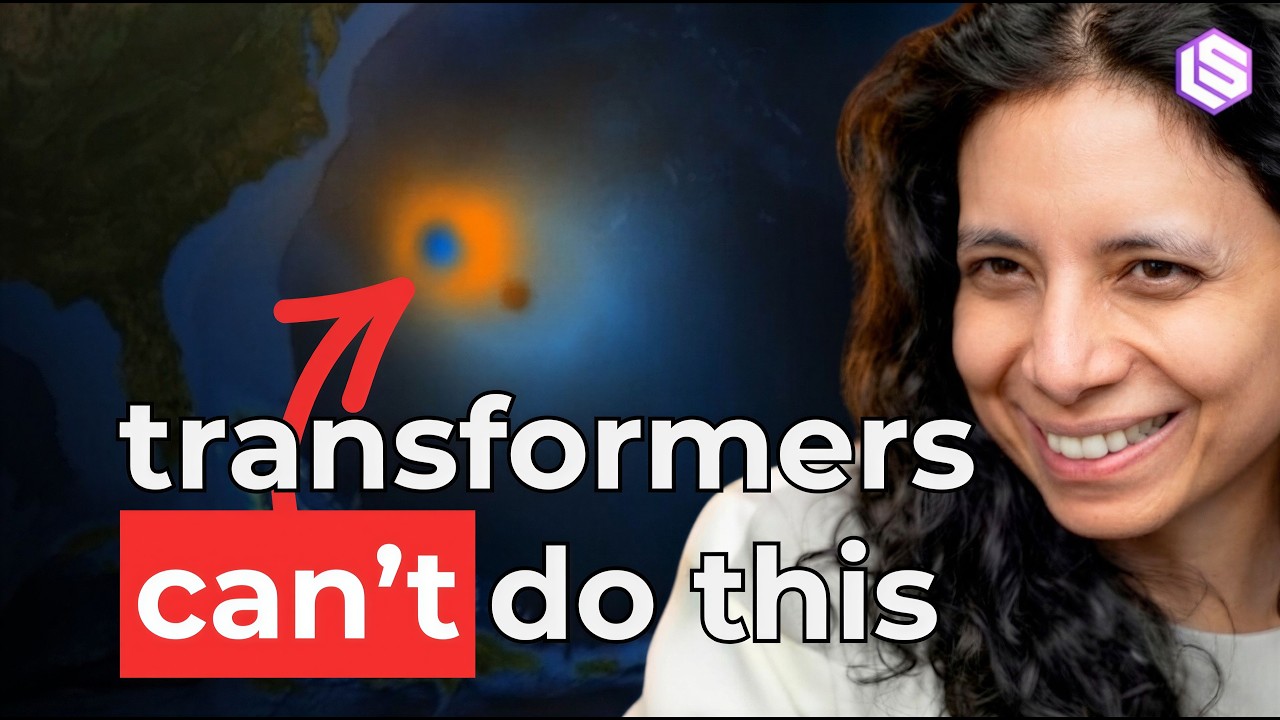
Anima Anandkumar outlines her core thesis on applying AI to the physical world, emphasizing that science requires different approaches than language-centric models. Her work centers on building AI with guarantees for real-world applications, moving beyond mere hypothesis generation to verification and robust performance.
Limitations of Traditional AI in Science
Anandkumar explains that traditional Physics-Informed Neural Networks (PINNs) often fall short for complex, time-dependent, and chaotic systems, like fluid dynamics. Their reliance on solving partial differential equations (PDEs) from scratch makes optimization difficult and frequently unstable. Furthermore, scientific data is inherently scarcer than linguistic data, and the high-resolution requirements for accurate physical simulations—often involving 4D data with thousands of grid points per dimension—render traditional deep learning architectures like transformers computationally unfeasible due to their quadratic complexity.
Neural Operators: A Principled Solution
To address these challenges, Anandkumar’s team developed neural operators, which generalize neural networks to operate on continuous function spaces rather than fixed-size inputs and outputs. This allows for multi-scale modeling, enabling models to “zoom in and out” and resolve phenomena at arbitrary resolutions. Neural operators integrate data-driven learning with physical constraints (e.g., conservation laws, PDEs) as loss functions, guiding the model toward physically valid solutions even for super-resolution tasks. This hybrid approach overcomes PINNs’ limitations by leveraging available data for training while still respecting fundamental physics.
Fourier Neural Operators (FNOs) are a specific and highly effective architecture within this framework. FNOs utilize Fourier transforms to efficiently capture non-local phenomena prevalent in natural systems (e.g., fluid dynamics, material deformation). They combine the computational efficiency of Fourier transforms (quasi-linear complexity) with the expressivity of nonlinearities and residual connections (inspired by modern neural networks), offering a robust and scalable solution for scientific modeling.
Transformative Applications
Anandkumar details several groundbreaking applications of neural operators:
- Weather Modeling (ForecastNet): Initially met with skepticism, ForecastNet demonstrated that neural operators could achieve accuracy comparable to traditional supercomputer-based weather models while being tens of thousands of times faster, running on consumer-grade GPUs. The open-sourcing of ForecastNet spurred a paradigm shift, democratizing high-fidelity weather forecasting globally.
- Climate Modeling (ForecastNet 3): Building on this success, ForecastNet 3 unifies weather and climate prediction by explicitly incorporating the Earth’s spherical geometry. This architectural choice enables stable, long-term simulations (months to years), a feat where models assuming flat geometries fail. The Allan AI Institute has since built climate models based on this architecture. The models train on short (6-hour) predictions but generalize to much longer rollouts. Anandkumar highlights the importance of probabilistic ensemble predictions for accurate risk assessment of extreme events, citing ForecastNet’s early and accurate prediction of Hurricane Lee’s landfall.
- Fusion Reactor Control: Neural operators are creating “digital twins” of plasma dynamics in tokamaks, simulating complex magnetohydrodynamics (MHD) equations a million times faster. This capability is crucial for predicting and preventing plasma disruptions, a major hurdle in achieving sustainable fusion, and enables the exploration of novel reactor designs.
- Materials Science and Inverse Design: The framework extends to modeling carbon sequestration, aerodynamics (by transforming geometries into a latent space), and solving inverse design problems in areas like lithography masks and quantum dot gates. This allows AI to discover optimized designs that are beyond human intuition, with integrated simulations ensuring physical validity.
The Future of Principled AI for Discovery
Anandkumar views her career as having come “full circle,” returning to principled AI design. She argues that purely data-driven approaches are saturating, especially in scientific domains where data is limited and extrapolation (discovery) is key. This necessitates careful architectural design, algorithmic innovation, and appropriate loss functions. She envisions foundation models for physics capable of handling multi-physics and coupled phenomena, not just for simulation but also for solving inverse design problems. Anandkumar suggests that the physical world, despite its complexity, is often “forgiving,” meaning extreme events or complex phenomena can have underlying structures that AI can uncover and exploit, making them tractable even with limited data.
AI Policy and Call to Action
As a member of the UN Scientific Advisory Board, Anandkumar advocates for a nuanced approach to AI regulation. She cautions against a “one-size-fits-all” framework that equates AI for science with language models, emphasizing that AI for science offers immense beneficial impacts and unique risk profiles. Her primary bottleneck for research is the need for more computational resources. She encourages practitioners and researchers to explore open-source neural operator libraries and to think broadly about AI’s potential for understanding and shaping the physical world, moving beyond symbolic representations to simulation, design, and control.
- Tags:
- Feature
- Scientific AI
- AI Ethics
- Formal Verification
- Fusion Energy
- Weather Forecasting
- Inverse Design
- Digital Twins
- Neural Operators
- Fourier Neural Operators
- Climate Modeling
- Physics-Informed ML
- Foundation Models for Physics
- TorchLean
- Spherical Harmonics
- Multiscale Modeling
- Computational Physics
- GPU Acceleration