Simulating Humanity: from Generative Agents to 8 Billion Digital Twins — Joon Sung Park, Simile AI
Joon Sung Park, co-founder and CEO of Simile, traces his path from painting to the Smallville generative agents paper and explains how Simile builds behavioral foundation models and digital twins. The conversation covers why frontier models fail to reproduce irrational human behavior, the role of interviews, observational data, and randomized controlled trials, the 85% accuracy result, scaling laws for simulation, Schelling's agent-based models, the economics of simulating large populations, and the long-term vision of simulating 8 billion people to tackle problems like climate change and democratic instability.
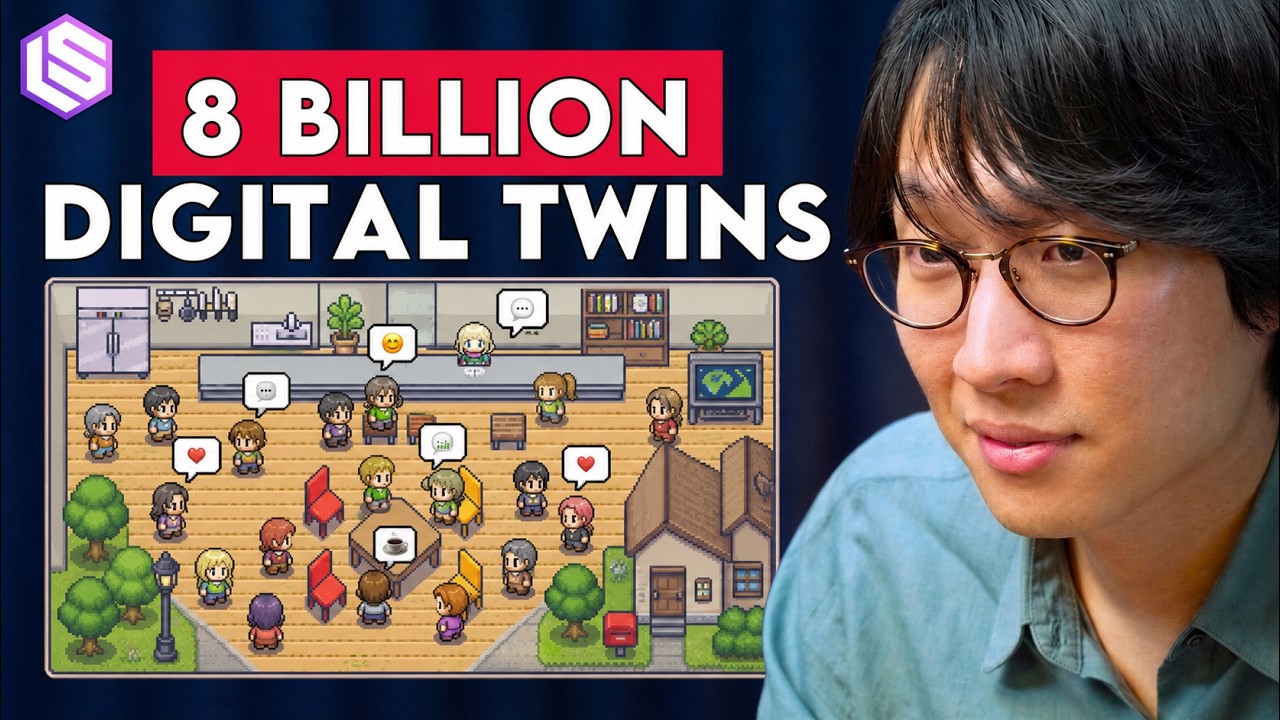
Simulating Humanity: From Smallville to Behavioral Foundation Models
Joon Sung Park opens with his path from painting and music toward computation, the thread that eventually led him to build generative agents at Stanford and then found Simile. He describes an early art-first identity, a move to Boston at age eleven, and a gradual realization that the best artists often create their own medium, which in his case became computation. That framing recurs throughout the conversation: simulation as a medium for representing the essence of human behavior, much as a painting highlights what matters most about its subject.
Origins: Smallville and the Time Machine Game
The Generative Agents paper, widely called the Smallville paper, grew out of a 2020 Stanford effort around GPT-3 and the broader “foundation model” idea, the term coined by Percy Liang and collaborators. Park’s central insight was that these models are trained on broad web data, which is itself a record of human behavior, so “if you poke at the right angle, you could see human behavior that would just pop out.” To decide what to pursue, his group played what they called the time machine game: imagine fast-forwarding ten years and asking which application mattered most. Their answer was ambitious and simple: “what if we can just recreate the world that we live in?”
Park is candid that a close second was personal assistants. His argument there is the more interesting part. A useful assistant, he says, requires a deep model of its user; his example is an agent that orders a pizza with pineapple after he has said he dislikes it. Accurate representations of people, in his view, should precede the more complex agents that automate the world. He is skeptical that current personal agents, including OpenClaw-style systems built on Markdown files, have reached that depth yet. He admires the intuition behind the memory architecture of the original paper, which deliberately avoided knowledge graphs and bespoke models in favor of plain text files, since language models already reason well over text. Yet he notes the limits: retrieving and making sense of very large personal data is hard, and some things cannot be shaped by prompting alone.
Social Physics and Why Parameters Matter
A key argument is that prompting suffices when a model already has the relevant “physics” of its environment and needs only to react, but when it must learn new social physics, the parameters themselves need to change. Park argues that current open models have not learned the full mapping of human social physics, partly because web data is dominated by self-exposed attitudinal content: what people say they do, not what they actually do. He calls the missing layer the “dark knowledge of humanity,” and frames the goal as a behavioral foundation model.
Three Buckets of Data
Park organizes Simile’s data strategy into three buckets. The first is qualitative, long-form interviews, the kind of life-story conversation the podcast itself is performing. Such interviews are not behavioral, but they add texture about childhood, trauma, and formative experiences that is hard to predict otherwise. The second is observational behavioral data, such as transaction records or scraped web activity, which supplies base statistics. The third, which Park considers most important, is causal mechanism data, found chiefly in randomized controlled trials. The coffee example illustrates it: the same person on a day they drank coffee versus a day they did not. Because the world offers only one ground truth, controlled variation of a single variable is rare, which makes this data both scarce and valuable.
Running RCTs with real stakes is central to the approach. Park explains that what separates attitudinal from behavioral data is whether the decision carries real consequences, so Simile borrows techniques from social science and psychology, such as an online store where purchases are actually delivered.
Population-Level and Individual-Level Models
In practice, customers typically start by defining a population of interest, such as Californians in their twenties and thirties or a national general-population sample. Simile recruits matching people with consent and incentives, models them, and lets clients query the resulting population with an environment that might be a survey, a behavioral experiment, or an A/B test. Use cases include concept testing, focus groups, and modeling public company earnings calls. Simile trains two model types, population-level and individual-level, and Park notes the individual-level task is harder and is the one emphasized in their reported results.
The discussion of politics is notably cautious. Simile has a strategic partnership with Gallup but has not deeply pursued political work yet, and Park stresses the need for guardrails given societal impact. He invokes a West Wing episode in which a poll is run to test how a disclosure would be received, observing that counterfactual questions like this are exactly where simulation could help if it were trustworthy.
Simulation Versus Prediction
A recurring theme is that decision-makers rarely want to know what will happen. They want to know how to shape the future. Park draws on Asimov’s Foundation and psychohistory: the first act’s counterintuitive move of exiling the scientists to Terminus illustrates how a simulation reasons backward from a goal along a chain of steps, sometimes producing moves that look strange in isolation. He contrasts this with a more mundane automotive example, where optimizing EV sales through a marketing message might inadvertently change how people perceive cars that are not EVs, reducing overall sales. He also connects this to Shopify’s Sim Jim work on shopping trajectories, noting the shared emphasis on multi-turn behavior rather than attitude.
Evaluation and the 85% Result
The question of groundedness drives much of the conversation. The paper that followed Smallville, often referred to as the thousand-person study, recruited a representative sample of about 1,000 Americans into a virtual lab for two hours of wide-ranging data collection, drawing partly on interview scripts from the American Voices Project. Their digital twins were then used to predict participants’ responses across surveys, behavioral economic games, personality tests, and published randomized controlled trials. The digital twins replicated people’s behaviors and attitudes about 85% as accurately as people replicated their own responses across two weeks, which Park presents as the first validated evidence that individuals can be modeled accurately.
The reasoning for why frontier models fall short is one of the most provocative points. Models like GPT and Claude are optimized to be super-rational, trained on sources such as professional programmers and scientists, whereas Simile’s target is models “as dumb as I am,” making the same mistakes humans make. Park reports that frontier model performance can drop to 20 to 30% on niche populations and around 50 to 60% on general population samples, which is far from robust. The discussion of a simple walk-versus-drive question reinforces this: a model may recommend walking to a car wash without accounting for the human value of walking itself, which Park describes from his own experience of thinking while walking home from Stanford. The lesson is that good simulations must reproduce human inefficiency, bias, and non-optimal but meaningful behavior.
Post-Training on Randomized Controlled Trials
A follow-up paper post-trained a model on data from the Open Science Framework, a platform containing tens of thousands of preregistered experiments. Park frames this in the context of the replication crisis in social science, where publication bias and p-value thresholds have made many findings unreliable, and preregistration has improved confidence. The point of the paper was that high-quality, well-designed RCTs can meaningfully improve a model’s ability to predict human behavior, though this model was not commercially deployed.
Scaling, Scale, and the Long Ambition
Park reports early evidence of scaling laws in simulation: more human data and more compute yield predictable gains in predicting people. The long-term ambition is to simulate 8 billion people, with multi-agent systems living in rich environments. Park suggests the questions change at that scale, shifting toward emergent collective behavior. Examples include climate change as a wicked problem, the signals of collapsing democracy, and the origins of the monetary system. He also imagines that a societal-scale simulation worth running could cost as much as training a foundation model, and that he would raise money for it immediately.
He points to Thomas Schelling’s agent-based segregation model, a grid of red and blue dots following a simple neighborhood-preference rule, which showed that small individual preferences can produce complete segregation. That work informed housing policy, and Park sees generative agents as a way to revive agent-based modeling with far higher fidelity. The host adds a relevant observation about Singapore’s public housing racial quotas.
Cost, Economics, and Use Cases
Simile currently collects data on the order of tens of thousands of people weekly and maintains panel partnerships reaching tens of millions globally. Participants can be reused across studies because the models aim to capture stable traits like risk tolerance, while other behaviors change over time. Park argues that the value of simulation is less about the raw number of people and more about having the right subpopulations. The cost argument is that real studies are expensive, slow, and sometimes infeasible, so a cheaper simulation that informs decisions worth hundreds of millions has an obvious return. Efficiency is a consideration, but Park says it is not yet the highest priority.
Use cases extend to multimodal testing, such as agents traversing Figma mockups or websites, a capability that Wealthfront was among the first to request. Most demand currently comes from places that have historically used human panels, and Park frames the broader mission as ensuring that people’s voices are represented in rooms where decisions are made. He also estimates the addressable market, noting that market research is roughly a 100-billion-dollar industry but that simulation is really a tool for human decision-making, which makes the total addressable market hard to define.
Painting, UBI, and Simulated Life
Park describes simulation as closely related to painting, since the best paintings reveal the essence of their subject without perfect fidelity. Drawing on his earlier work photographing everyday life in a rural town, he suggests that the mundane aspects of human life, when combined, reveal something deep about individuals and societies. He links this to the 1970s book Working as an example of deep interview-based portraiture.
For a future question, he proposes universal basic income as a societally important topic to simulate. He acknowledges Sam Altman’s reported UBI study in Africa, where the answer was no but the implementation was an open question, and argues that simulation could run many variations instantly where a multi-year study costing tens of millions yields a single finding.
The closing reflections touch on whether we live in a simulation. Park says that whether or not we do, experience remains real, and the host notes the mathematical argument that simulated possibilities outnumber non-simulated ones, tempered by computational cost. Park’s closing note frames AGI and simulation as twin pillars of advanced civilization in science fiction.
Simile as a Company
Simile is headquartered in San Francisco with a smaller New York office, and was founded by four researchers: Park, Michael Bernstein, Percy Liang, and Ellen, who leads the business side. Roughly sixty people work there, with many former lab members from Park’s Stanford group now returning after positions at OpenAI, Google Gemini, and elsewhere. The company hires research talent and engineers, many drawn from Figma, Notion, and Harvey.