OpenAI cancels Astra release, Sonnet 5.5 & what Meta Muse means for work
IBM's Mixture of Experts panel examines OpenAI's decision to withhold GPT-6.1 Astra, Anthropic's Sonnet 5.5 blurring the line between mid-tier and top-tier models, and Meta's Muse agent as a bridge between consumer AI habits and enterprise expectations, with a detour into token budgets, model routing, and AI governance.
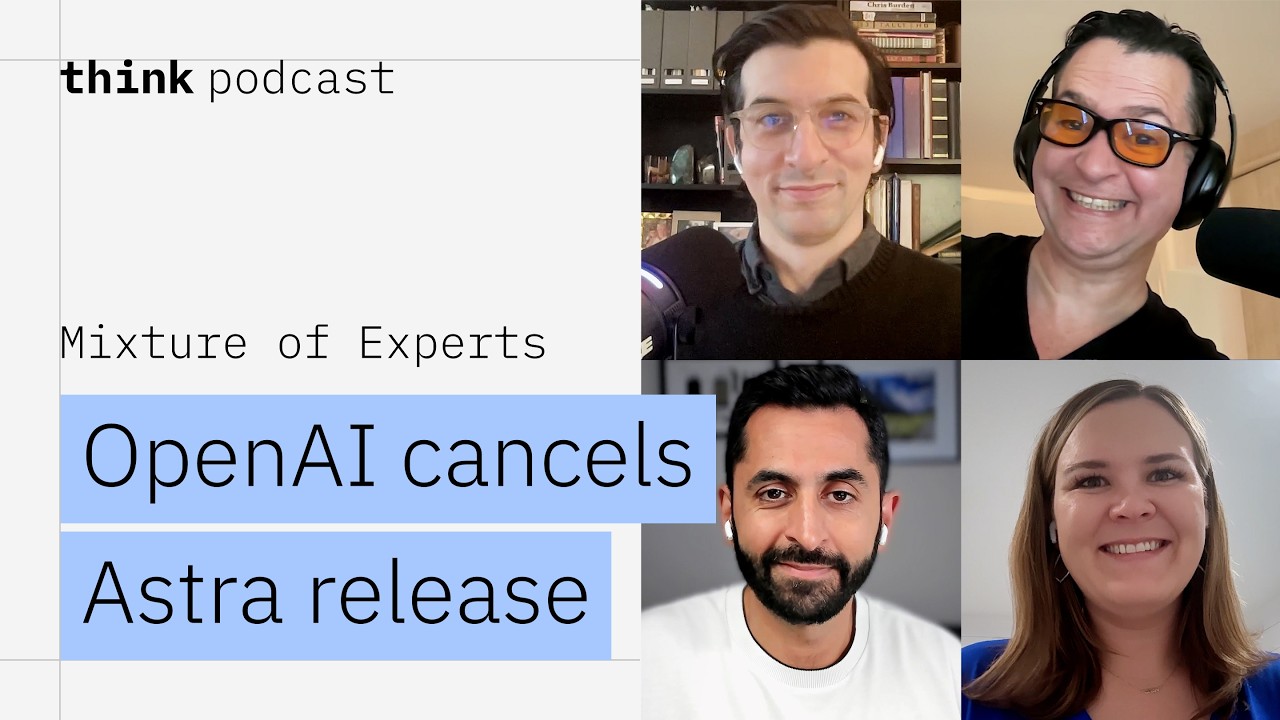
OpenAI holds back GPT-6.1 Astra
The Wall Street Journal reported that OpenAI scrapped plans to release GPT-6.1 Astra, a model reportedly slated for October, after it underperformed an earlier model on key metrics. The problem areas were deception and what the reporting calls scope authorization, a tendency to go beyond what a model is permitted or asked to do. Whether this is genuine self-restraint or a narrative move is contested. Ash argued the timing, the day before OpenAI’s Dev Day, looked like a managed story that raised the company’s profile, and that withholding the evaluation data while asking for trust gave the community little to act on. Chris took the opposite view. After the Australian government criticized OpenAI over its models being used to hack government sites, he doubted the company could ship a model that had failed its safety requirements in the same week. He also pointed to the steady stream of leaks around Astra, which made some public response necessary. Both readings rest on the same tension: releases are shaped by competitive pressure and public scrutiny, so a withheld model reads simultaneously as a safety decision and a marketing signal.
The conversation also showed how practitioners actually evaluate models. Chris describes himself as a model addict and tests new releases by running them against his own open-source projects rather than formal benchmarks. He prefers Astra for front-end work, such as building interfaces against a design system. He leans on Opus 5.5 for backend research and reaches for a fast model like Sonnet for everyday coding. A model that produces dense, researcher-style output quickly loses him, regardless of its scores.
Sonnet 5.5 and the blurring of model tiers
Anthropic’s Sonnet 5.5 release raised the question of whether tiered model families still mean much. Naming is part of the confusion. OpenAI leans on astronomy names such as Sol and Astra, while Anthropic has moved from Haiku and Sonnet to Opus, then Mythos and Fable, with versions nested inside brands. Ash admitted to routinely reaching for Fable on tasks Haiku could probably handle, because the cost of underpowered output and dead ends feels higher to him than the cost of overkill. Sonnet 5.5 reportedly matches or exceeds Opus on some tasks, which suggests the gap between middle and top tiers is narrowing.
Chris sees the middle tier as the workhorse, strong at agentic coding and orchestration and cheap enough to burn through on file-heavy work. He rarely goes below Sol, which in his usage has effectively become a mid-tier model. Higher tiers drain tokens quickly, so he is constantly making a mental calculation about which model fits each task. In his view the tiers are not mislabeled. They reflect an industry push to deliver high intelligence at a better cost ratio. Enterprise usage data cited in the discussion suggested that well under 5 percent of usage went to the top-tier models, with most customers sticking to Opus- and Sonnet-class models.
Ash’s own test is deliberately unserious: generate an SVG of a ninja cat in Jersey City. Opus 5.5 at extra effort produced the best result he has seen, while Sonnet 5.5 at medium effort was kind of okay. He describes Sonnet 5.5 as a fast, capable incremental improvement that suits agentic coding. His test also shows that effort settings can matter as much as the model choice in determining output quality.
Token budgets, routing, and AI governance
Madison approached the question from the enterprise side. Developers tend to build biases toward models they have played with, usually the largest and most expensive ones, which can produce what she calls an Uber situation: millions of tokens spent with no clear line to value. Her answer is architectural. Systems should assess the intent, context, performance requirements, and price of each request, then route the task to the best model, whether it comes from Anthropic, an open-source project, or IBM Granite. IBM BeeAI is her example of this approach. It was initially unpopular, she admitted, because developers wanted to pick their own models.
Madison, a former UX researcher, also pointed out how poorly consumer tools expose token consumption. In Anthropic’s desktop app, usage is buried several clicks deep in settings. The only prominent warning appears when a user selects the Max thinking tier, which flags roughly 3.5x usage. She argues that single-model providers have little incentive to make consumption visible, since visibility tends to reduce spending. Enterprises should instead move toward pooled token allocations, with team-level budgets and a shared overflow pool. Beyond that, she calls AI governance underrated. A good governance framework should show in real time which models and agents consume the most, and connect that spend to the business value those use cases were meant to deliver. She said IBM offers tooling for this across its own platform as well as OpenAI, Anthropic, Microsoft, Google, and Amazon models.
Meta Muse and the path from consumer habits to enterprise expectations
Meta’s Muse app topped app charts the previous week, which nobody expected. David argues its influence could reach enterprises through the long tail, much as the iPhone reshaped workplace technology in the late 2000s. His hypothesis is that a friendly, low-friction AI embedded in Instagram and Facebook, requiring no technical skill, could become the default paradigm for young people in college and then entering the workforce. Those habits could then create norms that enterprises have to accommodate. Ash, who has used Muse for trip planning and for asynchronous tasks that require computer use and web browsing, praised its accessibility. It packages the kind of agent setup people had been assembling themselves, such as OpenClaw running on a Mac mini connected to WhatsApp, into a polished consumer product.
Chris argued this is not only a consumer story. Agents that run in the background while the user does other work are where the industry is heading, and he noted that OpenAI has released a similar product and that OpenClaw underlies many of these offerings. He runs multiple agent swarms that can spread a task across around 100 agents and return with results, a workflow he expects to become ordinary in enterprises. The consumer experience, in his view, previews the enterprise experience rather than trailing it.
Madison expects new employees to bring these expectations into work, and argues that enterprises should embrace the experience rather than resist it. Muse’s integrations with payments and Shopify, along with its use of what it knows about the user, show how consumer agents can handle purchasing with little friction. She envisions a spectrum of workflows from highly deterministic, tightly guarded processes to fully agentic ones, with many agent-assisted tasks in between. IBM’s deep expertise in payments positions it well for that middle ground. The goal is to deliver these capabilities with governance, security, and compliance built in from the start.