Open claw

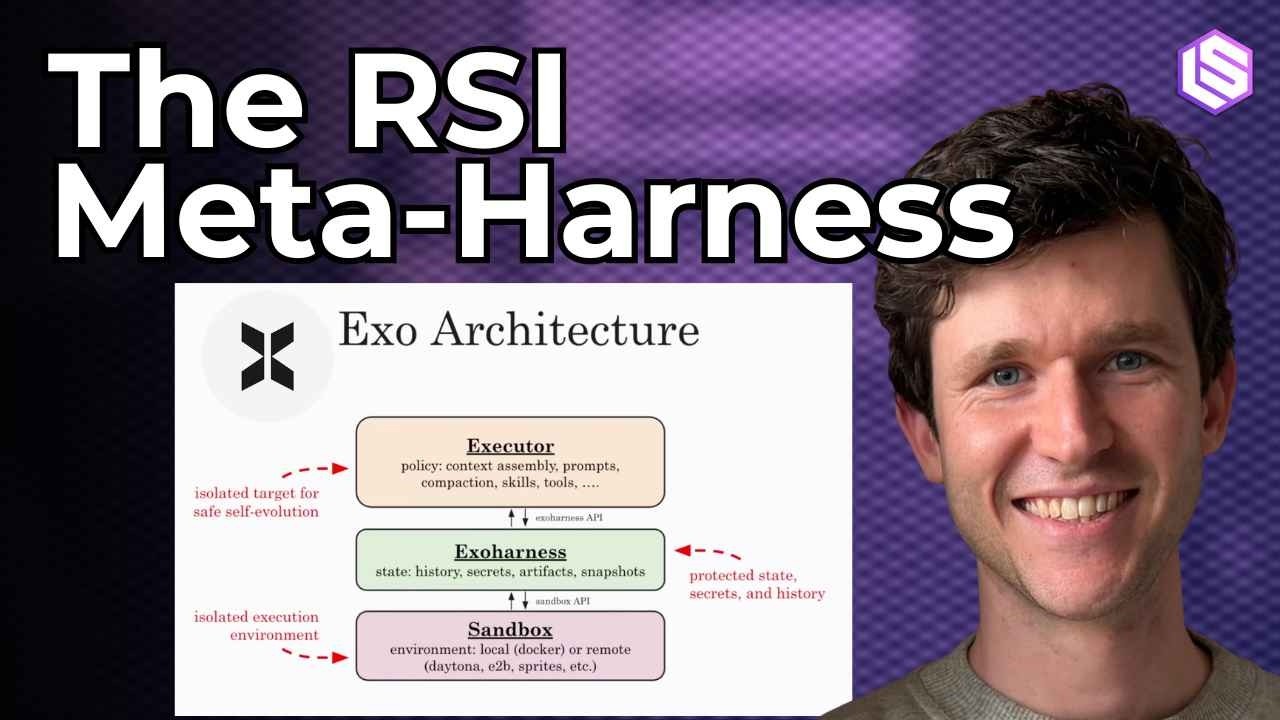
Exo: Harnesses should see their own code and logs — Alex Krentsel

Exo: Harnesses should see their own code and logs — Alex Krentsel

An introduction to Exo, a fully recursive AI agent harnessing a novel three-layer architecture (Executor, Harness, Sandbox) designed for autonomous self-improvement. It delves into how Exo surpasses current agent limitations by allowing the agent to edit its own code and policy at runtime, ensuring protected state and isolated execution, and discusses practical implications and the underlying systems philosophy enabling this paradigm shift.

Peter Steinberger: What Happens When 4.7 Million People Let It Cook

Peter Steinberger: What Happens When 4.7 Million People Let It Cook

Peter Steinberger, founder of OpenClaw, shares the candid story of building one of the world's largest open-source AI projects. Starting from a personal annoyance, OpenClaw went viral, leading to both immense success and unforeseen challenges, including burnout, security pressures, and feature creep. He offers invaluable lessons on product-market fit, managing hyper-growth in open source, the peril of dependencies, and the philosophy that "fun is velocity" in building impactful technology.

Your Agent Didn't Fail. Your Harness Did. — Vinoth Govindarajan, OpenAI

Your Agent Didn't Fail. Your Harness Did. — Vinoth Govindarajan, OpenAI

Vinoth Govindarajan's talk addresses critical 'harness failures' in AI agents, arguing these, rather than model errors, are the root cause of most production incidents. He introduces the core contract: 'A model proposes, the harness commits, and a receipt proves it,' and outlines five key boundaries (state ownership, ordering, deadlines, authority, user-visible proof) that lead to failures like silent success and incomplete reality. The talk culminates in a practical 'run receipt audit' with five questions to diagnose and ensure reliable agent behavior.

Claws Out: Securing and Building with OpenClaw - Nick Taylor, Pomerium

Claws Out: Securing and Building with OpenClaw - Nick Taylor, Pomerium

This talk details how the speaker contributed a "trusted-proxy auth mode" to the OpenClaw project to enhance security and user experience by eliminating the need for tokens and device pairing. It explains the technical implementation of this mode using Identity-Aware Proxies like Pomerium. The speaker also demonstrates a unique workflow, building and live-editing a Multi-Modal Chatbot Protocol (MCP) application directly within ChatGPT, controlled by their OpenClaw instance via Discord, showcasing the power of secure, natural language-driven web development.

Lobster Trap: OpenClaw in Containers from Local to K8s and Back — Sally Ann O'Malley, Red Hat

Lobster Trap: OpenClaw in Containers from Local to K8s and Back — Sally Ann O'Malley, Red Hat

This talk presents a container-first methodology for developing, distributing, and managing AI agents. Using a stack of Podman for local development and Kubernetes for scalable deployment, this approach transforms personalized agent setups from messy collections of files into reproducible, secure, and portable container images that can serve as a team-wide baseline. The session covers practical techniques for secrets management, state persistence, and automated setup, highlighted by a real-world example from an Nvidia team using this pattern for model evaluations.

Scaling Agents on Kubernetes with acpx and ACP — Onur Solmaz, OpenClaw

Scaling Agents on Kubernetes with acpx and ACP — Onur Solmaz, OpenClaw

Onur Solmaz from OpenClaw discusses the challenge of managing 300-500 daily, often AI-generated, pull requests. He introduces ACPX, a headless CLI for the Agent Client Protocol (ACP), designed to automate PR triage through a node-based workflow. The talk culminates in a vision for on-demand, disposable agent pods on Kubernetes, managed by a Go operator that provisions and tears down full compute environments per task, wiring them into chat platforms like Slack.