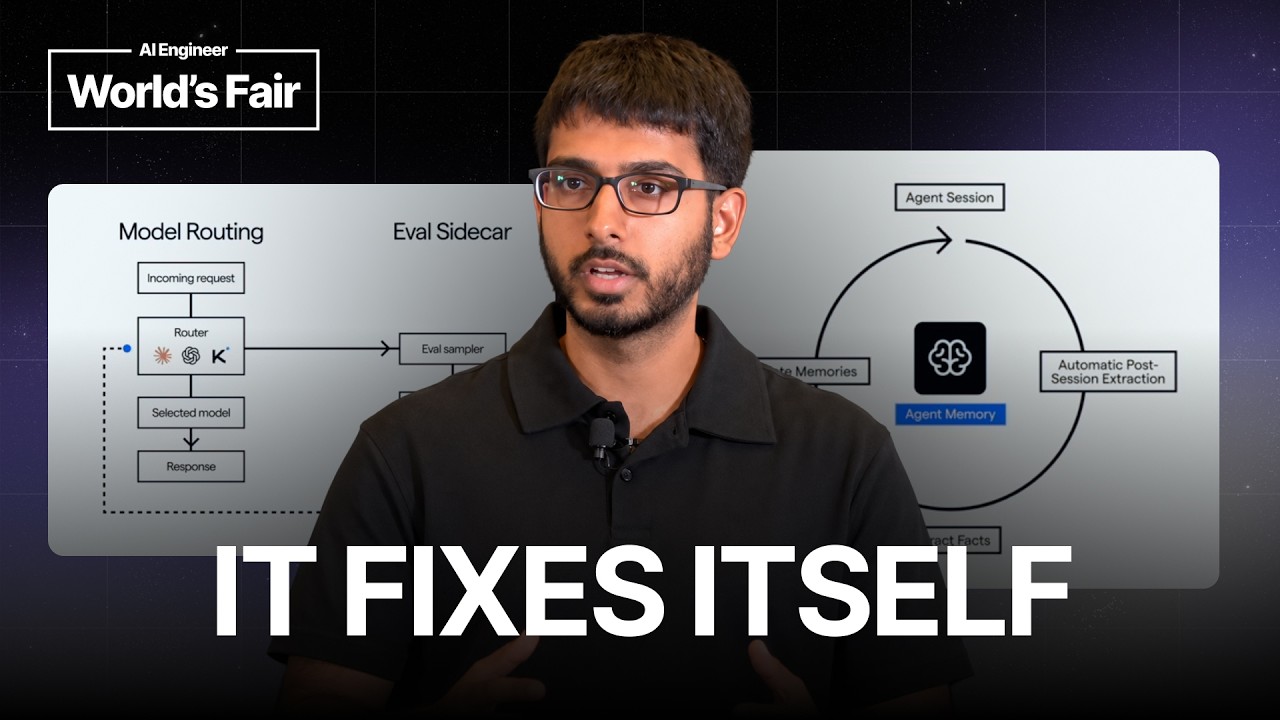
Model routing

The State of Model Routing — NVIDIA, Cognition, OpenRouter

The State of Model Routing — NVIDIA, Cognition, OpenRouter

A deep dive into model routing strategies for AI/ML production, featuring experts from Cognition, OpenRouter, and NVIDIA. Key topics include optimizing costs with multi-model systems, delegating tasks between frontier and smaller models, managing context efficiently (sidekicks, compaction), and adapting to dynamic task complexities. The panel discusses the fragility of naive routing, the cost implications of in-distribution vs. out-of-distribution tasks, and the evolution of auto-routers driven by real-world usage patterns like OpenClaw's heartbeats. Insights also cover NVIDIA's Flex Run for dynamic model sizing, hallucination probes for detecting model limitations, and the future of hybrid local/cloud routing and model collaboration.

Agents Need Feature Flags - Sachin Gupta

Agents Need Feature Flags - Sachin Gupta

AI teams are deploying advanced agent systems without the fundamental safety mechanisms (feature flags, canaries, kill switches) that web teams adopted over a decade ago. This oversight leads to critical incidents like data deletion and financial loss. This talk introduces six agent-specific feature flag types—for prompts, tools, models, memory, autonomy, and sub-agents—and outlines a practical playbook for secure AI deployment, emphasizing the critical role of a pre-wired kill switch to manage the high blast radius of AI agents.

GPT-5: Five AI Model Improvements to Address LLM Weaknesses

GPT-5: Five AI Model Improvements to Address LLM Weaknesses

GPT-5 introduces five key improvements to address core limitations of large language models, including a new routing system for model selection, targeted training to reduce hallucinations, post-training penalties for sycophancy, a nuanced "safe completions" approach for sensitive topics, and chain-of-thought monitoring to prevent deception.