Token economics

Why a $1M Startup Wasn’t Worth Building in the Age of AI

Why a $1M Startup Wasn’t Worth Building in the Age of AI

Jean-Denis Greze, Town's CEO and former Plaid CTO, explains why he shut down a nearly $1M-revenue AI tax business for SMBs and pivoted to Town, an AI assistant that works from email and calendar. The conversation with a16z's Alex Rampell covers founder decision-making under time pressure, product-market fit, the consumer-grade enterprise thesis, token allocation as a business model, neutrality versus frontier labs, horizontal versus vertical strategy, uneven AI diffusion, and how agents may reshape commerce and advertising.

The AI Bill Is Too Damn High: Tokenomics 101 — Eugene Cheah, Featherless AI

The AI Bill Is Too Damn High: Tokenomics 101 — Eugene Cheah, Featherless AI

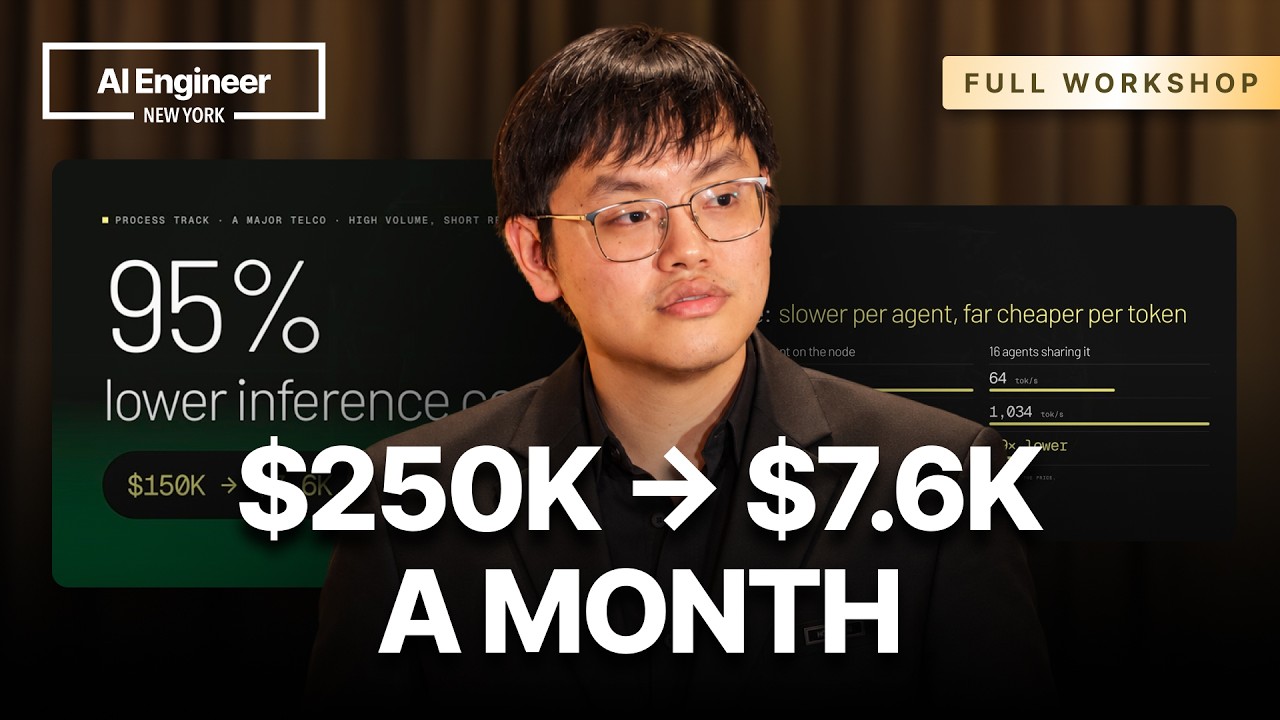
Eugene Cheah, CEO of Featherless AI, presents a four-step framework for cutting AI inference costs at scale: measure token spend by team and workload, right-size models through evals, classifiers, and fine-tuning, buy GPU capacity with an understanding of the speed-versus-cost tradeoff, and check whether organizational processes can absorb the extra output.

The true price of Intelligence: an economic study by Signal65

The true price of Intelligence: an economic study by Signal65

A Signal65 TCO study, presented with CoreWeave, examining the fully loaded economics of AI training and inference. It covers hidden costs such as storage fees, support, and reliability, how performance compounds with price to set cost per million tokens, and how serverless and dedicated inference models differ on useful-token economics.

OpenAI cancels Astra release, Sonnet 5.5 & what Meta Muse means for work

OpenAI cancels Astra release, Sonnet 5.5 & what Meta Muse means for work

IBM's Mixture of Experts panel examines OpenAI's decision to withhold GPT-6.1 Astra, Anthropic's Sonnet 5.5 blurring the line between mid-tier and top-tier models, and Meta's Muse agent as a bridge between consumer AI habits and enterprise expectations, with a detour into token budgets, model routing, and AI governance.

Box's Aaron Levie: On Reinventing Yourself in the AI Age and Enterprise Diffusion

Box's Aaron Levie: On Reinventing Yourself in the AI Age and Enterprise Diffusion

Aaron Levie, CEO of Box, details his company's successful pivot to AI, emphasizing the critical role of application companies in bridging raw model capabilities to complex enterprise workflows. He argues that significant value will accrue to "applied AI" solutions that understand domain-specific needs, can handle intricate data permissions, and build specialized agents, rather than relying solely on foundational models. Levie shares insights on the economics of tokens, the rise of open-weight models, and why AI diffusion in coding differs from other knowledge work, predicting that 90% of enterprise tokens will soon be consumed by non-human initiated tasks.

Why AI Agents Fail

Why AI Agents Fail

Abi Aryan discusses the shift from MLOps to LLMOps, framing generative AI deployment as a distributed systems challenge. She highlights the critical role of FinOps due to high model costs, the need for custom tooling over generic agent frameworks, and the importance of a 'decision layer' for agent autonomy. Observability is re-conceptualized as anomaly detection, and she points to dynamic RL environments and strong data engineering as future research priorities and essential skills for AI engineers.