Jensen Huang: The Mindset That Built NVIDIA
Jensen Huang, CEO of NVIDIA, shares critical lessons from NVIDIA's journey, emphasizing how early failures and a commitment to learning new technologies, like purchasing textbooks from Fry's to pivot the company, laid the groundwork for their success. He discusses NVIDIA's strategic vision, driven by accelerating algorithm domains and seeing AlexNet as a universal function approximator, which led to a reinvention of the computing stack. Huang also explores the future of AI with agents, the importance of fine-grained control, and the "Linux moment" of open-source AI, while also forecasting the rise of physical AI and job creation. He concludes with profound advice on resilience, systems thinking, and the "how hard can it be?" mindset for aspiring entrepreneurs in this unprecedented era of technological reset.
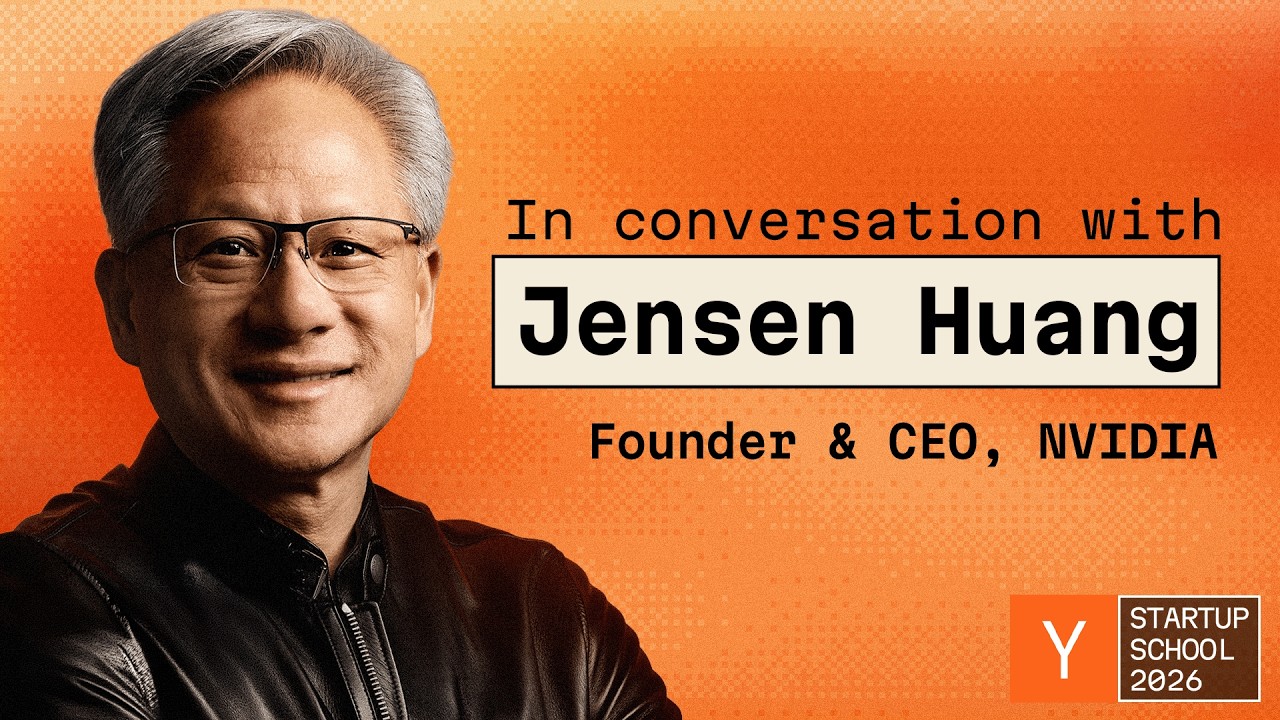
Jensen Huang, CEO of NVIDIA, shared profound insights into the company’s journey, the evolution of AI, and future technological trends at Startup School 2026. He underscored the importance of resilience, continuous learning, and a “how hard can it be?” mindset for entrepreneurs.
NVIDIA’s Foundational Principles: Learning from “Wrong” Starts
Huang revealed that NVIDIA began with the “absolutely wrong” algorithm for 3D graphics in 1993, aiming to turn every PC into a game console. By 1995, realizing their technology was fundamentally flawed, Huang confronted the reality, purchased three OpenGL textbooks from Fry’s, and empowered his engineers to learn the correct approach. This experience forged a core company philosophy: technology is constantly changing, so the ability to confront reality and learn is paramount. This flexible mindset, rather than fixed technological expertise, has allowed NVIDIA to consistently innovate across various domains.
A pivotal moment involved a $12 million contract with Sega for the Dreamcast console. Huang, acknowledging NVIDIA’s flawed technology, honestly communicated this to Sega’s CEO, Madrasan. Despite the admission of failure, Madrasan’s trust in Huang as a founder led to a $5 million payment, saving NVIDIA from bankruptcy. This highlights the importance of integrity and “investing in people, not just companies.”
NVIDIA’s enduring “big idea” was to augment general-purpose CPUs with accelerators to solve computationally challenging problems. This wasn’t about building a great chip, but about accelerating algorithm domains – from molecular dynamics and image processing to deep learning. Huang believes great companies possess a “unique perspective about the world” that they deeply believe in, driving them to tackle inherently difficult visions.
The AI Revolution: A New Software Paradigm
The turning point for NVIDIA in AI came with AlexNet. Huang recognized it not just as a specific neural network, but as a universal function approximator – a foundational shift in software development. This insight led to a “five-layer cake” vision for reinventing the entire computing stack, from processors and middleware to algorithms and applications. He emphasizes the power of “first principles” thinking, constantly asking “if this, then what?” to anticipate technological implications.
Huang describes his role as CEO as one driven by curiosity and service, delving into technical details (reading papers, engaging with scientists) to understand rapidly evolving fields. This “in the weeds” approach allows him to gather insights and empower his team. He likens leadership to “surfing,” requiring an understanding of the “waves” of technology and the agility to adapt, advocating that leaders “build the car to fit your driving style.”
Frontier Algorithms and the Rise of Agents
Looking forward, Huang identifies systems thinking as the most critical skill. As low-level tasks become automated by AI, professionals must think abstractly about system design, constraints, and optimization.
He highlights the rapid evolution of AI agents. While current agents exhibit coarse-grained self-improvement, the next major breakthrough will be fine-grained controllability. This will enable precise human-agent collaboration, even if agents are only 80-99% accurate, allowing for iterative refinement and unlocking unprecedented productivity.
NVIDIA’s strategy regarding agents involves:
- Deep understanding: Intimately learning agentic workloads to design future computer architectures, living 5-10 years ahead.
- Internal adoption: Using agents (e.g., internal “Boris” systems for autonomous code, various co-pilots) to accelerate NVIDIA’s own operations and learn from diverse tool usage.
- Future solutions: Observing early indicators, such as “chain of thought” reasoning, led to innovations like Alpameo, NVIDIA’s self-driving car AI that requires significantly less training data due to prior knowledge and reasoning capabilities.
Huang positions Open Claw as a “Linux moment” for AI, emphasizing the importance of open-source development for democratizing AI. He believes everyone should have the ability to build their own domain-specific AI, complementing cloud services and fostering innovation. “Words are thoughts,” he noted, underlining the inherent intelligence in language models.
AI’s Transformative Societal and Economic Impact
Contrary to fears of job displacement, Huang asserts that AI and automation create jobs by increasing productivity and driving economic growth. While AI automates specific tasks, it doesn’t eliminate entire job roles, but rather transforms them. He cites examples like software engineering, radiology, and paralegal professions, all of which have seen growth despite AI integration, because AI enables them to tackle larger backlogs and be more ambitious.
Regarding physical AI (robotics), Huang believes the “ChatGPT moment” occurred a couple of years ago. Observing generative AI’s ability to create articulated video (e.g., a hand picking up a glass) led him to realize robotics articulation was imminent. NVIDIA is now focused on world foundation models that imbue AI with an understanding of physics and causality. Key to this is a comprehensive simulation strategy: real-to-sim, generative physics simulations (Isaac Sim, Cosmos), and sim-to-real. He estimates NVIDIA’s physical AI business, largely driven by autonomous vehicles, is already a $10 billion segment and could reach $100 billion within a decade.
Enduring Advice for Future Innovators
Huang, an admitted introvert, made his first public post on X in 2026 because the message about open-source AI was too important. He credits open-source platforms (Linux, Kubernetes, PyTorch) as foundational to modern AI.
For young people, his advice is to focus on hard problems and deep sciences (physics, chemistry, biology, computer science, engineering) and systems thinking, as simple, repetitive tasks will be automated. AI empowers greater ambition, allowing us to tackle problems of unprecedented scale.
His core message to entrepreneurs is the “how hard can it be?” mindset. While acknowledging that challenges will inevitably be “way harder than you think,” this attitude prevents anxiety and encourages action. Above all, resilience – the ability to overcome challenges “one day at a time” – and a deep belief in one’s capacity to learn are the most critical superpowers for success. He sees this era as “the greatest time in the last 60 years to start a company” due to the fundamental reset in computing technology.
- Tags:
- AI Agents
- Future of Work
- AI
- Open Source
- Robotics
- Machine Learning
- Deep Learning
- GPU
- Innovation
- Nvidia
- Productivity
- Self-Driving Cars
- Algorithms
- Y Combinator
- Entrepreneurship
- Physical AI
- First Principles
- Systems Thinking
- Jensen Huang
- Accelerated Computing
- Startup School
- Open-Claw
- Hermes
- Resilience
- Learning
- Dreamcast
- AlexNet
- Alpameo
- Job Creation