First principles

Jensen Huang: The Mindset That Built NVIDIA

Jensen Huang: The Mindset That Built NVIDIA

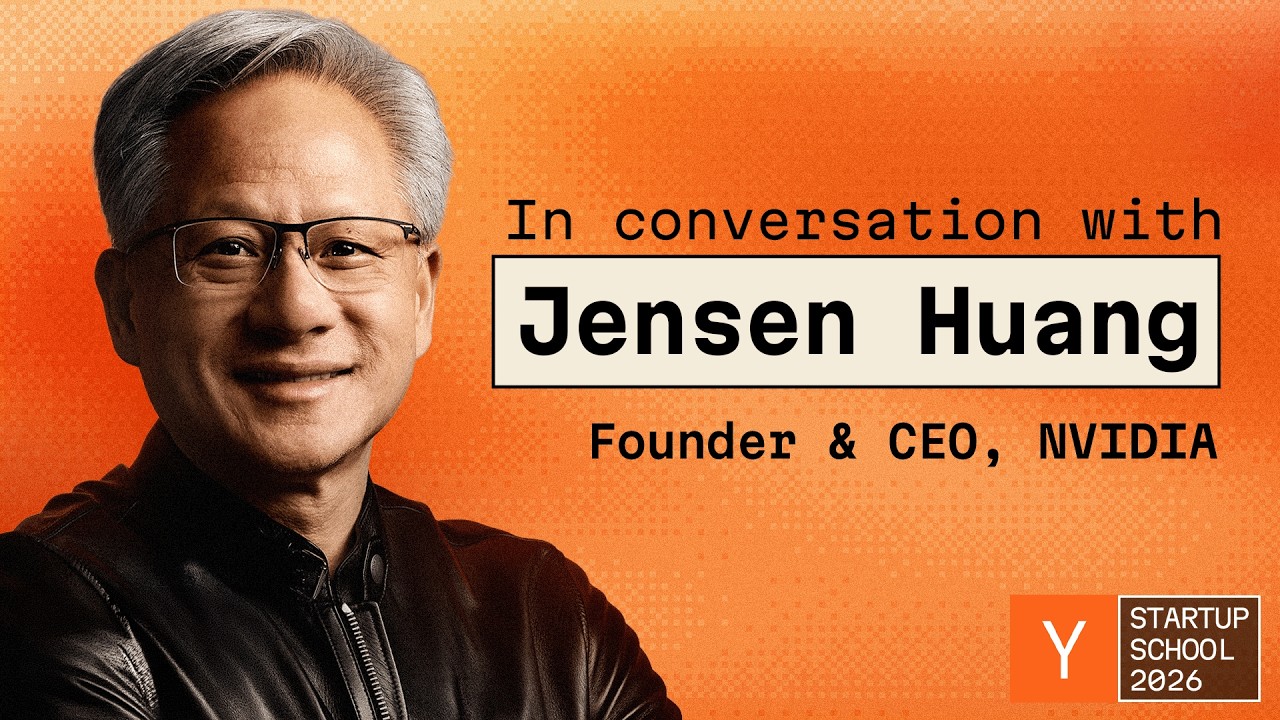
Jensen Huang, CEO of NVIDIA, shares critical lessons from NVIDIA's journey, emphasizing how early failures and a commitment to learning new technologies, like purchasing textbooks from Fry's to pivot the company, laid the groundwork for their success. He discusses NVIDIA's strategic vision, driven by accelerating algorithm domains and seeing AlexNet as a universal function approximator, which led to a reinvention of the computing stack. Huang also explores the future of AI with agents, the importance of fine-grained control, and the "Linux moment" of open-source AI, while also forecasting the rise of physical AI and job creation. He concludes with profound advice on resilience, systems thinking, and the "how hard can it be?" mindset for aspiring entrepreneurs in this unprecedented era of technological reset.

The Mathematical Foundations of Intelligence [Professor Yi Ma]

The Mathematical Foundations of Intelligence [Professor Yi Ma]

Professor Yi Ma challenges our understanding of intelligence, proposing a unified mathematical theory based on two principles: parsimony and self-consistency. He argues that current large models merely memorize statistical patterns in already-compressed human knowledge (like text) rather than achieving true understanding. This framework re-contextualizes deep learning as a process of compression and denoising, allowing for the derivation of Transformer architectures like CRATE from first principles, paving the way for a more interpretable, white-box approach to AI.

The Mathematical Foundations of Intelligence [Professor Yi Ma]

The Mathematical Foundations of Intelligence [Professor Yi Ma]

Professor Yi Ma presents a unified mathematical theory of intelligence based on two principles: Parsimony and Self-Consistency. He argues that current AI, particularly LLMs, excels at memorization by compressing already-compressed human knowledge (text), but fails at true abstraction and understanding. His framework, centered on maximizing the coding rate reduction of data, provides a first-principles derivation for architectures like Transformers (CRATE) and explains phenomena like the effectiveness of gradient descent through the concept of benign non-convex landscapes.

How To Be Contrarian — And Right

How To Be Contrarian — And Right

Garry, Harj, Jared, and Diana discuss why founders should pursue contrarian ideas in a crowded AI market. They analyze how companies like Uber, Coinbase, and Flock Safety found massive success by tackling non-obvious, legally ambiguous, or seemingly impossible problems that others ignored.