Knowledge Systems: The New GTM Stack — Jeffrey Wang, Exa
Jeffrey Wang, co-founder of Exa, details how "go to market" (GTM) is transforming into an AI engineering problem. He showcases Exa's agent-first approach, using tools like an ICP dashboard for market intelligence and a personal AI clone (Jeffbot) to automate and optimize sales, emphasizing the need for robust APIs and arbitrarily customizable systems in this new AI-driven landscape.
Jeffrey Wang, co-founder of Exa, argues that “go to market” (GTM) has fundamentally transformed into an AI engineering problem. He addresses the perennial debate of “product versus distribution,” stating that for a company to succeed, both are indispensable—a great product needs effective distribution, and vice-versa. Wang emphasizes that for engineers, this shift makes GTM more engaging and efficient than ever, as AI allows for significant automation.
Go-to-Market as a Data Problem
Wang posits that GTM is, at its core, a data problem. It involves understanding the capabilities of your product relative to the vast landscape of potential customers. Solving this requires a “live model of your world that agents can act on,” which integrates both internal data (customer information, product usage) and external data (information on millions of companies and billions of individuals, daily news, etc.).
Exa’s Agent-First GTM Systems
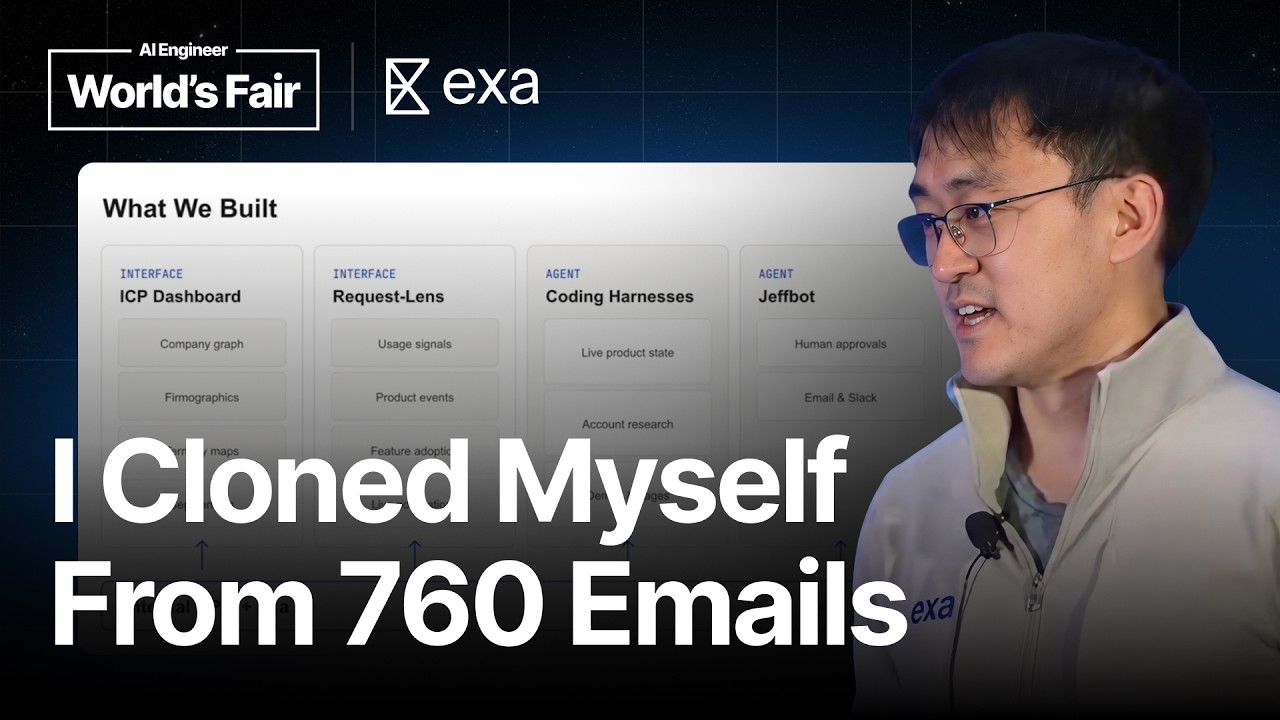
Exa leverages an agent-first approach with two key interfaces and two primary agent types:
-
ICP Dashboard: This internal product classifies virtually every company within Exa’s Total Addressable Market (TAM). It utilizes Exa’s core technology—a powerful search engine for AIs that trains embeddings over the internet—to semantically filter and analyze web data. The dashboard provides insights into categories like “model providers” or “AI coding platforms,” offering detailed metadata and anticipated annual spend for individual companies (e.g., SpaceX).
-
Request Lens: This system alerts the GTM team whenever significant events occur with customers, such as a new sign-up, a surge in searches, a sudden stop in usage, or the appearance of a high-priority customer. These real-time signals enable proactive engagement.
-
Coding Agents in Slack: Exa’s GTM team extensively uses about a dozen internal agents within Slack. These agents have access to vast amounts of internal data and are constantly queried by account executives to research customers, build tailored demos, and delve deeper into account specifics, indicating a high level of agent usage and integration into daily workflows.
-
Jeffbot (AI Clone): Wang built an AI clone of himself by analyzing 760 of his past emails to discern his unique communication style (e.g., averaging 18 words per email, signing off with “best” instead of “sincerely”). He also calibrated its judgment by analyzing hundreds of his past decisions, creating “evals” to ensure the agent’s decision-making aligns with his own. Jeffbot has read and write access to all of Wang’s personal data. While Wang can use it with full read/write capabilities, anyone else at Exa can only use Jeffbot to draft Slack messages or emails, ensuring security boundaries. The historical decision artifacts used for calibration primarily came from Slack and email.
Principles for an Agent-First Company
Wang outlines three core principles for companies embracing an agent-first strategy:
-
Agent First Means API First: Agents cannot access data without programmatic interfaces. Therefore, building an agent-first system fundamentally requires an API-first approach, ensuring robust APIs for all internal and external data sources.
-
Not Everything Should Be a Chatbot: While dynamic, AI-generated user interfaces offer flexibility, consistent, learnable graphical user interfaces (GUIs) remain crucial for repeatable tasks. An effective agent-first strategy strategically combines “crystallized UIs” with flexible, arbitrarily powerful chatbot agents.
-
Buy or Build is a False Dichotomy: The critical factor is “arbitrary customizability.” Whether a company builds software in-house or procures SaaS (e.g., Salesforce), the ability to deeply customize the system to specific needs is paramount. Exa uses Salesforce as a robust database, integrating it via APIs with their agents, demonstrating that purchased solutions can be highly effective if they offer sufficient customizability and programmatic access.
Organizational Approach to GTM
Exa’s GTM team comprises Account Executives, Sales Development Representatives (SDRs), and a unique “Forward Deployed Engineering” (FDE) organization. While non-FDE members are highly proficient in using AI tools, the FDEs are responsible for both supporting revenue generation (e.g., running deals) and actively building and maintaining the AI systems that empower the GTM team. This blend of sales and engineering within the FDE role allows for a highly agile and efficient GTM operation.