Local Models: Trust, Control, Optimization — Carter Abdallah, NVIDIA
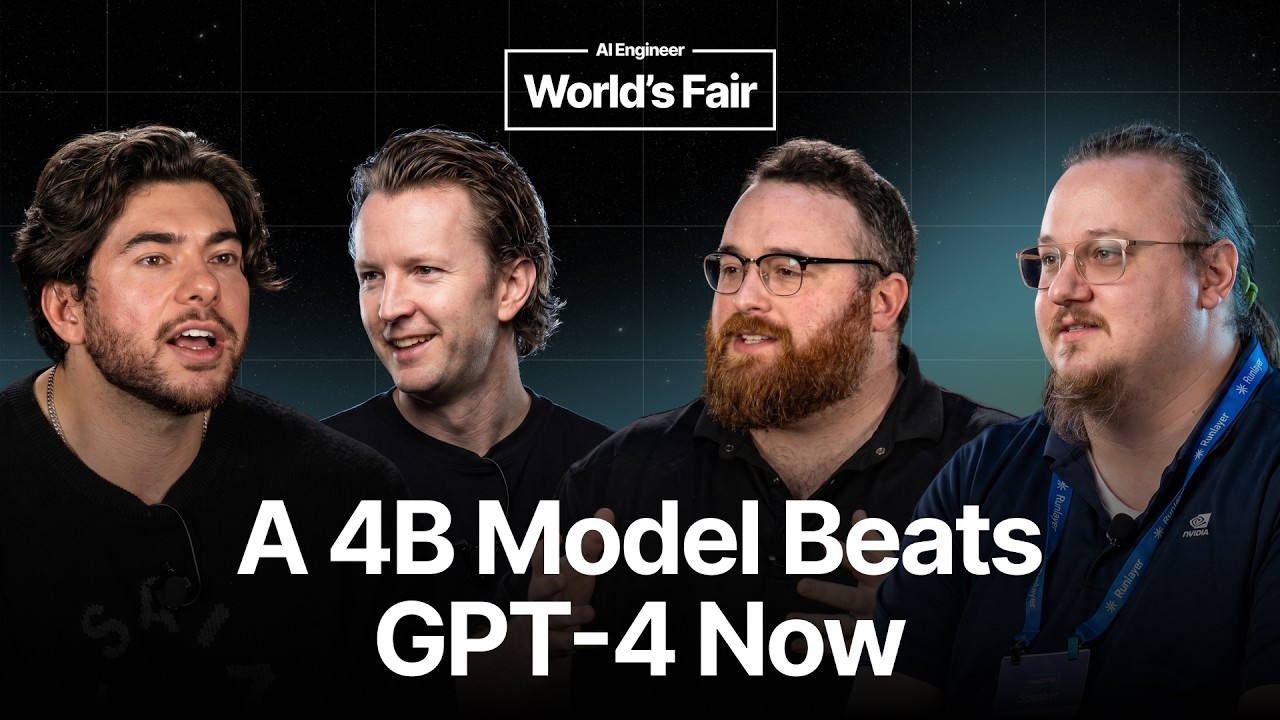
A panel with Vincent Weisser (Prime Intellect), Lucas Atkins (Arcee AI), and Chris Alexiuk (NVIDIA) on why open models matter for trust, control, cost predictability, and data ownership. The discussion covers the distinction between trust and safety, post-training open models for specific harnesses and use cases, the open MDW license, the Linux-like role of open infrastructure alongside closed models, and predictions for open model capabilities and local AI adoption over the next year.
Opening: Trust, Control, and the Case for Open Models
The panel opens with a framing that ties the whole discussion together: when access to frontier systems stopped looking guaranteed, enterprises began moving toward open models, not because they benchmarked better but because availability could be counted on. Lucas Atkins from Arcee AI treats that reliability as the working definition of trust, and he separates it sharply from safety. An open model is a set of files you can inspect running on code you can read, while the same claim about a closed API is unverifiable by construction.
Why Arcee and Prime Intellect Exist
Vincent Weisser of Prime Intellect describes the mission as making frontier intelligence open and accessible, including the full stack needed to train models, not only the weights. Prime Intellect works with Arcee on pretraining and with NVIDIA’s Nemotron coalition, and Weisser suggests Nemotron and Trinity may be among the strongest open models outside China, a claim he admits needs fact-checking.
Atkins traces Arcee’s origin to early 2023, when enterprises were paying around $100 per million output tokens for closed APIs to perform narrow tasks. Arcee built on open models and released tooling publicly. The turning point came when he observed the West losing its lead in open models, with much of the best work coming from China. He is clear that he admires those models and learns from them, but argues that geopolitics makes large enterprises uneasy about provenance. Arcee responded by reorienting the entire company toward pretraining a 400 billion parameter model in six months, a feat many considered impossible and which he says was in many ways genuinely hard.
NVIDIA’s Position: Speed as Intelligence
Chris Alexiuk frames Nemotron around openness across weights, data, training methodology, and frameworks. His core belief is that AI must be open so the field can compound on shared work. He also makes a point about speed: “faster models are smarter models,” because the rate at which tokens can be generated shapes what a model is practically useful for. This drives design choices for Nemotron, especially as local AI becomes more prominent and models need to run well on hardware that is not concentrated in distant data centers.
Trust Is Not Safety
Atkins argues that the AI community often conflates trust and safety, and the two should be kept separate. Critics say you cannot trust open models because you do not know what went into them, but the same is true of closed models, and more so. With open models, anyone can inspect the weight files and read the inference implementations from projects like vLLM, SGLang, and the providers themselves. He acknowledges that open models can still write unsafe code, and that users must apply judgment and safeguards. Outputs should be treated as coming from an inherently random system that the field is working to make less random.
He points to a telling episode: for years, the phrase “you can’t trust Chinese models” effectively meant “you can’t trust open models.” Then Anthropic had to withdraw Fable, and people realized access to frontier systems might not be universal. Enterprises and developers began moving to Chinese open models because they could count on continued access. For Atkins, the only way to be fully sure that what you send is what you get back is to run an open model yourself or work with a partner that can validate it.
Data Transparency
Alexiuk adds that open data is not mandatory for trust, since the incentives to release it are not universal. Still, validating what went into a model is fairly straightforward even without the original sources, and NVIDIA continues to release datasets and environments alongside its models. Seeing a breakdown of token counts across datasets helps people understand what a model learned from. Atkins notes that Hugging Face pages let anyone examine datasets directly, which informs priors about a model’s training. Reputation and intent also play a role: a group’s stated goals are part of whether people trust them.
Control, Cost, and the Post-Training Layer
Weisser argues that openness must extend beyond data to the knobs and dials of the industry. Post-training, especially RL and the surrounding infrastructure, is the most economically viable layer for customizing an open model with a specific evaluation environment and domain. Prime Intellect has built tooling to make this accessible, focusing on post-training specialized agentic models from open bases like Trinity or Nemotron. He gives an example of a customer, which he calls RAM, that specialized an open model to automate finance work within a week or two and got better results than Opus at a fraction of Haiku’s cost.
He connects this to what enterprises increasingly care about: predictable cost. Companies are burning through large token budgets and cutting back on expensive models. Token prices have dropped sharply, but per-session token consumption has grown exponentially, so total spend keeps rising. Providers can deprecate models or release more expensive successors, leaving customers at their mercy. Owning the model lets you guarantee that the same input produces the same output at the same cost, which Weisser frames as making your CFO trust you. He also proposes that the real metric is “outcome maxing” rather than token maxing: a dollar of input should yield more than a dollar of value. Cheaper models will drive more usage for specific use cases.
The Harness, the Model, and the Mismanaged Genius
Atkins argues that the most meaningful AI applications blend the harness, model, and product together. He cites OpenAI’s Deep Research as the first truly game-changing agentic experience, because OpenAI spent substantial reinforcement learning effort on o3 with test-time compute for long-running research, rather than simply looping over search. Frontier labs routinely ship custom model versions for their own products, so if off-the-shelf models are not good enough for their own apps, why should they be good enough for everyone else’s? He credits Weisser and NVIDIA for giving people tools to customize their own models.
Alexiuk makes the point more pointedly. Nemotron and Trinity are designed to perform well across many harnesses, and the tactical reports show that. But users rarely use all harnesses at once; they use one. Open weights let a team such as Nous Research post-train a model for their own harness so it performs especially well there. He invokes the idea of the mismanaged genius: a model tuned to be good at everything leaves significant capability on the table for any particular use. Closed models allow prompt changes, skills, and other adjustments, but none of these match the customization possible with open weights. He notes that dropping a favorite coding agent environment into a CLI can instantly make a model feel better with little effort, and that this will only get easier.
A Call to Action for Builders
Weisser offers a concrete suggestion for builders who want to create the next Claude Code or Cursor. The easiest path is to take the best open model available and post-train it on the harness you care about, building a truly AI-native product.
Data Ownership and the Flywheel
Atkins draws a parallel to the cloud and social media era, when companies monetized user data through ads and similar means. The data users generate with models is how labs improve their models, whether by training directly or using usage as a signal for what data to generate. Closed-model terms of service prohibit training on outputs from models like Opus, Fable, or GPT-5, and providers work to make that inconvenient. With an open model, you can save every trace from using it inside your harness. Those traces can drive fine-tuning on a smaller model, help identify training signals, or feed verifiers and environments built with NeMo RL or NeMo Gym, so you can hill-climb and improve your models over time. Owning your stack, your intelligence, and your outputs becomes the key goal.
Alexiuk makes the licensing point directly. AI differs from traditional software in that outputs are used to train new models, and standard licenses often discourage this through deliberately obscure language. Nemotron and Trinity have adopted the open MDW (model, data, weights) license to make it crystal clear that using outputs to produce or train models is permitted. He sees maturing licenses that fit the use case as a positive signal for how the ecosystem thinks about open models, to the point where even lawyers are unworried.
Optimization and Where Post-Training Unlocks New Use Cases
The discussion moves to optimization. A common assumption is that choosing an open model means trading performance for benefits like data sovereignty. The panel argues that with the right customization and optimization for a specific use case and harness, open models can exceed frontier performance. Weisser describes where this diffusion of intelligence happens. The most concrete path today is to build an RL environment for a specific use case, train on it, and deploy it to real users, the way self-driving improved through deployment in real conditions rather than a general chatbot. For example, a bank deploying a financial agent to millions of customers can continuously learn from production traces. He mentions work with AI-native companies on computer use, where millions of production traces help agents keep improving. He sees this as a white pill for AI application builders and startups, who can create specialized models and build a data flywheel around them.
He also highlights efficiency. Closed APIs carry large margins and may not pass optimization savings on to customers. Open models benefit from an ecosystem that drives down inference and training cost, with collaboration across vLLM, NVIDIA, and others.
Alexiuk adds that most people do not need frontier intelligence for roughly 90% of their tasks. Frontier models are often overkill or have capability horizons that make them good at many things, like chemistry, while most users need only one or two things done very well. Open models let you pick those one or two capabilities and make the model excellent at them, at the expense of almost everything else. A hypergeneralized model that performs across 90 axes is impressive but makes little sense for the person trying to get one job done. It serves someone who needs one endpoint to handle everyone’s tasks, not an individual with a specific task.
Efficiency Has to Happen in the Open
Alexiuk argues that a room full of people running AI locally has a strong interest in making models faster and more efficient, and that many attendees are capable engineers who will contribute small but meaningful improvements. Closed companies can hire great teams, but Linux offers the model to follow: it runs the internet, networks, and critical services precisely because it was hyperoptimized by people working under tight resource constraints. He believes this kind of efficiency cannot be achieved behind closed doors, because doing so shuts out the many people who could each contribute.
Closed Models Are Not the Enemy
The panel is careful to say that none of them dismiss frontier closed models like those from OpenAI and Anthropic. Atkins uses them daily. The question is where they fit in the future ecosystem. He offers an analogy: open models and self-hosted intelligence can be understood as a Linux layer, already taking hold through hyperscalers, neoclouds, and providers like Fireworks, Together, Baseten, and Modal. Closed products are like Macs, the easiest way for most people to get everyday work done, while open infrastructure is the layer where enterprises and builders run critical systems. Enterprises use Microsoft and Windows because they are cheaper than giving everyone a Mac. Both kinds of providers will coexist, and the ecosystem is one where open and closed models both have roles. Atkins emphasizes that the message is not that using ChatGPT or Claude is a sin, only that there is another layer to explore, and it is far more accessible than before.
Predictions for the Next Year
Weisser predicts that open frontier models will stay close to the general frontier, and that the slowing of closed frontier models will let open models catch up further. The most concrete change he expects is the move from chatbots and coding agents toward general knowledge worker agents across every domain, with computer use agents rising in a similar way to coding agents. He thinks it is likely that within 12 months open models will reach better-than-Fable, Methos-level capability, which would enable a wave of new AI startups. He compares this to Cursor’s inflection point, which came when Opus became good enough for coding. He points to a recent moment with GLM 5.2 as evidence of a similar inflection for open models, and expects hundreds of such inflections for startups over the next year or two.
Atkins offers a bold but playful prediction that Prime Intellect and Arcee will have a combined valuation of a trillion dollars. More seriously, he argues that this will be the most consequential year for how AI gets distributed. Fable and GPT-5.6, and their embargoes, have raised open questions about who gets access and when intelligence becomes politicized or withheld, making sovereign intelligence important. He observes that among the one to two billion people who use AI daily, perhaps a tiny fraction have ever used an open model. He hopes that a meaningful share, from the current rounding error to 10 to 15 percent, will have run a model locally. He also laments that conversations about capability and access have happened largely behind closed doors in recent weeks. If the community stays quiet, open models will be put under a microscope and labeled untrustworthy or unsafe, so advocacy and reasoned public discussion are essential.
Alexiuk predicts that this will be the most consequential year for open intelligence, potentially determining the future of events like this summit, which could look very different in two radically opposed ways. He expects that within the year most daily tasks will run on a capable model on a laptop, and that this is not very bold given how close it already is. He expects models to remain the future of AI, with swarms and specialized systems of models growing in importance. He also anticipates large architecture shifts, especially as diffusion models for text mature, producing models better suited to the hardware people own. Finally, he predicts people will buy computers with agent operating systems rather than traditional ones, similar to buying a DGX Spark preloaded with Hermes.
Another prediction is that when the next iPhone arrives in September, many family members will text about a magical new Siri, pulling many people who have not engaged with AI into it. The reaction will resemble the wave of questions after DeepSeek.
Weisser adds that combining models that are good enough with on-device compute strong enough to serve today’s frontier-level models may be an inflection point comparable to a new platform shift. If open models can run at decent speeds on a phone or laptop within a year or two, most of humanity will likely run local models. This applies more to consumer use than to the heaviest enterprise agents, but it may enable a new generation of AI applications built on device compute. Alexiuk notes that a four-billion parameter model on a phone today is already more useful than GPT-4 was at launch, and the focus should be on using that capability well while pursuing new frontiers in drug discovery and scientific exploration.
Closing Reflections
The panel closes with a summary that the field is at an inflection point. Not long ago AI was mostly for researchers, then ChatGPT brought it into public consciousness. Open source is now beginning to enter that consciousness, but few people have yet touched it and had that aha moment. The panel suggests 2026 could be the year that happens, and the builders in the room will shape whether this moment brings more intelligence to everyone. Thanks go to the panelists and to NVIDIA, with the hope that the community will keep building together.