From Agent Traces to Agent Simulations — Rustem Feyzkhanov, Snorkel AI

Rustem Feyzkhanov discusses the critical need for companies to build private, production-aligned benchmarks for AI agents. He explains how to turn agent traces into repeatable simulations, why public benchmarks are insufficient, and how a CI pipeline for agents, integrating observability and experimentation, can ensure reliable evaluation, continuous improvement, and effective release management, moving beyond simple pass rates to measure cost, latency, and policy adherence.
2 min read
From Agent Traces to Agent Simulations — Rustem Feyzkhanov, Snorkel AI
source: https://www.youtube.com/watch?v=Ib5t2RLtxvM

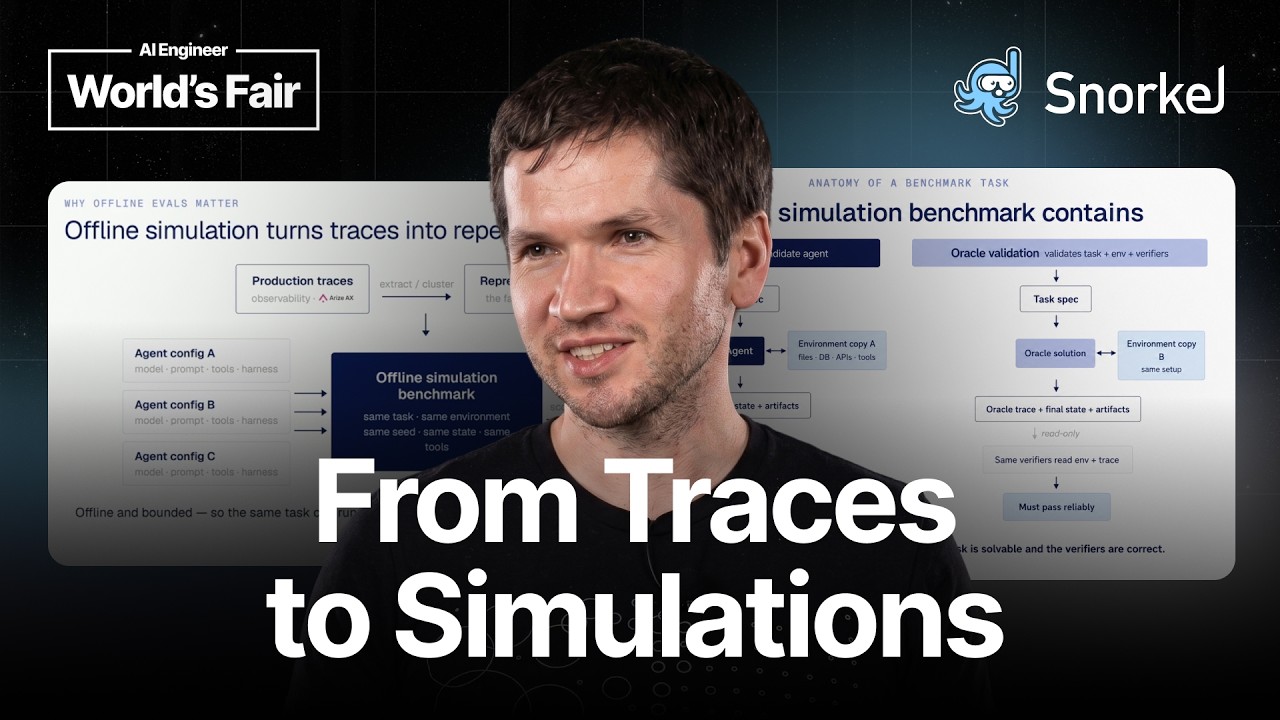
Rustem Feyzkhanov’s talk underscores the critical need for every company to develop its own private benchmarks for AI agents. He argues that this is the only reliable way to evaluate, release, and continuously improve agents, emphasizing that these benchmarks must closely mimic real production environments, including tools, API services, policies, and workflows. Crucially, they should be a dynamic part of the agent’s lifecycle, constantly updated with data from production traces.

Limitations of Production Traces and Public Benchmarks

Production traces, while useful for identifying failures, lack repeatability due to variations in database states and tool versions, preventing true “apples-to-apples” comparisons. Offline simulations address this by converting production traces into repeatable experiments, enabling comprehensive evaluation across metrics like cost, latency, retries, and success rate.

Public benchmarks (e.g., SweepBench, TerminalBench, Co-Bench) are domain-specific and often prioritize pass rates. While they help in

Share post

Stay In The Loop! Subscribe to Our Newsletter.

Get updates straight to your inbox. No spam, just useful content.

Recommended for You

Open vs Closed Source Agent Infra?

Open vs Closed Source Agent Infra?

This panel delves into the strategic implementation of open-source, community-driven agentic stacks, balancing the benefits of open-source frameworks and models for rapid iteration, cost-efficiency, and compliance against the complexities of abstraction and debugging in production environments. Experts from NVIDIA, Stacklok, and Prosus discuss when to adopt open source, challenges in framework choice, the critical need for robust observability, and the role of no-code solutions for diverse user groups, emphasizing the importance of aligning tooling decisions with specific use cases and organizational needs.

Sandboxing, Agent Harnesses, and Agent Teamwork

Sandboxing, Agent Harnesses, and Agent Teamwork

Shahram Anver, CEO of Cleric, details how AI agents for SRE are evolving beyond fast triage to continuous learning and operational memory. He discusses Cleric's architectural shifts, from complex early designs to simpler, sandboxed query agents, and the unique challenges SRE agents face in diverse production environments. A core focus is on human-agent interaction, redefining roles as managers overseeing agents, and how agents learn from unstructured data like Slack to build robust, actionable knowledge for autonomous, self-healing infrastructure. The discussion also touches on the future of software, differentiating between durable systems and rapidly developed "skills" or "vibe-coded" solutions.