Simulation

SimulationMaxxing: How Nubank ships agents 20× faster with simulations — Shreya Rajpal, Snowglobe

SimulationMaxxing: How Nubank ships agents 20× faster with simulations — Shreya Rajpal, Snowglobe

Nubank, serving 135 million customers, uses AI agents for support. The talk reveals how simulated data for evaluations (evals) has enabled them to ship AI agents 20x faster. By addressing the bottleneck of multi-turn, stateful eval data, Snowglobe's grounded simulations create realistic customer interactions, allowing rapid testing, derisking, and significant improvements in customer satisfaction and self-service rates, even for open-source model experimentation.

The Next Frontier of AI Is Spatial Intelligence | Fei-Fei Li on a16z

The Next Frontier of AI Is Spatial Intelligence | Fei-Fei Li on a16z

Fei-Fei Li and Yunzhu Li discuss World Labs' acquisition of SceniX, focusing on building "spatial intelligence" and "large world models" to enable robots to understand and interact with the physical world. They elaborate on SceniX's "real-to-sim-to-real" pipeline, emphasizing how simulation, coupled with generative models like Marble, addresses the data bottleneck in robotics by providing consistent, scalable, and efficient training and evaluation environments. The conversation covers the role of counterfactual reasoning, the development of robotics foundation models, and the strategic focus on semi-structured environments for pragmatic, reliable robot deployment.

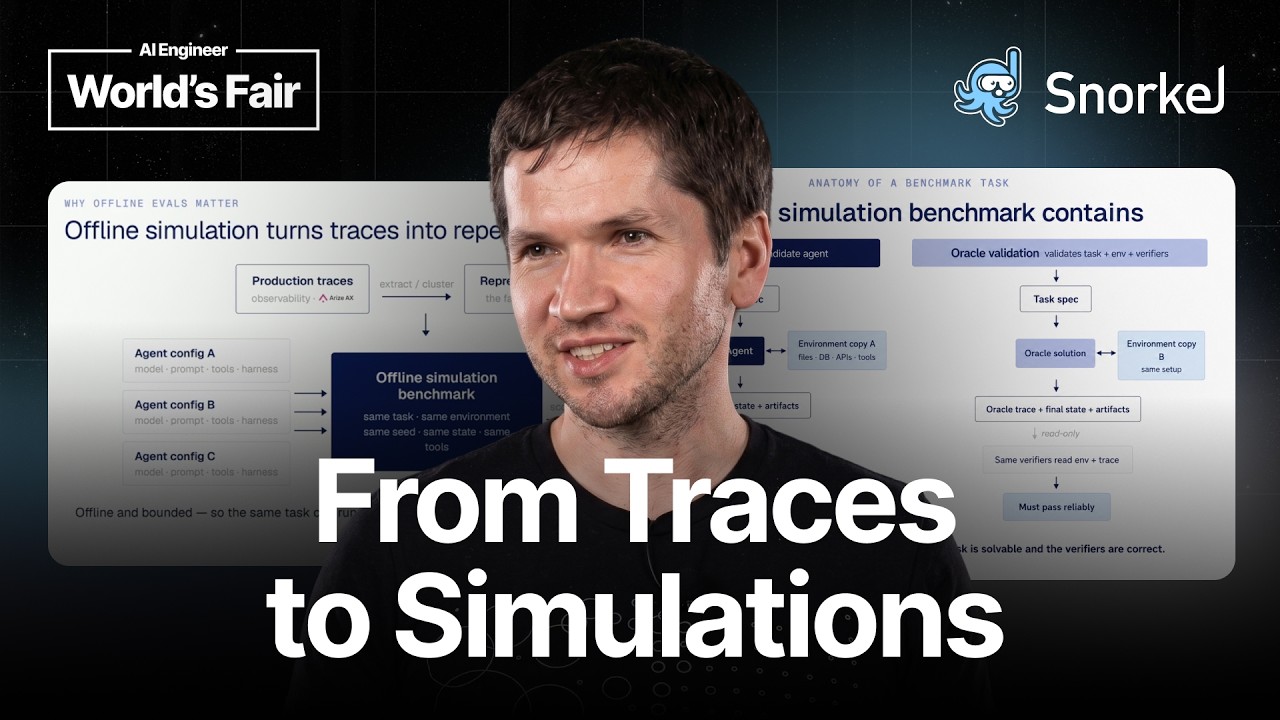
From Agent Traces to Agent Simulations — Rustem Feyzkhanov, Snorkel AI

From Agent Traces to Agent Simulations — Rustem Feyzkhanov, Snorkel AI

Rustem Feyzkhanov discusses the critical need for companies to build private, production-aligned benchmarks for AI agents. He explains how to turn agent traces into repeatable simulations, why public benchmarks are insufficient, and how a CI pipeline for agents, integrating observability and experimentation, can ensure reliable evaluation, continuous improvement, and effective release management, moving beyond simple pass rates to measure cost, latency, and policy adherence.

Why Physical AI Is the Next Frontier | The a16z Show

Why Physical AI Is the Next Frontier | The a16z Show

Applied Intuition discusses the emergence of physical AI, its mission to put intelligence on a billion machines, and its latest platform, Dana, designed to democratize autonomous system development. The conversation covers the vast scope of physical AI beyond automotive, the unique challenges of real-world deployment (safety, data, hardware), the current state and future of self-driving cars and trucks, and the transformative potential of humanoids and world models. They also touch upon the geopolitical landscape of AI and the global ambitions of Applied Intuition.

Robotics' End Game: Nvidia's Jim Fan

Robotics' End Game: Nvidia's Jim Fan

Jim Fan of Nvidia outlines the endgame for robotics, arguing it will mirror the successful playbook of Large Language Models. He introduces "The Great Parallel," a roadmap where World Models replace Language Models, and data collection shifts from limited teleoperation to scalable egocentric video, culminating in a future of physical APIs and automated research.

Demis Hassabis on Building DeepMind, AlphaFold, and the Final Stretch to AGI

Demis Hassabis on Building DeepMind, AlphaFold, and the Final Stretch to AGI

Demis Hassabis, CEO of Google DeepMind, outlines the path to AGI, which he predicts by 2030. He discusses the profound impact of AI on science, particularly in revolutionizing drug discovery with systems like AlphaFold, and posits that AI will enable new forms of simulation-based science. Hassabis also delves into the philosophical underpinnings of his work, viewing information as the universe's most fundamental quantity and advocating for developing AGI as a powerful tool before tackling the deeper questions of consciousness.