The Death of Developer Advocates — Stephanie Jarmak, Sourcegraph
Stephanie Jarmak argues that Developer Relations (DevRel) isn't dead, but its audience has shifted to include AI agents. She introduces the "Agent Advocate" role, focusing on measuring agent experience (e.g., through CodeScaleBench), optimizing for "Generative Engine Optimization" (GEO), and adapting traditional DevRel principles like enablement and community for this new user. The core message is that designing for agents, like a curb cut, ultimately improves the experience for all human developers.
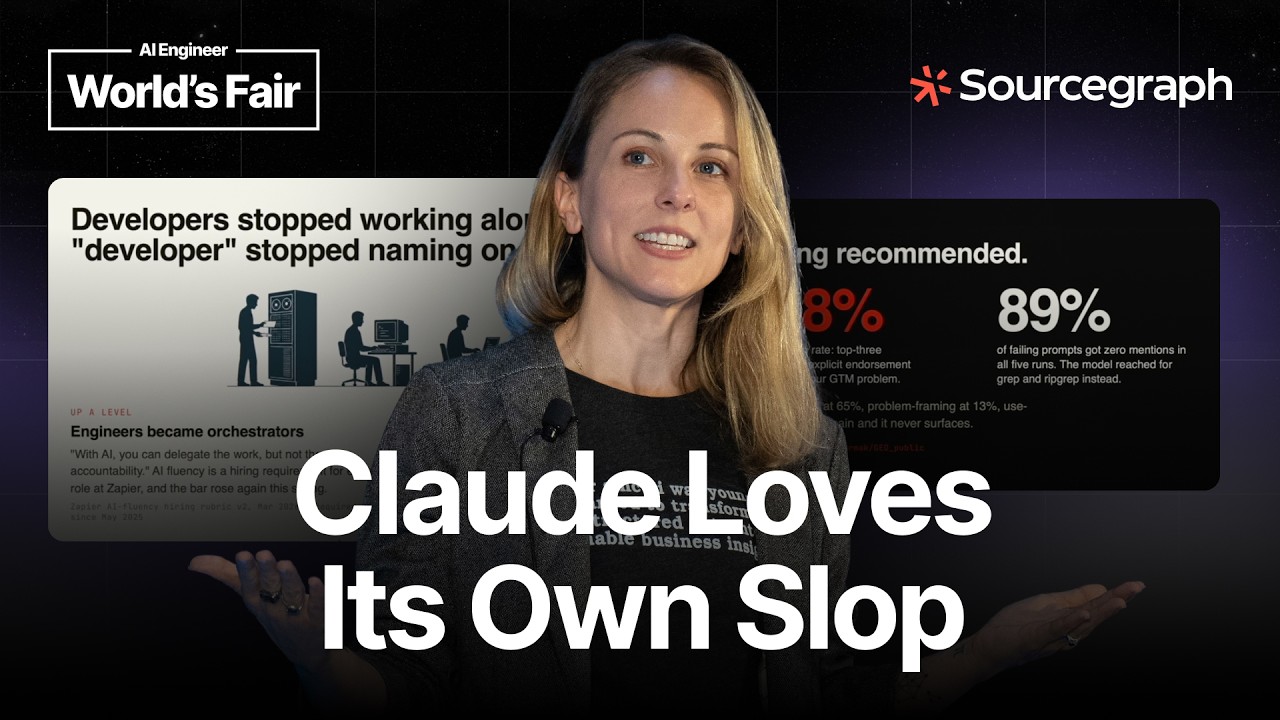
The Shifting Landscape of Developer Relations in the Age of AI
Stephanie Jarmak, a former astronomer turned research scientist and “Agent Advocate” at Sourcegraph, presents a provocative re-evaluation of Developer Relations (DevRel). The talk’s title, “The Death of Developer Advocates,” was a borrowed, buzzworthy idea from her manager. Jarmak clarifies that while her manager went on vacation, she’s here to argue the opposite: DevRel isn’t dead; its audience has fundamentally changed with the rise of AI agents. She advocates for a new role: the “Agent Advocate.”
The Evolution of Developer Relations
Historically, DevRel evolved from 1980s “software evangelism”—a one-way communication of product benefits—to a two-way feedback loop in the 2010s. DevRel professionals cultivated deep empathy for developers, understanding their needs and bringing insights back to product teams. Developers gained significant influence, becoming “kingmakers” and making developer experience a critical Go-to-Market (GTM) strategy. However, in the current landscape (estimated 2026), developers are no longer working alone; they are orchestrating “fleets of agents.” This shift means the definition of a developer is changing, requiring AI fluency. Moreover, non-engineers, like Jarmak herself (who went from zero to 12,000 GitHub commits and became an open-source maintainer for a multi-agent orchestration framework), can now leverage dev tools through agents. This introduces a completely new persona and ideal customer profile (ICP) for DevRel to relate to.
The Agent as a Unique User and Recommender
AI agents are unique because they act both as direct users of tools and as implicit recommenders.
- Agent as User: Agents read documentation (albeit differently than humans), call APIs, encounter errors, and attempt self-recovery. Their experience with a tool, including frustrations and recovery mechanisms, is highly measurable.
- Agent as Recommender: Agents recommend tools by directly integrating them (e.g., installing libraries on behalf of a user) or by surfacing products in response to queries (e.g., ChatGPT suggesting a solution). This shifts the bottom-up adoption driven by traditional DevRel, as agents now significantly influence tool choice.
Benchmarking Agent Experience: CodeScaleBench
To understand agent interaction, Jarmak, a self-described “data scientist nerd,” developed CodeScaleBench, a benchmark of hundreds of software development lifecycle tasks. She used this to test agents with and without Sourcegraph’s code navigation tool, generating thousands of traces. This provides a tight feedback loop to identify and fix friction points.
A concrete example showed an agent burning an entire turn because it assumed a non-existent parameter name (e.g., readline instead of startline). While it recovered from the error message, a clearer tool description could have prevented this inefficiency. This highlights that tool evaluation for agents now includes not just functionality, but also token consumption and latency.
Generative Engine Optimization (GEO) and the 65-to-Zero Gap
Jarmak introduced the concept of Generative Engine Optimization (GEO), akin to SEO for AI agents. Her experiment revealed a significant gap:
- When agents were prompted with a direct comparison of code intelligence tools, Sourcegraph was recommended 65% of the time.
- However, when prompted with a specific pain point that Sourcegraph solves (e.g., “we keep breaking downstream services when changing shared libraries because we can’t see all consumers”), the agents provided zero mentions of Sourcegraph, instead suggesting developers write a wiki page. This “65-to-zero gap” demonstrates that existing product messaging might not be clearly attributing pain points and use cases in a way agents can interpret. This insight allows for targeted content campaigns to improve agent discoverability.
Guiding Agents: Content Freshness and Accessibility
Effective GEO requires continuous effort:
- Stale Content Compounds: The rapid evolution of AI means training data quickly becomes outdated. Older models might continue to recommend outdated products (e.g., Claude 4 pitching Cody even more than older versions did). This “compounding noise” necessitates strategies to surface true signals.
- Authoritative Sources: Leveraging
LLMs.txtfiles can direct agents to authoritative sources of truth. However, agents still need to use real-time information and provably accurate content. - Agent-Friendly Content: Provide current examples, maintain fresh content (even for unchanged features), and include structured data like charts and FAQs, which agents “love.”
- Be Where the Agents Are: Ensure your product is listed in all relevant marketplaces and MCP registries.
- Reduce Friction: Make the path from discovery to adoption as frictionless as possible. Agents won’t recommend tools requiring extensive demos or sales calls.
- Address Pain Points: Ensure ample content exists online for agents to connect specific user pains with your product’s solutions.
The Blurry Lines of Agent Advocacy
The role of an Agent Advocate blurs traditional organizational lines, encompassing aspects of engineering, product, and marketing:
- Engineering Flavor: Partnering with engineering to build agent-product interfaces (e.g., through MCP servers) and create evaluation frameworks.
- Product Flavor: Owning the end-to-end agentic experience, translating evaluations into product improvements, and developing agent experience rubrics.
- Marketing Flavor: Driving “pipe gen” by ensuring agents enter the funnel and recommend the product to human developers.
Core DevRel Principles Adapt for the Agent Era
Despite the changes, the core tenets of DevRel remain crucial, simply adapted for the new audience:
- Enablement: Educating human developers on orchestrating agents and educating agents themselves through machine-readable content and agent-friendly APIs.
- Community: Building human-to-human connections that can also involve agents, considering new challenges like privacy and data concerns when agents participate in community spaces (e.g., Discord).
- Feedback: Continuously bringing the “voice of the developer-using-agents” back to the organization. Additionally, agents enable large-scale experimentation that is difficult with human users.
- Credibility: Earning trust from human developers (avoiding “Claude’s slop”) and understanding agent-specific biases (agents “love their own slop” and structured content).
The Curb Cut Argument: Serving Agents, Clearing the Path for All
Jarmak concludes with the “curb cut” analogy: just as curb cuts, initially designed for wheelchairs, benefit everyone with wheels, designing for agents (a specific user) clears the path for all human developers. By serving agents effectively, the human experience naturally improves.
Immediate Actionable Steps
- For DevRel: Point a coding agent at your documentation, analyze the transcript, and start developing an “agent experience report.”
- For GTM: Develop GEO experiments, craft prompts, and analyze mentions vs. recommendations to refine content strategy.
Jarmak emphasizes that the talk itself was made “agent legible,” offering a QR code and toy repositories with templates for getting started.