Supabase: Cash Does Not Equal Success
Paul Copplestone, CEO of Supabase, discusses the company's rapid rise as a leading dev tool. He explains their strategic bet on open-source Postgres, the pivotal "Open Source Firebase" rebrand, and how three distinct "chapters" of AI — from vector databases and code generation to advanced AI agents — have dramatically accelerated Supabase's growth and forced a re-evaluation of developer experience and internal operations.
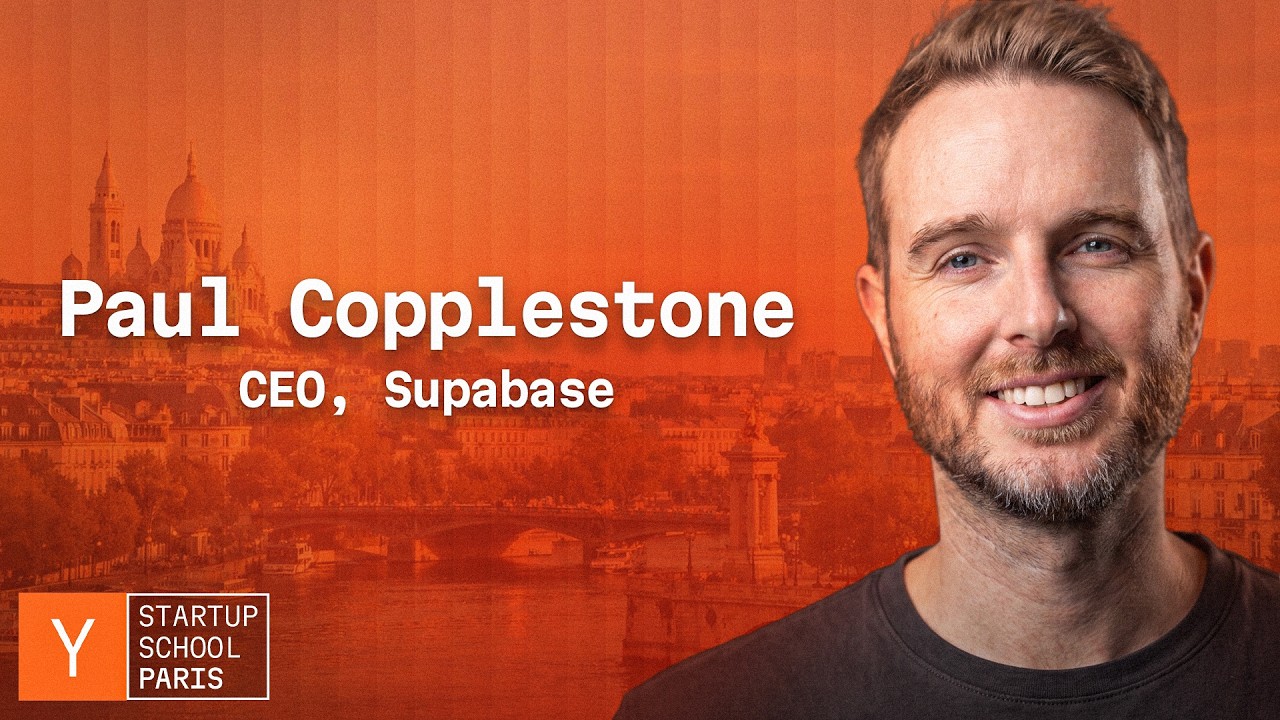
Supabase CEO Paul Copplestone shares insights into building one of the fastest-growing developer tools in the AI era. His journey began with a personal need 10-15 years ago to simplify database interactions, having previously built real-time systems using technologies like ColdFusion. This experience laid the groundwork for Supabase.
Betting on Postgres and Open Source
Supabase made a strategic decision to build a database company, recognizing the “big hairy problems” that databases present as opportunities. They chose Postgres based on observing a “nascent but growing groundswell of developers” on platforms like Hacker News, anticipating its future popularity despite being 30 years old. Copplestone attributes Postgres’s success and longevity to its vibrant, distributed community and the fact that “no one company owns it,” fostering a powerful “flywheel” effect where contributions from all (including hyperscalers and Supabase itself) continuously improve the technology.
The company’s open-source commitment is deeply philosophical, aligning with its founders’ beliefs. Supabase explicitly avoids an “open core” model, making all its tools genuinely open source under permissive licenses (MIT, Apache 2, Postgres). Their strategy is to contribute to existing open-source tools within the Postgres ecosystem, building new ones only when necessary and always making them open source. This approach also mitigates concerns about cloud providers, as Supabase is an amalgamation of tools around Postgres, rather than a single component easily replicable by hyperscalers.
The “Open Source Firebase” Pivot
Supabase’s initial launch as “Realtime Postgres” gained limited traction. The pivotal moment came when they repositioned themselves as an “Open Source Firebase Alternative.” This immediately resonated, driving significant attention, including a top spot on Hacker News. While aspirational (Firebase was far more comprehensive), this tagline clearly communicated their intent.
Supabase won over developers by addressing key pain points with Firebase:
- Not being Google appealed to many.
- Offering Postgres’s relational model contrasted with Firebase’s NoSQL, aligning with a market shift.
- Providing predictable pricing without “bill shock.”
- Being truly open source, a path Firebase couldn’t fully commit to after Google’s acquisition.
This bottom-up adoption strategy, combined with “launch waves” and continuous feature parity efforts, eventually led to significant growth. While early Y Combinator batches were hesitant due to the need for database credibility, Supabase now sees over 60% adoption in recent batches.
The AI Era: Three Chapters of Accelerated Growth
AI has profoundly impacted Supabase’s trajectory, driving exponential growth in three distinct “chapters”:
- Vector Databases (Early 2023): The company adopted PG Vector for embeddings. This started with a community contributor’s pull request. Supabase then built one of the first docs chatbots using PG Vector, leveraging its own documentation. Initially cautious about LLM hallucinations, they humorously branded it with a “Clippy” icon. PG Vector has since become a standard for Postgres.
- Code Generation (Late 2023): Supabase observed platforms like “Loveable” launching “hundreds of thousands of databases” through code generation. This validated their long-held thesis that a generational database company must be present “at the start” of a developer’s journey. This led to the creation of Supabase for Platforms, allowing other platforms to build on top of Supabase.
- AI Agents (Late 2023/Early 2024 - Claude Code): This chapter brought a “fundamentally different” acceleration. Not only did top-of-funnel growth surge, but all key metrics—activation, conversion, and revenue—saw dramatic increases. AI agents (e.g., via Claude Code) enabled developers to go from project idea to a production-ready, paying database within a day. Notably, this growth was organic, with over 60% of new databases now being launched by agents, and likely much higher due to undetectable CLI usage. Supabase’s deep open-source presence and early timing meant its code was extensively used in model training, giving it a significant “tailwind” as a default recommendation.
Adapting to an Agent-Driven World
The shift to AI agents necessitates a change in developer experience. While dashboards remain relevant, CLIs and APIs are becoming first-class citizens. Supabase is focusing on seamless Git workflows and ensuring that its supabase folder (reflecting database state) and dashboard are perfectly in sync. The company acknowledges that its strong community and vast open-source content, heavily used in AI model training, has been crucial for agents recommending Supabase by default.
Operational Scaling and AI Internally
Scaling from 220 to 360 employees in a year, managing 6-7x developer growth, required Supabase to evolve from a “pushing a lot” (roadmap-driven) organization to an “order taker” (responding to external demand). This hyper-growth demanded a shift from periodic “launch weeks” and “defrag” cycles to a constant, parallel operation of both velocity and reliability.
Internally, Supabase’s fully distributed nature (360 people in 60+ countries) meant all historical context is documented (Slack, Notion). This rich, accessible data provides an ideal training ground for internal AI agents. The company is now pursuing AI-enabled “BizOps,” aiming for end-to-end automation with “no human in the loop” for true productivity gains.
Examples of internal AI implementation:
- Data Engineering: By opening their data warehouse (using Hex with an agent) to the entire company, they observed a 3x increase in questions asked, as non-technical staff could self-serve detailed answers, significantly boosting productivity beyond what traditional data engineers could handle.
- Sales: Supabase, primarily a Product-Led Growth (PLG) company, introduced sales by focusing on customers hitting growth limits. Sales commissions are uniquely structured based on the uplift in customer spend compared to a control group, making the sales team’s impact directly measurable and incentivizing genuine customer success.
Funding and Future Advice
Despite a recent $500M funding round at a $10B+ valuation, Copplestone emphasizes that fundraising is merely a “meta process” to provide essential operating capital, especially for a database company with a gap between customer acquisition and payment. He stresses staying grounded by remembering that financial success doesn’t equate to product success, and the company must continue to focus on its unique strengths that differentiate it from larger, better-funded competitors.
His advice for new dev tool founders in today’s unprecedented world: “be relentless and prolific.” Founders must try many things, identify what works, and then “relentlessly push on that thing to see where it can continue to grow,” all while embracing a “grind mindset” and acknowledging the role of luck.