Peter Steinberger: What Happens When 4.7 Million People Let It Cook
Peter Steinberger, founder of OpenClaw, shares the candid story of building one of the world's largest open-source AI projects. Starting from a personal annoyance, OpenClaw went viral, leading to both immense success and unforeseen challenges, including burnout, security pressures, and feature creep. He offers invaluable lessons on product-market fit, managing hyper-growth in open source, the peril of dependencies, and the philosophy that "fun is velocity" in building impactful technology.
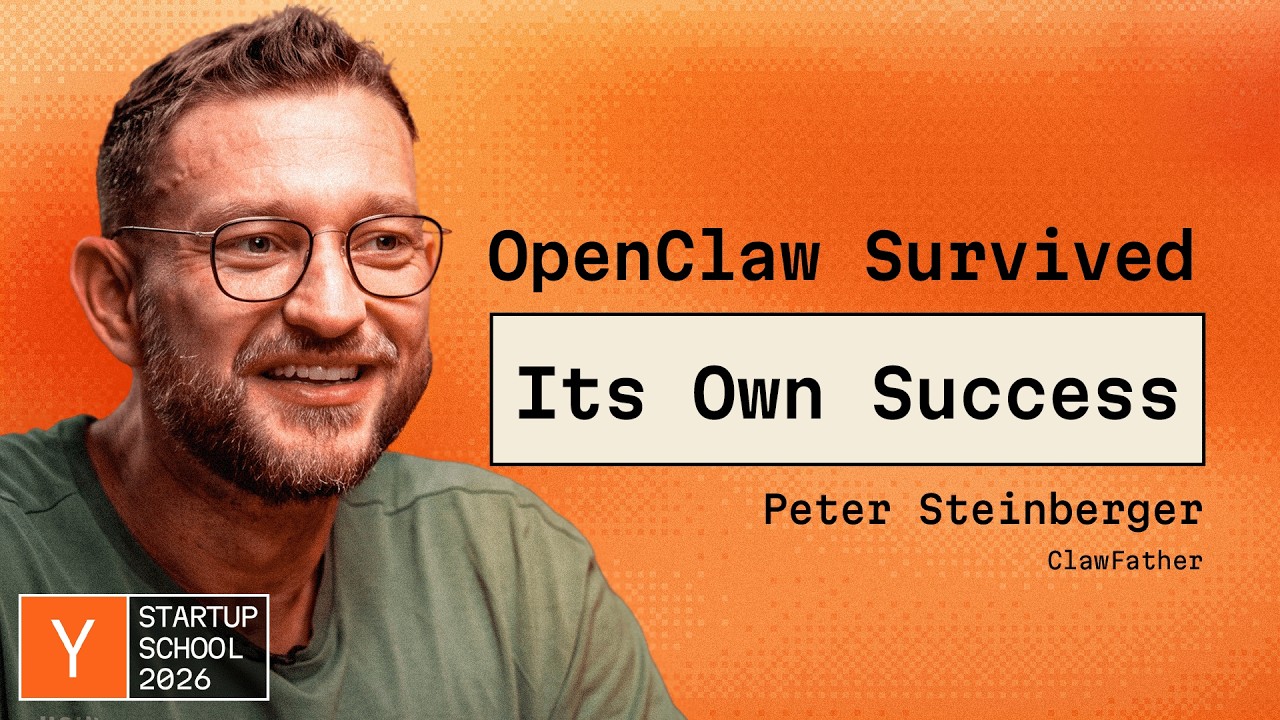
OpenClaw: A Journey from Annoyance to Open Source Phenomenon
The Genesis of OpenClaw: Annoyance as the Mother of Invention
Peter Steinberger recounts the origin of OpenClaw, a project born from personal frustration in late 2023. Annoyed by the lack of a seamless way to interact with his coding agents from his phone, he sought to bridge the gap between mobile convenience and desktop computational power. His initial solution was a simple WhatsApp relay, allowing him to send prompts and receive agent responses while away from his desk.
He describes the early experience as “magical” due to the agent’s concise, proactive responses and its ability to abstract away underlying complexities like model selection, context size, and session management. This personal “AGI-like” experience, however, initially failed to resonate with his broader online audience.
Finding Product-Market Fit: The Power of Strong Emotional Reactions
Despite initial disinterest on social media, Steinberger discovered product-market fit by demonstrating his WhatsApp relay to friends. Their strong emotional reactions—ranging from amazement to fear—and the frustration of non-technical friends being told the tool wasn’t “yet for them,” signaled clear demand. This indicated a strong, untapped need for accessible AI agents.
The project evolved from a personal “V relay” to “Claudis” (incorporating Discord support after a pull request), eventually becoming OpenClaw. This period highlighted the rapid iteration and basic, sometimes hacky, nature of early AI tooling, including the absence of fundamental features like compaction.
The Viral Explosion and Unforeseen Consequences
OpenClaw’s launch on Discord around New Year’s Eve 2024 marked its viral ascent. Peter vividly describes an all-night session where users interacted, “hacked,” and received “smug replies” from the agent. Despite his attempt to shut it down, the resilient software (a launch daemon) restarted, leading to an overnight explosion in usage.
The ensuing virality brought an overwhelming flood of media attention, security reports, and community engagement. The project’s name also faced challenges, evolving from Claudebot to OpenClaw after legal requests from Anthropic due to similarity with their “Claude” model. Nvidia’s CEO Jensen Huang notably referred to it as “the most successful open-source project in the history of humanity.”
However, this rapid growth came with significant personal costs. Peter describes being “almost broken” by the relentless attention, leaked personal details, and the sheer volume of demands. He reflects on his past burnout from a successful B2B company, realizing his passion was for building, not just programming. The experience led him to re-evaluate his path, emphasizing the importance of a personal brand (“Your name cannot be forked”) over any single product.
Lessons from Growth: What OpenClaw Got Wrong
Security Overreach and Feature Creep
The project faced immense pressure from security reports, many of which were generated by agents without human verification. While the media amplified fears of malicious skills (claiming 20% vs. an actual 0.3% in their analysis), Peter felt a profound responsibility to harden the codebase. This led to extensive security layers—sandboxing, allow lists, web protocols with built-in permissions, and atomic configuration writes. While abstractly valued, these measures often resulted in a slower, harder-to-update product that broke user setups, alienating many practical users.
Coupled with a rapidly growing open-source community, there was a significant feature creep. The temptation to merge every “fun” feature led to an unsustainable architecture with approximately 9,500 configuration options, making thorough testing and stable evolution nearly impossible. This contrasted sharply with competitor projects that maintained simplicity and aggressive marketing.
The Peril of Dependencies: Anthropic’s Opos Model
A critical blow came from an over-optimization for Anthropic’s Opos model. When Anthropic disabled subscriptions with only 24 hours’ notice, OpenClaw, which had built its harness largely around Opos, suffered significantly. This experience underscored a crucial lesson: “Your dependencies’ business model is your business model.” While OpenClaw adapted to support open-weight models, the initial setback caused many users to move on.
The “Hype is Like the Weather” Cycle
OpenClaw experienced extreme fluctuations in popularity, with weekly downloads bottoming out at 835,000 before peaking at 4.7 million. Steinberger likens this to weather—uncontrollable and unpredictable, emphasizing that such hype cycles are an inherent part of rapidly evolving tech.
When Building Becomes Work: Rediscovering “Fun is Velocity”
Around February, the joy of building OpenClaw diminished as it transformed into a “responsibility” and “work.” Peter found himself no longer using his own product, having shifted from building something he loved to something “for everyone.” This period was marked by overwhelm, an inability to strategically delegate, and his role shifting to bug fixing and support amidst a “rumor mill” about OpenAI’s involvement.
The turning point came with external help, notably from Nvidia, which provided resources for security work. This, combined with finding dedicated contributors and establishing a non-profit foundation, allowed him to slowly regain his passion. He coined the mantra “fun is velocity,” observing that during weeks he enjoyed building, the product improved visibly; during less enjoyable periods, it only accumulated configuration options.
The Future of OpenClaw and Key Takeaways
OpenClaw’s Vision and Impact
OpenClaw’s ongoing mission is to demystify AI, making it “fun and weird” for a broader audience. The project aims to build a robust open-source ecosystem through events and education, now employing 10 people and seeking a CEO. “Claw” has become a recognized term in the AI landscape, signifying a new paradigm for agents.
Peter highlights the persistent need for “always on, always syncing” agents and the exciting evolution of models that are finally enabling seamless, session-free interactions. He champions OpenClaw as the open-source alternative to proprietary agents, emphasizing “Your agent, your machine, your life,” where data remains on local devices. The future includes building OpenClaw with OpenClaw itself, enabling team-based, orchestrated agent workflows beyond traditional terminals.
Three Enduring Lessons for Builders:
- Don’t Stop Having Fun: Fun is the ultimate driver for innovation.
- Listen to Your Gut & Fix Annoyances: Personal frustrations can lead to the next big thing.
- Stay Focused: Avoid distractions, “live in the future, build what’s missing,” and “keep shipping.”
Q&A Insights: Practical Advice for AI Development
In the Q&A, Peter delved into practical aspects:
- Agent Workflows: “Loops” and “graphs” are essentially advanced automations. Modern models excel at orchestrating sub-agents, computer/browser use, and sophisticated QA environments, reducing the need for manual testing.
- Reliability & Scalability: The biggest bottleneck in AI infrastructure isn’t just compute, but managing compute for diverse environments (e.g., Mac OS, specific hardware) in a reliable, fleet-like manner.
- Code Review & Speed: Early on, he viewed code review as risk management, accepting less scrutiny for lower-risk areas like UI.
- User Acquisition: Your first user must be you. Your initial beta testers should be friends. In today’s fast-paced building environment, “eyeballs are kind of the most expensive currency.”
- Opinionated Open Source: A clear
vision.mdfile is crucial. He regrets not saying “no” enough to feature requests, as every feature adds responsibility and complexity. - Perpetual Agents: The challenge isn’t technical feasibility but optimizing token usage to make “always-on” agents economically viable and efficient.
- Next Startup Advice: Build something you personally want to use. Prioritize personal brand and visibility. Consider “hard and boring” niches, as they offer less competition than “fun” areas where AI can rapidly generate alternatives.
- Desired Product: A reliable, fast, and cheap test box solution for Mac and Windows environments, acknowledging the difficulty of dev tool businesses.