Developer Experience in the Age of AI Coding Agents – Max Kanat Alexander, Capitol One
Max Kanat-Alexander explores the rapid changes in software engineering driven by AI and identifies 'no-regrets investments' that will benefit development teams regardless of the future. He argues that by focusing on foundational developer experience principles—such as standardizing tools, improving validation, structuring code for testability, and refining the code review process—organizations can create a virtuous cycle of productivity for both human developers and their AI agent counterparts.
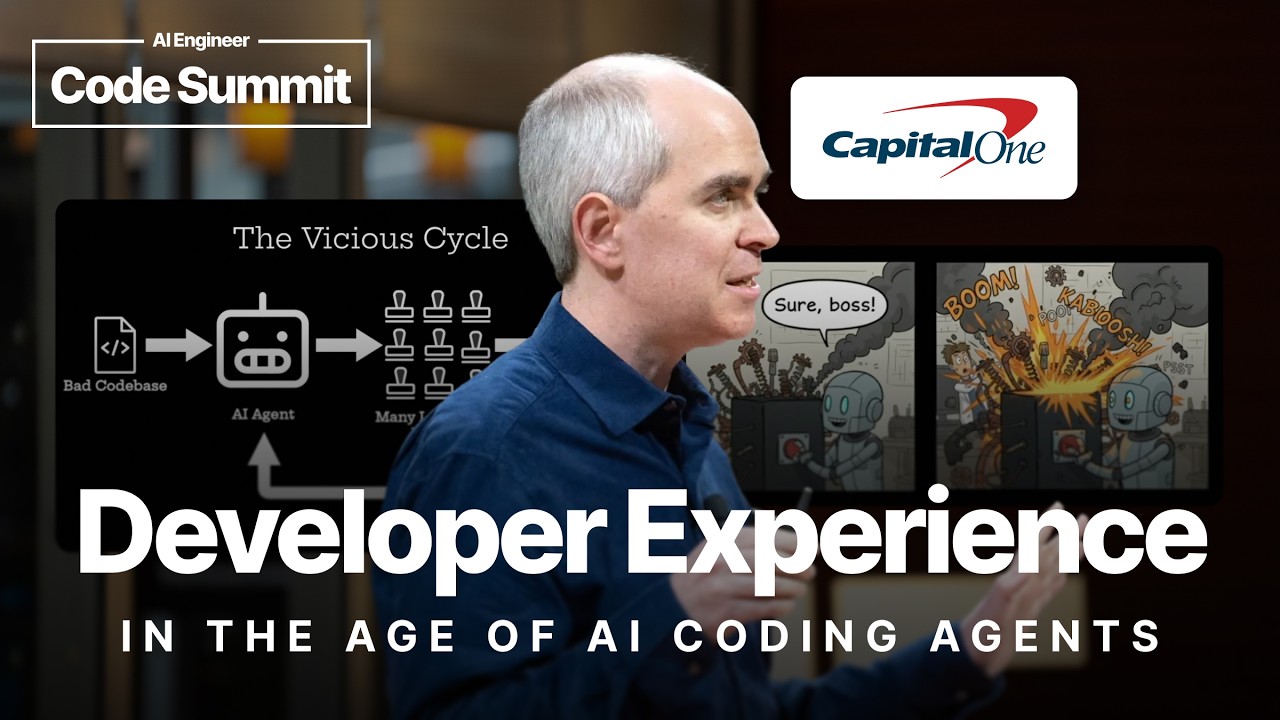
The field of software engineering is experiencing unprecedented, rapid change, largely driven by advancements in AI. This creates uncertainty about which technological investments will remain valuable. The central thesis is that by focusing on foundational principles of developer experience, organizations can make “no-regrets investments” that benefit both human developers and AI coding agents, creating a virtuous cycle of productivity.
The core principle is that what’s good for humans is good for AI. These investments de-risk future planning because even if they don’t perfectly align with a future agent’s specific needs, they are guaranteed to improve the productivity and experience of human developers.
Foundational Technical Investments
These investments are crucial inputs that enable AI agents to be more effective:
- Standardized Development Environments: Use industry-standard tools (package managers, linters) in the conventional way the outside world uses them. This aligns with the AI’s training data. Creating custom tools or using obscure languages forces you to “fight the training set,” which is inefficient and error-prone.
- Actionable Interfaces (CLIs & APIs): Agents need a reliable way to take action. Native text-based CLIs and APIs are far more robust and accurate than making an agent orchestrate a UI. Crucially, these tools must be runnable locally during development, as reliance on slow CI pipelines (e.g., a 20-minute cycle) severely hampers the iterative workflow of both agents and humans.
- High-Quality Validation: Objective, deterministic validation through tests and linters dramatically increases an agent’s capabilities. Error messages must be clear and actionable, as an agent cannot interpret a generic “500 internal error.” Agents struggle to write meaningful tests for untestable legacy code, highlighting the need for codebases designed with testing in mind.
- Well-Structured Systems and Code: Agents, like humans, are more effective when working with well-structured, comprehensible code. They struggle with legacy systems where the logic is opaque and not contained within the code itself. Refactoring for testability and the ability to reason about the code is a perennial investment.
- Documentation of Intent and Context: Agents can’t read minds or attend meetings. While they can be prompted to explain what code does, they cannot know why it was written or understand external constraints (e.g., the shape of data from an external API) unless it is written down. Documentation should focus on this external context and the original intent, which cannot be inferred from the code alone.
Process and People Investments
With AI, the nature of software development is shifting, requiring changes to team processes:
- Elevating the Role of Code Review: As AI handles more of the initial code generation, “writing code has become reading code.” Every engineer’s primary job is becoming that of a code reviewer. The massive increase in PRs generated by agentic workflows makes the code review process itself a major bottleneck.
- Improving Code Review Velocity and Quality: The goal is not to shorten review time at the cost of quality, but to make each iteration faster. This involves:
- Distributing the Load: Instead of posting review requests in a team channel where one person does all the work, assign reviews to specific individuals and use SLOs to ensure timely responses.
- Clarifying Action Items: Tooling needs to improve to make it obvious whose turn it is to act in a review thread, reducing inefficient back-and-forth communication.
- Maintaining a High Bar: Resist the temptation to rubber-stamp AI-generated code. Allowing low-quality code to enter the system creates technical debt that makes the codebase harder for both humans and agents to work with over time.
- Fostering Apprenticeship: Senior engineers, who are often the best code reviewers, must be actively involved in the review process. This is the most effective way to teach junior engineers the critical skills of software design and effective code review, ensuring the team’s capabilities grow.
The Vicious vs. Virtuous Cycle
Organizations face a choice:
- The Vicious Cycle: A bad codebase is given to an agent, which produces low-quality output. A frustrated developer submits it, and an overwhelmed reviewer rubber-stamps it. The codebase gets worse, and productivity steadily decreases.
- The Virtuous Cycle: By making the foundational investments described, agents become more effective. They, in turn, help improve the system further, leading to an accelerating cycle of productivity and innovation.