Coding agents

Context Engineering for Coding Agents

Context Engineering for Coding Agents

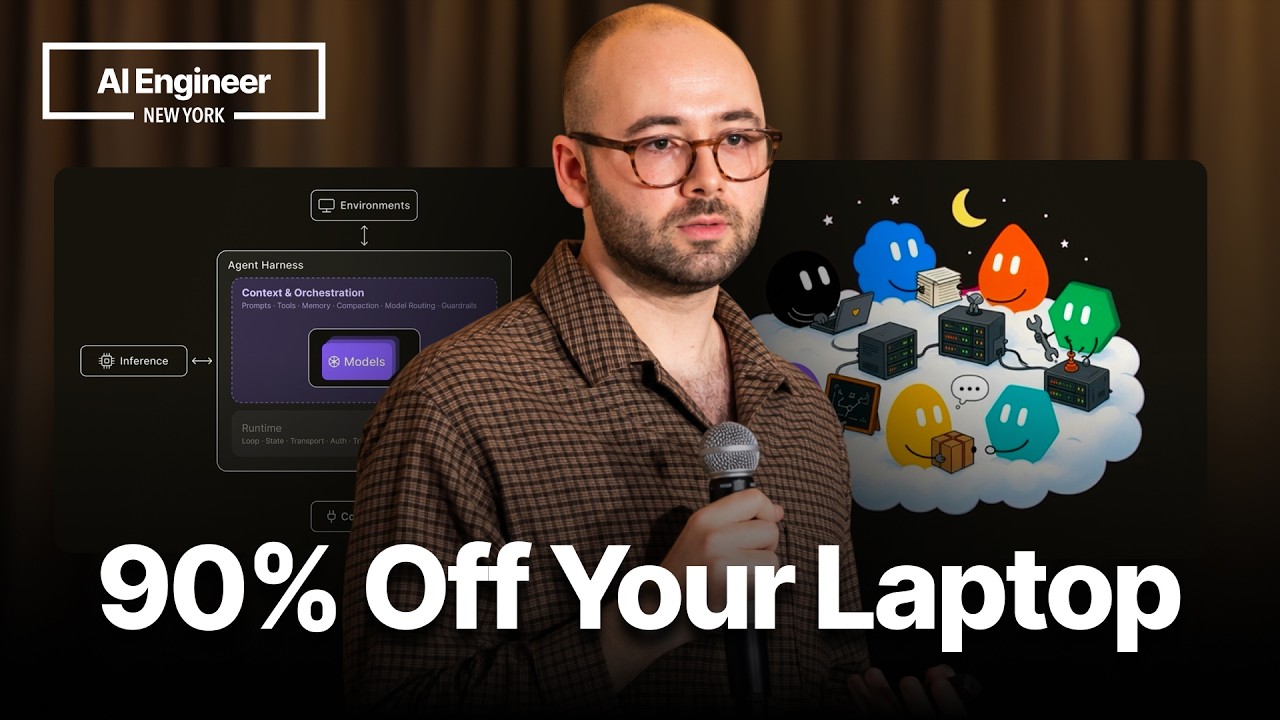
A deep dive into advanced engineering techniques for coding agents, focusing on effective context management in LLMs like Claude. The talk introduces a practical framework using a brain-inspired analogy, proposing a Markdown-based 'wiki' as a long-term memory system to augment the agent's limited context window. This approach is demonstrated through a real-world challenge of extracting structured data from technical drawings.

Your Coding Agent Should Do AI System Engineering — Ben Burtenshaw, Hugging Face

Your Coding Agent Should Do AI System Engineering — Ben Burtenshaw, Hugging Face

Ben Burtenshaw from Hugging Face demonstrates how coding agents are tackling complex AI systems engineering tasks. He outlines a three-tiered approach: interactively writing CUDA kernels, autonomously fine-tuning LLMs, and deploying a multi-agent research lab (AutoLab) to parallelize experiments, all powered by file-based "skills" and open primitives on the Hugging Face Hub.

A Piece of Pi: Embedding The OpenClaw Coding Agent In Your Product — Matthias Luebken, Tavon

A Piece of Pi: Embedding The OpenClaw Coding Agent In Your Product — Matthias Luebken, Tavon

Matthias Luebken explains the core principle of building with coding agents: make things easy for them. This talk deconstructs the Pi SDK, showing how a simple loop of an LLM calling CLI tools can lead to emergent capabilities. Luebken presents a real-world B2B sales pipeline built on this principle, where agents handle incoming emails, query CRM/ERP data via simple tools, and generate draft responses, keeping the human in their familiar email client.

⚡️ Matt Pocock - Why Engineering Fundamentals matter MORE now

⚡️ Matt Pocock - Why Engineering Fundamentals matter MORE now

Matt Pocock of AI Hero discusses the critical role of classic software engineering principles in the new era of AI development. He explores how concepts like Domain-Driven Design (DDD), deep modules, and intentional architecture are essential for building maintainable systems with AI, and shares his unique teaching philosophy for the rapidly evolving field of AI Engineering.

Vibe Engineering Effect Apps — Michael Arnaldi, Effectful

Vibe Engineering Effect Apps — Michael Arnaldi, Effectful

A practical guide on improving LLM coding agent performance by giving them direct access to a library's source code. The session demonstrates cloning the Effect repository to extract patterns and guide the agent in building a type-safe application from scratch.

Everything We Got Wrong About Research-Plan-Implement -  Dexter Horthy

Everything We Got Wrong About Research-Plan-Implement - Dexter Horthy

Dexter Horthy of HumanLayer critiques the initial Research-Plan-Implement (RPI) framework for AI coding agents, revealing its tendency to encourage 'outsourcing thinking'. He introduces CRISPR, a new structured methodology that emphasizes smaller, focused prompts, human-agent alignment through artifacts like Design Discussions, and engineer ownership to combat 'slop' and improve code quality in complex projects.