Smarter Models Killed the Harness. Here's What's Left — Jediah Katz, SpaceXAI
Jedidiah Katz, longtime agent-harness engineer at Cursor and now at SpaceX, argues that fancy harnesses no longer add coding intelligence because models absorb those skills through a data flywheel. He contends the harness matters more than ever: it unlocks new frontiers like Grokbot and owns infrastructure, trust and security, and efficiency. He closes with predictions, including that 90% of agent work will run off the laptop within six months.
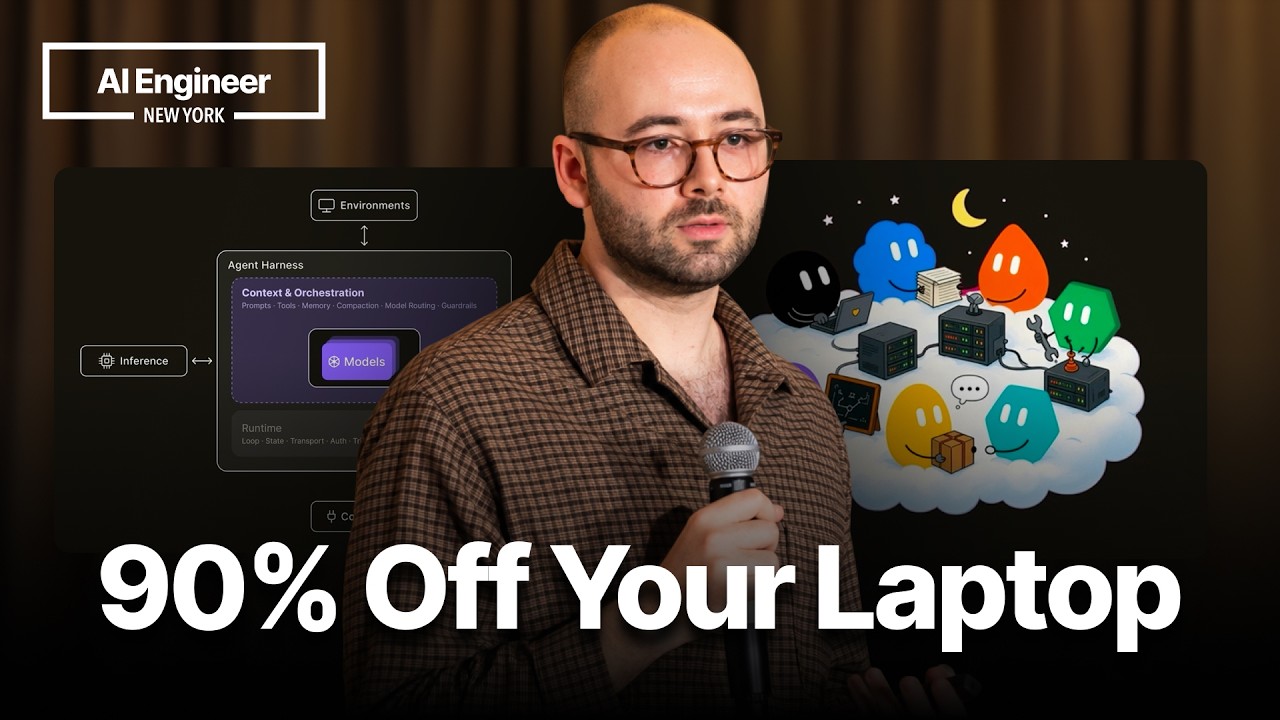
Jedidiah Katz opens by asking whether the agent harness is dead. He joined Cursor early in 2025 as the longest-tenured engineer on its agent harness and later moved to SpaceX with the Cursor acquisition. His answer is nuanced: the parts of the harness that made models better at coding are becoming obsolete, but the harness as a whole matters more than ever.
From prompt engineering to harness engineering
The vocabulary has shifted quickly. In early 2023, prompt engineer was the hottest title. By mid-2025 the term had become context engineer, meaning someone who programmatically assembles the best context for the model on the fly. Only at the start of this year did the industry settle on ‘agent harness’ and ‘harness engineering’ to describe work Katz’s team had been doing for some time.
What lives inside an agent harness
Katz uses the metaphor of eyes and hands. The harness wraps the model, steers it, and connects it to the world. Users reach it through apps, and it connects the model to computers and third-party services such as MCP servers. He divides the harness into two layers.
The first is the runtime, the foundation that determines where the core agent loop runs and how state is stored so work can resume. Katz says this resembles traditional software engineering. The second is the context and orchestration layer, which he calls the ‘wild west.’ This layer decides which models are called, when, and what context they see. It covers prompts, tools, memory, compaction, and a range of less visible techniques used to make the agent behave the way the team wants. This is the area Katz works in most directly, and it is where most people’s idea of ’the harness’ lives.
Peak harness and the backlash
Early this year Cursor announced it had built a browser from scratch using a long-running multimodal harness called Grind Swarm. It orchestrated many agents across many machines, was expensive to run, and reportedly took Cursor down once or twice during the demo.
Within a few months, people online were declaring the harness dead. Thariq from Anthropic described removing much of the Claude Code system prompt. Garry Tan of YC argued that only skills would matter. Katz and his colleague Stefan wrote about removing the guardrails Cursor had built to patch model weaknesses. These included a small dedicated model just to apply code edits, and coding-specific instructions on how to explore a codebase and verify work.
What the research says
Katz asks the audience to imagine a very simple harness where the model has access only to a shell and all of the user’s secrets. When he asks who believes this minimal setup would match a sophisticated harness on coding evals, only a few hands go up.
He then cites two studies. A UC Berkeley study tested seven frontier models across several harnesses, including Pi, Codex, and Claude Code. For the newer, stronger models, harness choice did not significantly change scores on SWE-bench Lite. A study from Apple and EPFL found that a dedicated MLE harness made little difference on MLE-Bench.
Katz’s reading of this evidence is that a fancy harness no longer adds coding intelligence. Skills the harness once supplied, such as exploring a codebase, working persistently on long tasks (he mentions the /goal pattern), and running tests to check work, have been absorbed natively by the models.
The data flywheel
Katz’s explanation for why the harness is making itself obsolete is what he calls the data flywheel. The harness brings harder coding tasks within reach. More users then attempt those tasks with agents, which sends more coding data to the labs. Eventually the models learn those skills natively. Once models are capable enough, the harness can delete the scaffolding it needed in the first place. This cycle explains why the harness appears to be dying.
Why the harness still matters: new frontiers
Katz gives two reasons the harness still matters. The first is that the harness opens new frontiers of tasks for models to solve.
He uses Grokbot as the main example. Grokbot is an autonomous colleague for all kinds of knowledge work, not only coding. Its harness relies on long-lived coordinator bots that orchestrate a fleet of worker agents. Katz compares this to a senior lawyer who owns strategy and directs a team of paralegals.
He points out a reversal. At Cursor the team kept removing prompting and guardrails as models improved. At Grokbot they are adding them back, because the new domains have tasks models have not yet mastered. These include building slide decks, booking travel, keeping the user informed without overwhelming them, deciding when to act versus ask (for example, emailing colleagues in ways the user intended), and learning the user’s working style through memory. Katz notes that none of these tasks are new, but they matter far more now that everyone needs them. In his view, the harness is what makes them feasible today.
This fills in the last arrow of the flywheel. When a capability such as coding becomes commoditized, the harness unlocks the next frontier, and the cycle starts again. That frontier can be non-coding work or the broader software engineering job, since senior engineers often write less code and handle much more else.
Katz also describes a software factory, where multiple agents coordinate across the software development lifecycle. Internally, a bug reported in a Slack channel is automatically triaged. A cloud agent then attempts a fix and produces before-and-after videos as proof. After deployment, a rollouts agent watches production for issues. Katz calls this a meta harness that orchestrates many agents.
What models cannot absorb
The second reason is that some parts of the harness cannot be absorbed by the model.
The first is infrastructure and runtime. Agent tasks now run for minutes, hours, and sometimes days. That cannot happen reliably on a laptop that goes to sleep, so a true autonomous colleague has to run in the cloud.
The second is trust and security. A minimal harness with API keys sitting in a file may solve coding tasks, but no security team would accept that. Permissions need to be scoped to specific agents and people, and guardrails are needed to prevent catastrophic actions or a surprise $10,000 API bill.
The third is efficiency. Both studies Katz cited found significant differences in cost per task even when eval scores were similar. Over the past month he has worked on optimizing Grokbot’s harness through cache hit rate, token efficiency, and model mix. These changes cut cost and latency substantially with no loss in quality. The more people rely on agents, the more this matters.
Predictions
Katz expects the flywheel to speed up. Product is moving faster than models again, so the harness will get messier before it gets cleaner. Teams should design harnesses so features can be shipped and unshipped easily. Less of the harness internals are being exposed to users, which reduces change-management burden, though it trades away visibility. Hyrum’s Law is the warning here: whatever is exposed, users will depend on.
He also highlights a growing focus on primitives, composable building blocks that let features be added or removed without complicating the agent. One example is subscriptions. Agents need to wake on events such as Slack messages, CI failures on a relevant PR, or a time of day. Instead of separate integrations for each, Cursor uses one framework and one tool that lets the agent subscribe to any of them.
Cursor also tracks deterministic guardrails it calls shims, which patch model misbehavior. One example is nudging Grokbot when a user is waiting for a reply. Shims are logged centrally, and a bot watches the dashboard, opening a PR to remove any shim that no longer fires. The harness is also moving to a higher level of abstraction. Earlier harnesses composed raw LLM calls, while newer ones like Grokbot and the software factory use agents as the core building block.
Finally, Katz predicts that within six months, 90% of agent work will run off the laptop.
Closing thoughts
Katz’s answer is that the parts of the harness that made models smarter at coding are dying, and that is the flywheel at work. The harness is still how agents reach the next frontier of work, and the trust, efficiency, and infrastructure it provides are not going away. He closes with: ‘yesterday’s harness may be dead, but long live the agent harness of tomorrow.’