Harness engineering

Smarter Models Killed the Harness. Here's What's Left — Jediah Katz, SpaceXAI

Smarter Models Killed the Harness. Here's What's Left — Jediah Katz, SpaceXAI

Jedidiah Katz, longtime agent-harness engineer at Cursor and now at SpaceX, argues that fancy harnesses no longer add coding intelligence because models absorb those skills through a data flywheel. He contends the harness matters more than ever: it unlocks new frontiers like Grokbot and owns infrastructure, trust and security, and efficiency. He closes with predictions, including that 90% of agent work will run off the laptop within six months.
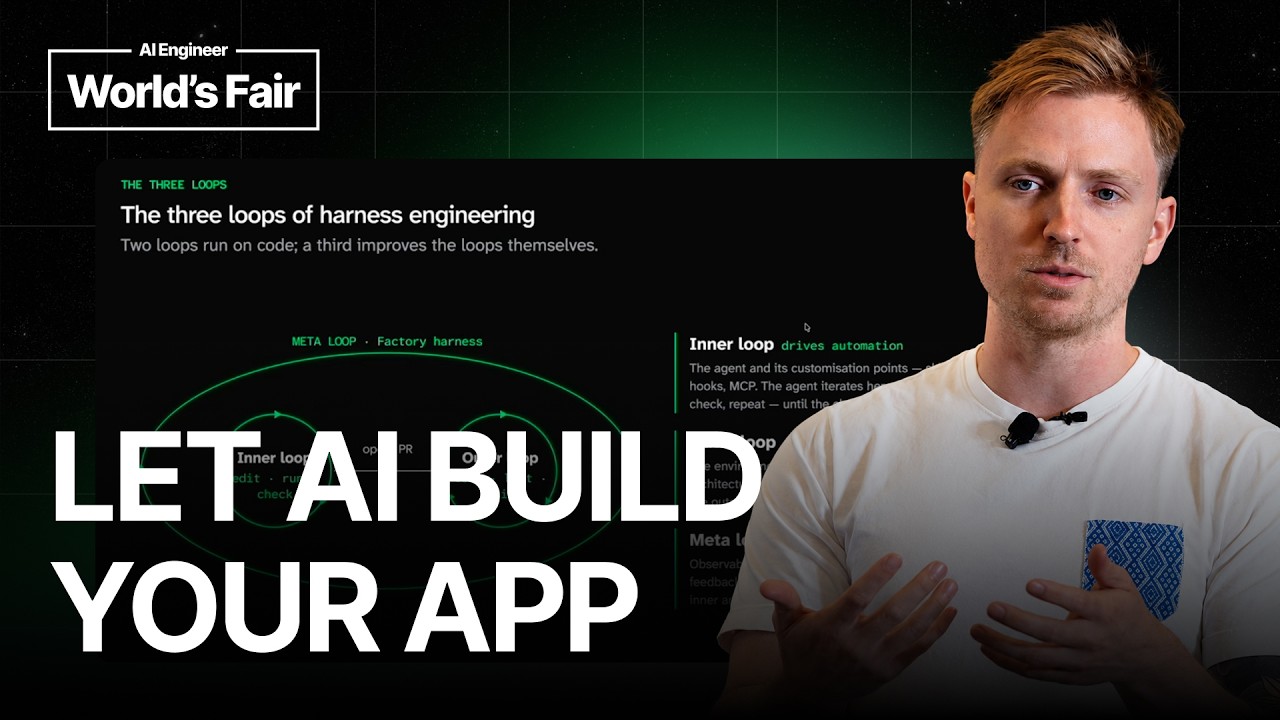

Harness Engineering: How to Build a Software Factory — Dru Knox, Tessl

Harness Engineering: How to Build a Software Factory — Dru Knox, Tessl

Dru Knox of Tessl discusses harness engineering, the discipline for building software factories with AI agents. He outlines a factory's three pillars—autonomy, automation, quality—and introduces inner, outer, and meta loops. Knox explains why this field is challenging and proposes a three-layer architecture: control plane, agent-ready stack, and improvement loops, concluding with key metrics to track progress towards an agent-driven software development future.

How a Voice Agent Learns the Rhythm of Conversation — Shawn Wen

How a Voice Agent Learns the Rhythm of Conversation — Shawn Wen

Shawn, CTO of PolyAI, explains why voice agents are harder than text agents: voice adds time, and good conversation depends on adapting to the person on the line. He describes Dialog-RSN-1, an audio-native model that predicts turn-taking, replies in text with citations, and writes the transcript last for auditability, along with training on real noisy calls, latency and what agents should do while thinking, voice personality, benchmarking, harness ownership, and the shifting bottleneck from producing content to validating it.

Can Rewriting an AI Agent Bend the Intelligence Curve? - Zhengyao Jiang

Can Rewriting an AI Agent Bend the Intelligence Curve? - Zhengyao Jiang

Weco let an AI coding agent rewrite the harness around a fixed language model for eight days. Zhengyao Jiang explains what the reported gains show, where the evidence stops short of recursive self-improvement, how reward hacking complicates evaluation, and why human-designed abstractions still anchor the search.

Total Recall: Agent Memory and Harness Engineering — Ignacio Martinez, Oracle

Total Recall: Agent Memory and Harness Engineering — Ignacio Martinez, Oracle

Ignacio Martinez's workshop delves into agent harness engineering, emphasizing that while LLMs are a 'frozen' reasoning core, the surrounding harness is where control and reliability are established. He outlines a seven-layer architecture for building robust agent harnesses, covering critical aspects like hybrid storage solutions, advanced memory engineering (including in-database embeddings and context card management), the semantic layer (Umwelt), agent loops, and context engineering. The session also explores continual learning through 'skill promotion' and addresses practical challenges like managing vast tool sets and optimizing model interactions.

Reading Group July 2026 - Loop Engineering

Reading Group July 2026 - Loop Engineering

This session provides an in-depth exploration of Loop Engineering, a paradigm shift from manual AI prompting to designing autonomous systems that orchestrate AI agents. Speakers share practical experiences, from building production-grade platforms with automated code generation and adversarial AI reviews to experimental loop structures and foundational infrastructure layers. Key discussions address challenges like managing token costs, preventing agent chaos, and implementing robust verification mechanisms for industrializing software development.