What Survives When AI Can Build Anything? (with Dr. Richard Socher)
Richard Socher, CEO of Recursive and author of The Eureka Machine, makes the case for automating the scientific method with recursively self-improving AI. He covers how AI keeps replacing hand-crafted expertise with scale, the four pillars of his approach, why hallucinations can aid discovery, why RSI still rules out an overnight takeoff, and how science may become an engineering discipline across physics, biology, and economics.
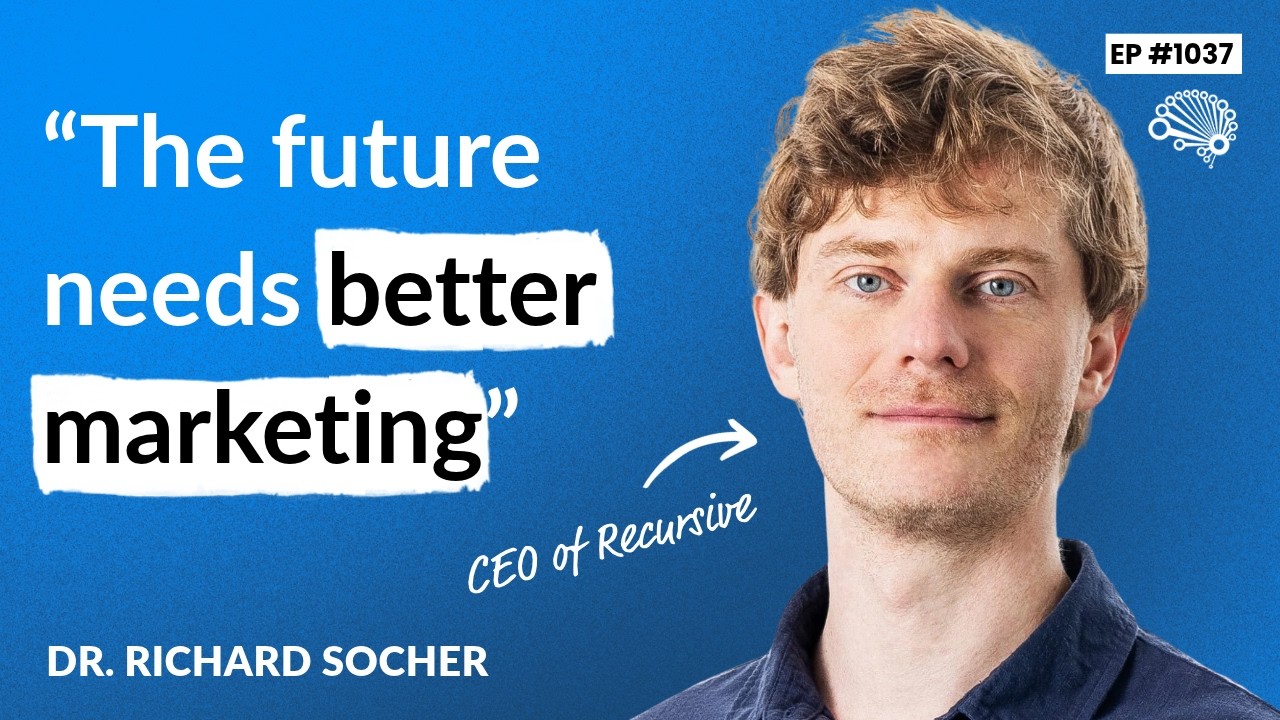
Richard Socher argues that the next leap in AI will come from automating the scientific method itself, and that this turns sciences into engineering disciplines. He frames his company Recursive around building recursively self-improving superintelligence, and his book The Eureka Machine lays out how AI could compress a century of scientific progress into a decade.
From hand-crafted features to automated research
Socher traces a pattern across his career: each time the field replaced human expertise with scale. Feature engineering gave way to architecture engineering, which he tried to eliminate with decaNLP, a single model that could be prompted with any question and return an answer. Sutton’s Bitter Lesson describes the same dynamic, where clever human insight is eventually outpaced by simpler methods running on large data and compute. The current bottleneck sits one meta level higher. Researchers still generate ideas and validate them by hand, and use AI mostly to implement them. Recursive aims to automate that loop as well, which Socher sees as possibly the last necessary step for AI.
He separates two forms of recursive self-improvement. The weak form, like OpenAI’s blog posts about using Codex more and more, still keeps many human experts in the loop. The strong form has AI generating its own ideas, implementing them, and validating them, while humans set the goals, rewards, and environments.
Why RSI should not be feared by default
Socher argues that fear of RSI ignores history. Experts failed to predict financial crises, overpopulation panic never materialized, and fears about nuclear power and GMOs held humanity back. He points out that deaths from continued coal use far exceed the deaths from all nuclear accidents combined. He does not dismiss risk entirely. He allows that chatbots could carry ratings like movies, and notes that drugs and self-driving cars are already regulated. Still, he thinks people imagine apocalypse too vividly. He applies the same reasoning to data centers. Much of the opposition, in his view, rests on fear or misinformation, such as the claim that data centers evaporate huge amounts of water, when most modern facilities use closed water systems. Noise, exhaust, and siting are real concerns, but he considers them fixable.
The Eureka Machine and its four pillars
The book argues that AI can connect every stage of science, from hypothesis generation and simulation to experimentation and validation. Socher sees potential in physics for energy generation, in chemistry for energy storage, in biology for eradicating disease, in neuroscience for understanding the brain, and in economics for better policy. Krohn notes that a neuroscience PhD finishing in 2012 would have found today’s capabilities implausible, which makes the century-in-a-decade claim seem less far-fetched.
The Eureka Machine rests on four pillars: world knowledge, scientific measurements, simulations, and real-world experiments, coordinated by a swarm of agents. Socher describes these as a sequence of checks. A new idea must first align with existing knowledge, then with measurements, then survive simulations across many circumstances, and finally be tested carefully in the physical world.
Alien hypotheses and hallucinations as a feature
Socher describes alien hypotheses, recalling how AlphaGo played moves that Go experts had never seen. AI can explore combinatorial spaces of ideas that no human could cover, starting from a strong prior built on past knowledge and proposing reasonably different ideas that can be recombined. In this sense hallucinations are sometimes a feature. For factual questions, however, they are a bug, and the system must rely on grounded facts. This is why Socher continues to work on You.com, a web search engine built for agents that provides citations and up-to-date information. He sees a broader shift in which technologies built for humans, such as browsers, GPUs, the internet, and search engines, become infrastructure layers for AI agents.
Krohn raises the explanation problem. If an AI discovers something no one can intuitively grasp, what minimal evidence should we require? Socher answers that understanding comes in levels, and cites GLP-1 drugs whose mechanism was misunderstood for years. Neural networks are also easier to probe than brains. fMRI has poor temporal resolution, and electrodes capture only a few neurons, so a trained model is a far more inspectable substrate. He suggests humans will have to accept not fully intuiting complex models, just as nobody consciously accesses how their own visual cortex processes an image.
Simulation fidelity and the AI Economist
Krohn asks how simulations avoid becoming sources of false confidence. Socher concedes that humanity does not have full answers, but points to progress. Neural networks now approximate parts of physical models for weather prediction, which is far more efficient than modeling raw physics. LLM-based personas can simulate user populations whose statistical outcomes increasingly resemble real experiments. His guiding principle is that all models are wrong, but some are useful, and they improve as fidelity increases.
He describes the AI Economist, a project from his Salesforce days. It is a two-level reinforcement learning system in which an AI planner sets taxes and subsidies while agents optimize their own utility. The system can iterate through simulated economic history to find policies that maximize productivity, equality, or sustainability. Socher argues that economics is still stuck in one-step, ideological models, and has not yet had even its machine learning moment. Chapter five of the book, titled how to make economics a less dismal science, makes the case for policy as an engineering discipline. He imagines superintelligence serving as an advisor that tests whether proposed financial instruments actually achieve chosen goals, potentially avoiding past wars over ideologies.
Scale, biology, and longevity
Socher co-developed ImageNet with Fei-Fei Li, and recalls how its scale made AlexNet-style breakthroughs possible without hand-coded features. He expects the same pattern to reshape other disciplines, turning biology into a programmable science in the way protein models such as ProGen suggest. Longevity is a major application area. Socher even suggests that aging could be treated as a disease to cure, acknowledging that this pushes the Overton window while pointing to the practical wish to keep moving, working, and hiking as years pass.
Chapter six covers brain organoids, miniature tissues of a few thousand to a few million cells that mimic parts of organs. Companies such as Parallel Bio (transcribed as Pearl Bio) test drugs on them, and Socher reports that such tests can predict human responses better than mouse studies. The company reportedly received FDA approval to skip animal trials for certain immune toxicity testing. Asked about the ethics of brain organoids, Socher notes they are smaller than a bee. Krohn extrapolates toward future RSI systems that might engineer whole brains in the lab, which Socher considers a distant moral dilemma.
Constraints on takeoff
Socher cautions against overnight takeoff narratives. Even with RSI in the loop, the system still needs compute and iterative experimentation, and the bigger the ideas, the more compute they demand. Physical constraints such as supply chains, manufacturing, and capital do not vanish because intelligence improves. Software experiments run much faster than wet lab biology, but training a multi-trillion-parameter model still takes time. Socher believes RSI could arrive within one to two years, but he expects this to unfold through iteration rather than in minutes.
Recursive plans to open-source some artifacts the Eureka Machine produces so the community can evaluate them, but not the entire machinery. He compares that to offering unrestricted access to every employee’s brain.
Coding, abstraction, and the gym for the mind
Krohn cites Opus 4.6 in early 2026 as a watershed in trusting coding agents with autonomous work, and notes that figures like Linus Torvalds and DHH now rely heavily on AI-generated code. Socher explains why coding was an early superhuman domain: it is simulatable and verifiable, and any task with those two properties can reach superhuman performance. Asked whether AI-generated code needs to be human-readable, he says readability still matters for high-stakes artifacts such as cryptographic proofs, but computer science has always moved up layers of abstraction, and new programming languages may emerge. He also treats programming as a ‘gym for the mind’, a cognitive workout that keeps reasoning sharp, similar to how people still study ancient Greek texts for the way of thinking they cultivate.
Abundance, scarcity, and progress
Socher imagines a world of abundant, nearly cost-free intelligence and argues that some things stay scarce by definition. Human attention cannot scale beyond twenty-four hours a day, and fame, brands, unique data, and network effects remain valuable. He points to humanprogress.org, which tracks how many hours of labor are needed to afford goods such as sugar, cotton, and coffee, showing that most have become cheaper over time. He argues that people underestimate progress because media rewards fear. He also reflects on the tension between inequality and enduring achievement, noting that the pyramids and cathedrals were products of unequal societies, and calls balancing broad welfare with long-term projects a hard question of our time.
Constructive optimism
Socher closes with his philosophy of constructive optimism. He views the future as a construction game rather than a prediction game, where people decide what future they want and then build it. AI is an omni-use technology that can disenfranchise people, but it can also empower entrepreneurs by delegating small tasks and accelerating experiments. Agency becomes more important as AI grows more capable.
Audience questions
On zero-shot innovation, Socher says yes, it is possible. Most breakthroughs recombine existing building blocks, and many combinations across math, physics, biology, and AI remain unexplored. Completely new paradigms may emerge once researchers learn to interrogate very large networks to understand how they reached conclusions.
On universities, a colleague at Tulane asked whether mentoring students still makes sense when Claude Code can do months of work in an hour. Socher says he now runs thousands of experiments over a weekend without other humans. He expects universities to continue creating new minds, with faculty acting at higher levels of abstraction, and expects managing AI agents and generating good ideas to become essential skills to teach.
Finally, Socher says that software with unique data, network effects, marketplaces, and strong brands will endure, since code itself cannot be bought in the way a social network’s users cannot. Jobs in entertainment, health, research, and AI-related roles will also remain.