The New Primitives: Building AI Native Software — Kwindla Kramer, Daily
Kwindla Hultman Kramer argues that current AI agents are akin to 1995 web pages – a foundational primitive, not the ultimate destination. Drawing a historical parallel, he predicts the emergence of "AI native software" that will build upon and surpass agents, much like web applications evolved from simple web pages. He illustrates this through computing history, highlighting transformative shifts like VisiCalc's impact on accounting and the vision of Apple's Knowledge Navigator, and concludes by showcasing a game, Gradient Bang, that demonstrates the core primitives of this future AI native software.
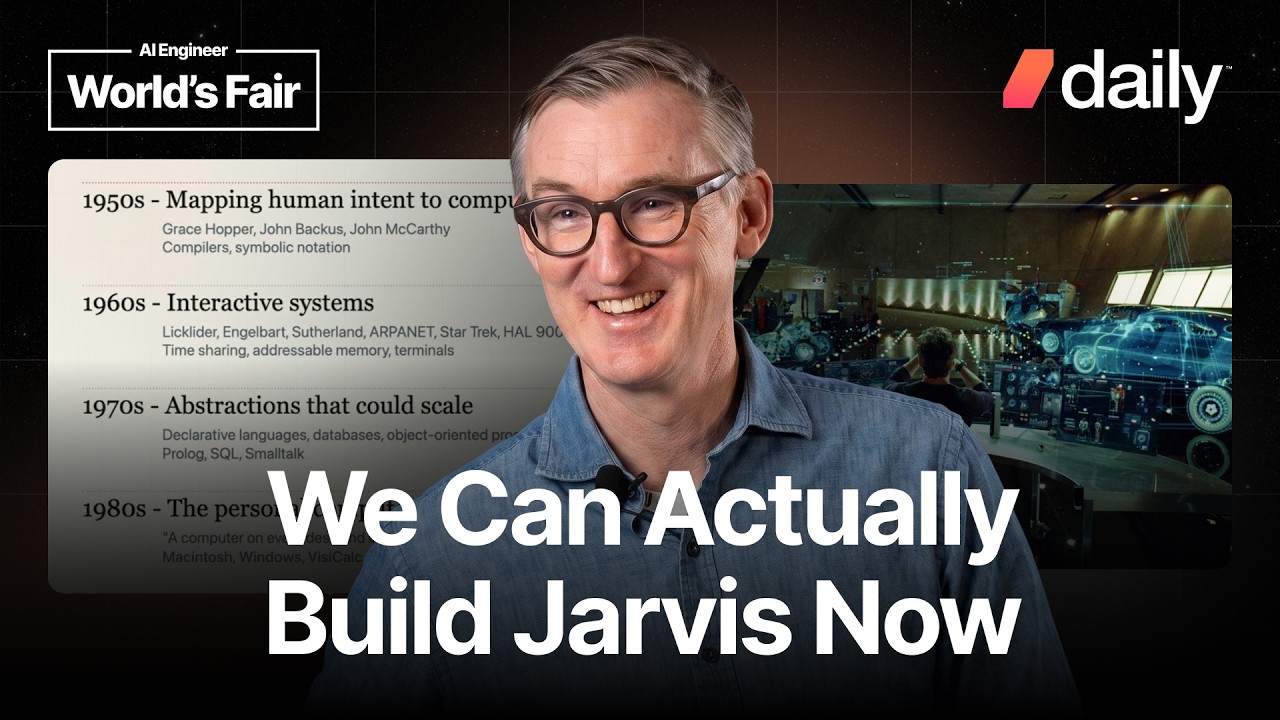
Kwindla Hultman Kramer, representing Daily and Pipecat (a widely used open-source framework for voice agents), posits a compelling vision for the future of AI native software, contextualizing it within the 80-year history of digital computing. His core argument is that just as web pages in 1995 were a primitive, not a destination, current AI agents represent a foundational stage, and the true innovation lies in the “AI native software” that will emerge next.
He begins by referencing Vannevar Bush’s seminal 1945 essay, As We May Think, which remarkably predicted technologies like document scanning, OCR, speech-to-text, hypertext, search engines, and voice interfaces. Bush wrote at the dawn of the computing age, and Kramer feels we are now at the “beginning of a new age, the intelligence age,” prompting the question: “what will we build?”
For Kramer, the current excitement around agents mirrors his own experience as a “baby programmer in 1995” who was “as excited about HTML… as I am about agents today.” He recalls hand-coding HTML, building web servers in C, and creating authoring tools in Perl for web pages. While web pages are still important, the evolution into full-blown web applications and native mobile apps demonstrates how a foundational primitive can pave the way for a more sophisticated software paradigm. He cites Satya Nadella’s view on “multi-model harnesses” and “software co-pilots embedded in every single piece of software” as “agents++,” suggesting the immediate next step.
To understand what comes after “agents++,” Kramer traces the evolution of computing:
- Abacus to Stored Program Computer to Personal Computer to AI Agents Era: This updated timeline highlights the rapid progression of computing paradigms.
- 1950s: Transmitting Human Intent: The focus was on building programming languages and compilers, combining mathematical formalisms with natural language elements.
- 1960s: Interactivity and Imagination: The era of two-way human-machine dialogue, graphical programming (like Ivan Sutherland’s Sketchpad), and the computer entering popular imagination through science fiction (Star Trek’s friendly computer vs. HAL 9000’s dystopia).
- 1970s: Abstractions that Scale: The development of relational databases, declarative languages, and object-oriented programming (Smalltalk) laid the groundwork for managing vast data and complex systems.
- 1980s: The Personal Computer & VisiCalc: The Macintosh (1984) and Windows 1.0 (1985) brought “a computer on every desk and in every home.” Kramer highlights VisiCalc, the first spreadsheet program, as a “truly new abstraction.” He argues that VisiCalc didn’t replace accountants but instead “made much much much more accounting like work possible” and invented “new categories of work,” serving as a powerful counter-argument to fears of mass unemployment due to AI.
- Apple’s 1987 “Knowledge Navigator”: This concept video, inspired by As We May Think, predicted foldable tablets, touchscreens, conversational voice assistants with personality, global/personal information access, real-time video, and continual learning. It “pre-aged this AI agents era we’re in now.”
- 1990s: The Network & Multimodality: The internet and web emphasized multimodality from the start, integrating text, audio, and video as belonging “together,” consciously attempting to realize the “Knowledge Navigator” vision.
- 2000s: Mobile and Ubiquitous Computing: The decade focused on making computing mobile and continually connected, giving a “supercomputer to everybody in the world.” This era saw futurism in films like Minority Report (gestural interfaces based on real MIT Media Lab work) and Iron Man, showcasing advanced human-computer interaction.
- 2010s: The Cloud: This decade established the infrastructure, data centers, and data capacity necessary to scale AI training and inference.
Today, we’re building agents, and Kramer contends that we now have the technological capability to build the “Memex and Jarvis from Iron Man and Knowledge Navigator from that 1987 video for real, completely working.” A recent video by Tavis, “reimagined knowledge navigator video… entirely built on real and available technology,” demonstrates this.
To explore the “next next thing,” Kramer showcases “Gradient Bang,” a massively multiplayer game where “LLMs are the core of every interaction.” This project, involving hundreds of inference calls, exercises key primitives for AI native software:
- Asynchronous non-blocking context compression
- Long-running subagents that share context
- Progressive skills loading
- Dynamic user interface generation
- Conversational voice
Kramer concludes with excitement for building current agents, but even more so for shaping the “next next thing” – the AI native software that transcends today’s agents.