Wavefunction Flows: Efficient Quantum Simulation of Continuous Flow Models
Continuous flow models map naturally to a Schrödinger equation, the fundamental equation of quantum mechanics. This discovery proves that a trained generative model can be efficiently simulated on a future quantum computer, enabling a new, more powerful type of access to its learned distribution for tasks like Monte Carlo estimation and structure discovery.
Continuous flow models—a category that includes flow matching, rectified flows, and the probability flow ODEs from diffusion models—are, in a sense, a form of quantum mechanics in disguise. This profound connection reveals that a velocity field learned by a classical generative model can be directly mapped to a Schrödinger equation. This equation can be efficiently simulated on a future quantum computer, yielding a quantum state that encodes the model’s learned probability distribution. This opens up a fundamentally new and more powerful way to interact with these distributions for downstream tasks.
The Quantum-Probability Analogy
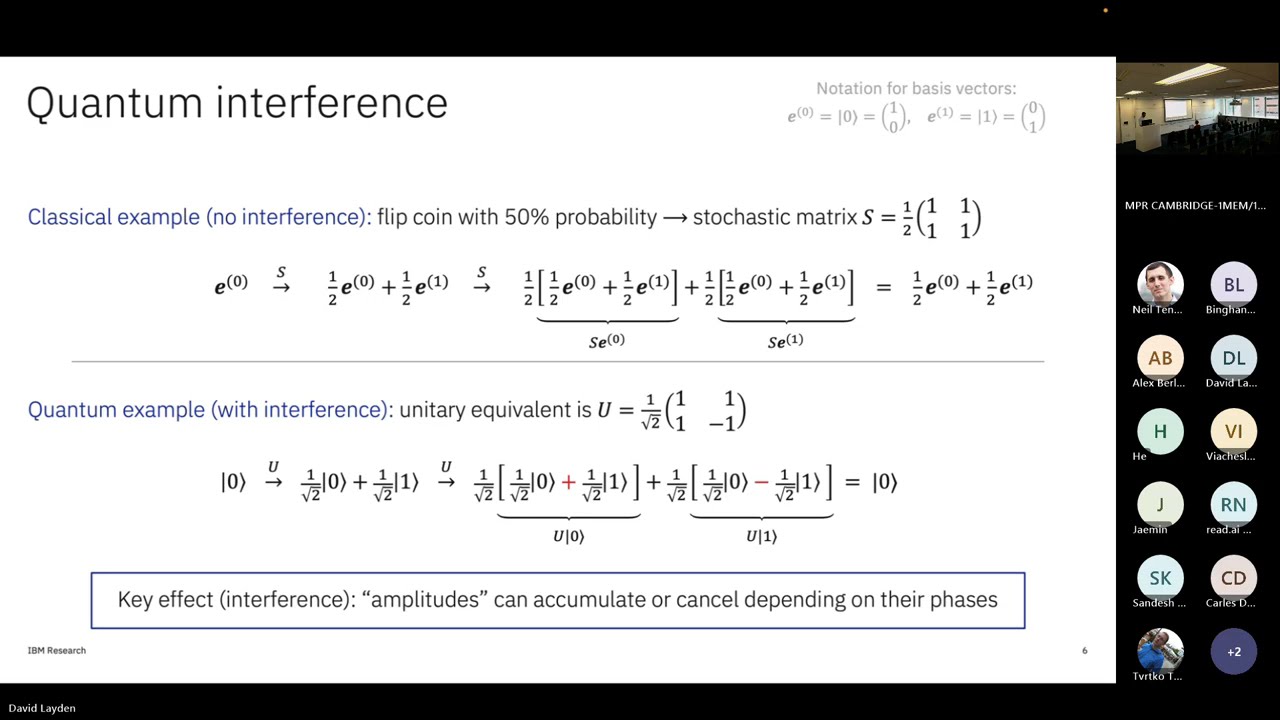
At its core, quantum mechanics can be understood as an extension of probability theory that uses the L2 norm and complex numbers, rather than the L1 norm and non-negative real numbers.
- In classical probability, a system’s state is described by a probability vector with non-negative elements that sum to one (unit L1 norm).
- In quantum mechanics, a system is described by a quantum state, a complex vector whose squared elements sum to one (unit L2 norm). These complex values are called “amplitudes.”
The probability of observing a particular outcome is the absolute value squared of its corresponding amplitude. This seemingly small change from probabilities to complex amplitudes introduces the phenomenon of quantum interference. Because amplitudes can have different phases, they can constructively or destructively interfere—they can cancel each other out in ways that are impossible for probabilities. This is the source of all unique quantum computational power.
From Probability Flows to Wave Function Flows
The connection to generative models begins with the standard probability flow Ordinary Differential Equation (ODE), which transports samples from a simple initial distribution (e.g., a Gaussian) to a complex data distribution according to a learned velocity field v(x, t). The evolution of the probability density of these samples, q(t), is described by the continuity equation.
The key insight is to define a quantum state, or “wave function,” ψ(t), as the square root of the probability density: ψ(t) = sqrt(q(t)). This is sometimes called a “Q-sample” or a “coherent encoding” of the distribution. By taking the time derivative of ψ(t) and substituting the continuity equation, one finds that ψ(t) evolves according to a Schrödinger equation.
This derived Schrödinger equation is governed by a “continuity Hamiltonian” that is constructed directly from the same learned velocity field v(t) used in the classical model. In the important special case where the velocity field is conservative (i.e., it is the gradient of a scalar potential, v = ∇V, as is true for the score in diffusion models), this Hamiltonian takes a specific form: a commutator between a kinetic energy term (the Laplacian) and a potential energy term V. This is structurally similar to the Hamiltonians that describe all of physical nature, which are typically a sum of these two terms, not a commutator.
Quantum Simulation and Its Implications
While this “continuity Hamiltonian” does not appear to arise in nature, it is precisely the type of operator that quantum computers are being designed to simulate. The techniques for simulating quantum dynamics, such as product formulas (or Trotterization), can be readily adapted to simulate the evolution dictated by this flow-derived Hamiltonian.
The process is as follows:
- Train a continuous flow model on a classical computer to learn a velocity field
v(t). - Construct the corresponding continuity Hamiltonian from
v(t). - Simulate the evolution under this Hamiltonian on a quantum computer, starting from an initial state corresponding to
sqrt(q_0). - The final state of the quantum computer will be
ψ(1) = sqrt(q_1), whereq_1is the target distribution learned by the classical model.
Just measuring this final quantum state yields a sample from q_1, just as solving the ODE classically would. However, having the quantum state itself enables far more.
New Capabilities: “Inference through Interference”
This quantum access to the learned distribution unlocks capabilities that have no classical analog.
- Quadratic Speedup for Estimation: For downstream tasks like Monte Carlo estimation (e.g., calculating the expected value of a function), quantum algorithms like amplitude estimation can achieve a target error with quadratically fewer uses of the Q-sample compared to the number of samples required classically.
- Novel Probes: One can apply unitary operations to the quantum state before measurement. For example, applying a quantum Fourier transform allows one to sample from the frequency domain of the learned distribution, potentially revealing hidden periodic structures or other non-local patterns in a highly efficient manner.
A Rosetta Stone Between Fields
This work establishes a “Rosetta Stone” translating concepts between generative AI and quantum complexity theory. The learnability of a distribution by a flow model becomes equivalent to the difficulty of preparing its corresponding Q-sample on a quantum computer. Complexity theory suggests there are distributions that are easy to sample from classically, yet for which preparing the Q-sample is computationally hard. This implies that no flow model could ever learn such distributions, revealing potential fundamental limitations on the expressivity of current generative models, independent of any future quantum hardware.