The Loop Is the Product — Roland Gavrilescu, Introspection
Roland Gavrilescu, co-founder and CEO of Introspection and formerly at xAI, presents a blueprint for autoresearch in 2026 built on three ideas: the loop is the product, system distillation is the moat, and valued work per watt is the score to optimize. He illustrates these with the OpenClaw car-haggling loop, the concept of portable agent recipes, and a talent-sourcing agent example that shows how to spot patterns in traces, calibrate judges with humans, and A/B test taste in production.
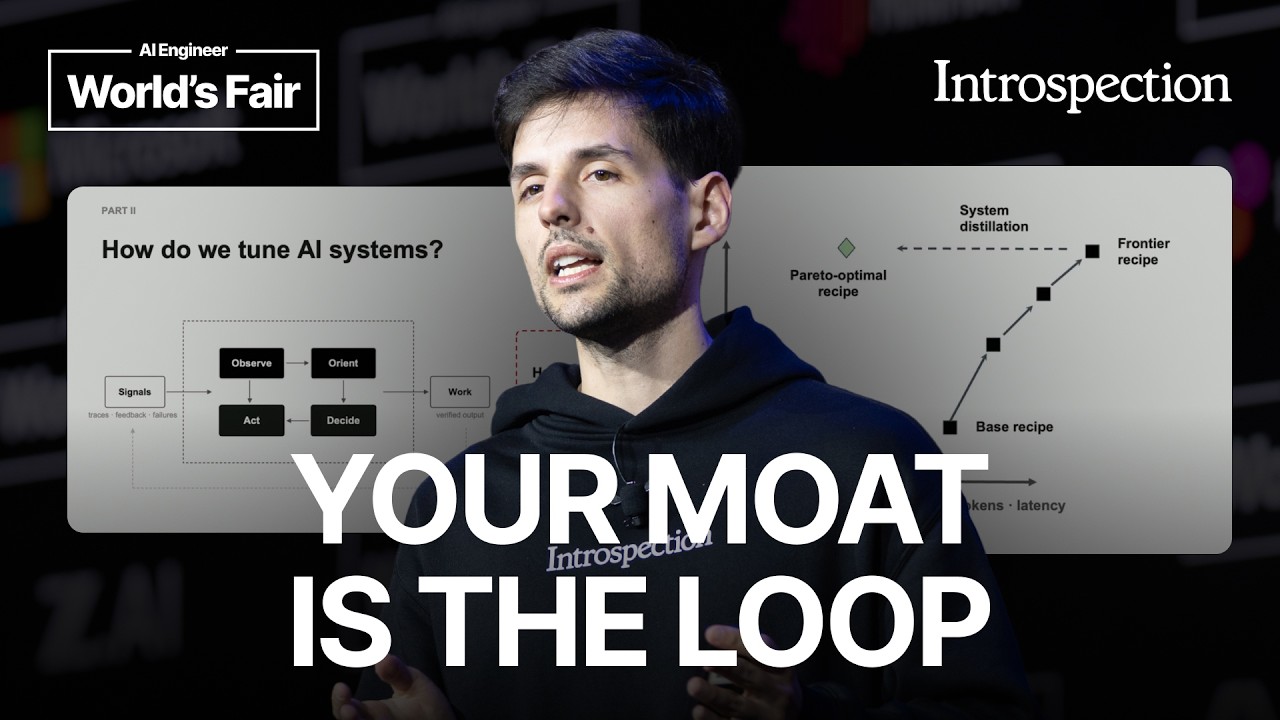
Roland Gavrilescu opens with a provocation: the first viral agent loop was not a coding agent. It was AJ using OpenClaw (originally called Clawdbot) to haggle with car dealers. The loop pulled prices from Reddit, checked inventory, played dealers against each other, and locked in a car once a verifiable price target was hit. Roland uses this as the starting point for a 2026 blueprint for autoresearch built on three ideas. He explains that he and his co-founder left xAI, where they worked on agent infrastructure, because they believed the next stage of deploying always-on, long-running horizon tasks needs to be built as a standalone effort.
Idea 1: The loop is the product
Roland traces how the field’s focus has moved. First came RL and reasoning training for models, then harnesses, where the model became a commodity, and now loops, where the goal is to build systems that improve without humans touching code. The car-haggling loop followed four steps: find prices, find inventory, put dealers head-to-head, and have a verifiable way to know when the price is right before locking in the deal.
The conceptual root is the OODA loop (observe, orient, decide, act), a term coined by the US Air Force in the 1970s to describe how fighter pilots react in fast-paced environments. Roland argues that models, like humans, are trained around this pattern of calling tools and taking observations. When strong signals and verifiable outcomes sit at the ends of the loop, you get capable workers, such as coding agents. Two properties dominate performance. Signal quality determines the loop’s success rate, and the verifier determines whether a success is actually correct.
The second layer is what Roland calls looping the loop. The artifacts produced at the end of one loop become the signals for the next, which is how continuous improvement happens.
Idea 2: System distillation is the moat
Each loop generates useful information about harnesses, profiles, evals, models, resources, tools, and the environment. Roland argues this knowledge should be captured in a portable, versioned form. He draws an analogy to data recipes in RL research, where practitioners learned to iteratively adjust data mixes to counter behaviors like hallucination and reward hacking. In his view, nothing equivalent exists yet for harnesses or AI systems in general.
He proposes “agent recipes”: reproducible, versioned artifacts that encode what you learned about your agent. This includes evals, tweaks, and human judgment that were not predetermined at the start but emerged from observing the agent act in its environment. Recipes should be owned by the company, not tied to any model or provider. The distillation mapping he describes is concrete:
- Failure patterns become judges and evals.
- Repeated behavior becomes skills and prompts.
- User frustration becomes extensions and memories in the harness.
These recipes live in a git repo, so changes are tracked and agents can record how and why things changed. Roland describes the arrangement as owned by you but managed by your agents. Introspection positions itself as the company that generates these recipes, and its early release, Pi recipes, is built on the pi harness with Harbor for evals. He compares it to skills from 2025 but takes it a step further. Pi recipes cover how to codify taste into evals, how to run and improve those evals, how to decide which signals matter, which tools suit which models, and how to maintain different harness profiles for different models.
A central claim is that recipes encode the taste of the maker, not just the harness or the model. If you adopt someone else’s recipe, you should also be able to inherit how they arrived at it and why.
Idea 3: Valued work per watt
The third idea is the score to optimize. Roland points to the progression at Cursor and Cognition: first build the best product, then the best evals for it, then the best models using those artifacts. Code was the first domain where this worked, and he expects everything beyond customer support and legal research to follow the same path. Measuring the value you produce is the first step. Confirming that you are getting a good economic deal on that value is the second.
Roland describes the path as starting from a base harness and base evals, reaching the frontier only by running systems in production, and then making the result economically viable so you do not spend more than the value justifies. Fine-tuning APIs and infrastructure have abstracted away much of the mechanics. What is missing is the know-how for codifying taste into evals and validating it through experiments. He stresses that evals are not just tests. They capture the creator’s taste, and the open problem is making that taste portable enough that someone could reproduce it one-to-one. He connects this to RL, which can turn taste-makers into environments and evals so the taste can eventually move into model weights.
He separates roles clearly. The worker is the inner loop that generates artifacts. The judgment about what to change in those artifacts is the taste. That judgment produces candidate changes, which are recipe diffs, and those candidates are tested offline and then validated in production.
Worked example: a talent-sourcing agent
Roland’s baseline is a recruiting agent with web search, LinkedIn access, subagents of the kind popularized by Codex and Claude Code, and a system instruction defining the recruiter role. His point is that recruiting has no single definition of good. It depends on whose taste defines it.
- Spotting patterns: cluster traces to surface recurring behaviors or user frustrations. In this example, the agent tends to reach out to big-tech employees, even famous names like John Carmack, when a recruiter would really want hidden gems. This is a behavior nobody would think to codify in advance, which is why pattern discovery matters.
- Calibrating judges: build an agent that detects this pattern in trajectories and generates an eval for it. The human’s role is calibration rather than authorship. The person confirms that the judgment, favoring hidden gems over big-tech candidates, is the right one. Roland’s view is that agents can build the evals, and humans only need to validate them.
- Recipe candidates and promotion: the resulting changes are diffs to be tasted. They are tested offline with a good eval set, then A/B tested in production, where Roland suggests multi-armed bandit setups. A change is promoted only when the maker and the end users both agree the taste is good.
Takeaways
Roland closes with three points. First, the loop is the product. You automate yourself as a higher-level judge so that second-loop agents apply your judgment to the workers you push to production. Second, system distillation is the moat. Continuously injecting taste into workers, and having them self-verify and coordinate, is the most important thing to focus on, and the faster you do it, the faster you build a defensible vertical AI company. Third, valued work per watt is how you measure progress. The work must be valuable, and the economics must make sense, with a price difference large enough that users would switch away from tools like Claude Code to your offering. He invites vertical SaaS companies and agent labs to get in touch about running autoresearch-style labs around their own products.