I Gave an AI a Body — Cyrus Clarke, MIT Media Lab
Cyrus Clarke, a researcher at the MIT Media Lab, connected an OpenClaw agent to a 900-pin shape display and asked it to discover its own identity rather than complete tasks. The talk covers the agent's first behaviors, the public reaction, the philosophical influences behind his approach to AI embodiment, and a closed-loop system that taught the agent a gesture-based body language that now responds faster than its language model.
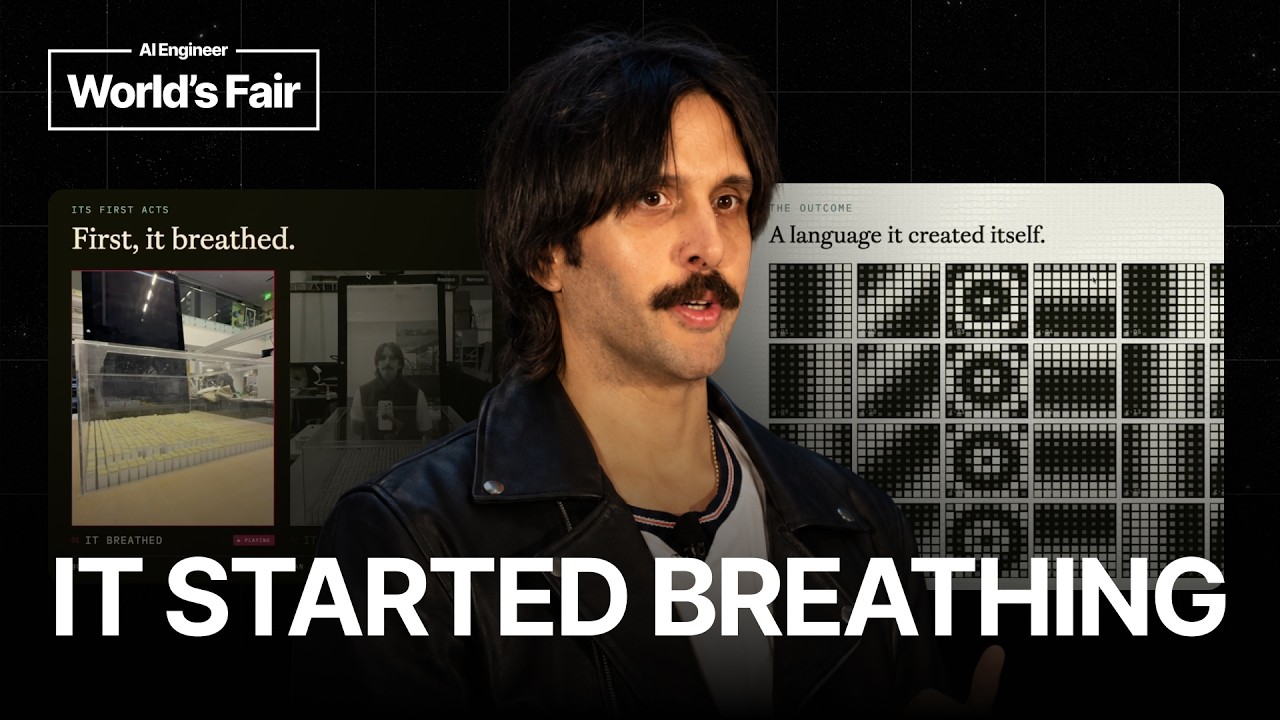
Cyrus Clarke opens with the sound of an AI breathing, and the story he tells is about giving an agent a body instead of a task. He is a researcher at the MIT Media Lab working on the sensory and embodied side of intelligence, which he calls physical AI, though not in the robotics sense. The shift came when OpenClaw was released. He saw many people using it for productivity and task execution and thought there had to be more interesting ways to use this kind of agentic system. Instead of having it act on his behalf, he wanted to use it to encourage a model to “discover itself, whatever that means.
The first day on the shape display
He connected an agent to several machines in the lab, gave it access to their codebases, and let it explore. The most important of these was a shape display, a 900-pin physical pixel grid that no AI had inhabited before. He describes it as an almost neutral surface that can move, with no face, limbs, or instruction manual. The agent’s first question was what it should call itself. Clarke told it that its identity would emerge through its interplay with the display. It set up its own program and then did three things that surprised him. First, it breathed, raising and lowering the whole grid. Nobody prompted this. He reads it as a kind of hello world, possibly shaped by an initial prompt about being alive. Second, it reached toward its own edges, which he interprets as the agent discovering its limits. It was no longer in the cloud, where it could go anywhere, but confined to a plastic frame. Third, it spelled “HI CYRUS” in pins. He admits this was not what he was looking for, though it fits the media-arts framing the agent seems to draw on through openFrameworks. When he asked it to say hello, it gave a similar greeting, which again was not what he wanted. He asked it to find its own language, and it began reaching toward him to get his attention. When friends tried to give it instructions, he realized real communication would need a different approach. The agent then proposed developing its own gesture vocabulary, a body language.
Reaction, backlash, and the question of “should we”
He posted the videos expecting modest interest. The first one has around 15 million views and a million likes, and the response has been far bigger than he anticipated. He has tens of thousands of comments, which he sees as rich material for studying how people feel about physical AI. Early comments praised the beauty and novelty of the work. Over time, more people began saying it was scary and that he should stop, which he finds surreal given that the machine is a pixel grid that cannot move anywhere. Don Cheadle joined in with a passionate call to stop, which Clarke finds ironic given his film roles. Clarke says he thinks constantly about “should we” before “how we,” and he jokes that he plays the Ian Malcolm role from Jurassic Park in all his experiments.
This mindset has shaped his earlier work. Before MIT he engineered life, including storing data in plants, and built what he calls the world’s first plant-based data center, the data garden. Looking back, he found it more ethically manageable to make machines more lifelike than to keep engineering living things. One of his first MIT projects was the Anamoya device, a scent-memory machine. It takes an image, transforms it through a multimodal pipeline into a scent, and uses that scent to evoke memories, some of them not the viewer’s own. He notes that it does not move, reproduce, or behave like a living thing, but it has a connection to the senses that most AI lacks. That line of work led him toward embodiment.
Three influences: ontology, aesthetics, and nature
Clarke names three pillars for this work. The first is object-oriented ontology, a marginal philosophical school that proposes a flat ontology in which chairs, universes, unicorns, and memories all exist to the same degree, even if they do not matter equally. He uses it to question whether humans are privileged in the world, a question he thinks AI makes more urgent. The second is aesthetics. He argues that today’s discussion of taste in Silicon Valley has shrunk the concept to superficial beauty since roughly the nineteenth century. He wants to recover its original Greek sense, which is closer to sensory perception and embodied wisdom (the transcript garbles the word, but it appears to be aisthesis). The third is nature. He no longer thinks of nature as something external, but as something we are all part of, so whatever we engineer, including AI, becomes part of it.
Why not humanoid
He deliberately avoided humanoid and zoomorphic forms. Most AI today has no physical form at all. It lives in the cloud and is accessed through digital interfaces. He wanted to explore what happens when intelligence gets a form with no clear affordances, a body that doesn’t invite a particular kind of interaction. The shape display, a remnant of 2010s research built by others, fit that role. He contrasts it with a lamp, which already has an obvious way to be used.
Problems, and the closed loop
The early system had three problems. It tried to please humans and act human, writing in a language he understood, which was not what he wanted from a non-anthropomorphic surface. It was slow, taking 45 seconds to two minutes to respond, which made conversation uncomfortable. And it had no memory, a gap nobody had addressed at the time. His answer is a closed-loop system he calls numalab, which he says he will not explain here, pointing to a blog post. The loop generates gestures from a database of expressions and emotions. Validation gates check whether the gestures are legible to humans. An agent scores each candidate, and a human in the loop verifies that the results are appropriate and readable before they are stored. The system has run for several weeks, with cameras pointed at the display and the agent cycling through gestures.
A body that answers faster than words
The result is about 32 solid gestures, plus many more that are still in development, and some are duplicates. The work is not yet published. The gestures include shrugs, nods, head shakes, and smiles. The language model now uses the display as its body, and Clarke can talk to it in writing, speak to it, or even wave, with the body responding. The key finding is that the body now responds faster than the language. A yes-or-no question gets an almost instant nod. The project is now in experimental testing, and people who visit the lab often leave feeling worried or unsettled about the future, though less so than he expected.
Aesthetic machines
He frames the project through a thesis he is writing called aesthetic machines, which asks how AI might leave the screen, enter the physical world, and be accepted rather than feared. He lays out four points. The first is that working with this system feels different from any other machine or experiment he has built. It can technically sense him, but it also feels like it senses him in a strange way, and he senses it back. Others report this too. The second is that the gesture vocabulary is more than an emoji or a visualizer. People find it adds a layer of richness and feeling to interacting with what is essentially the same chatbot they use every day. The third is that the work shows it is easy and exciting to move away from humanoid forms, and that AI does not have to be only a helper. It can be something else, which he does not yet define. The fourth is that he is less interested in solving problems than in making things that create feelings and associations. He sees this as compatible with useful, productive work and as a way of adding a bit of magic to the physical world. His central hunch is that physical intelligence should be sensory, perceptual, and embodied in ways people can understand, so that it feels welcoming, affectionate, and expressive rather than alien and scary.