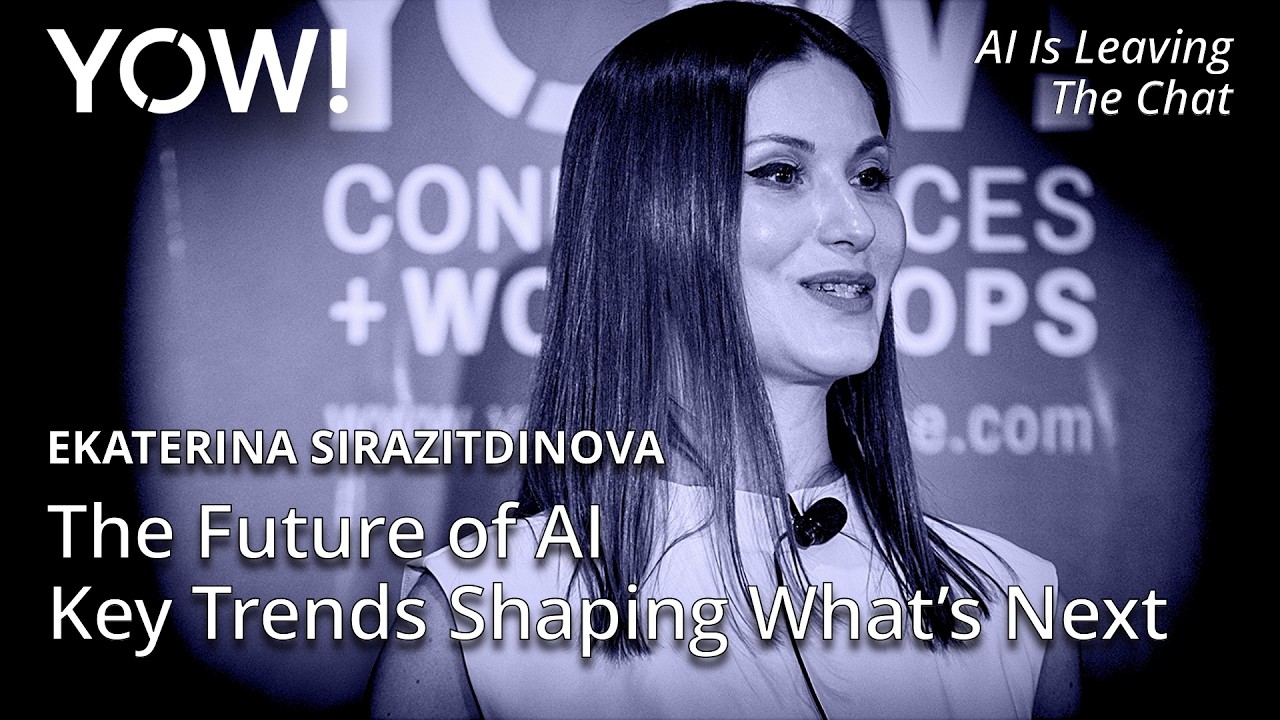
The Future of AI – Key Trends Shaping What’s Next • Ekaterina Sirazitdinova • YOW! 2025
Ekaterina Sirazitdinova from NVIDIA provides a high-level overview of the latest trends shaping the future of AI, covering the evolution from early deep learning to the rise of agentic and physical AI, and diving deep into the critical optimization techniques required to deploy these powerful models efficiently.
The field of Artificial Intelligence is evolving at an unprecedented pace, moving beyond simple classification tasks to complex reasoning and physical interaction. This rapid progress means that professionals, especially developers, must adapt. The question is not whether AI will replace jobs, but rather that professionals who leverage AI will replace those who do not.
The Journey from Image Recognition to Agentic AI
The modern AI boom can be traced back to 2012, when a convolutional neural network running on a GPU revolutionized the field of image processing. This pivotal moment unlocked advancements in computer vision, speech processing, and recommender systems.
A second major milestone occurred in 2017 with the publication of the “Attention Is All You Need” paper, which introduced the Transformer architecture. This architecture is the foundation of modern generative AI and led to the creation of models like ChatGPT, which made the technology accessible to a global audience.
Early generative models had significant drawbacks, such as hallucinations and a lack of explainability. However, the research community quickly developed solutions like Retrieval-Augmented Generation (RAG) to improve reliability. This has led to the current era of Agentic AI, where models can use tools, connect to databases, and perform complex tasks. The next major frontier is Physical AI, where AI systems will interact with and manipulate objects in the physical world.
Scaling Laws: The Engine of AI Progress
The dramatic improvement in AI capabilities is driven by a series of scaling laws:
- Pre-training Scaling Law: This was the initial discovery that increasing a model’s parameters, training data, and compute power directly correlates with increased intelligence. However, this approach is not sustainable due to the enormous energy and resource consumption.
- Post-training Scaling Law: This law focuses on making existing foundation models smarter without increasing their size. Techniques include fine-tuning for specific tasks, Reinforcement Learning with Human Feedback (RLHF), and integrating RAG systems.
- Task Scaling / Reasoning Law: A more recent discovery is that allowing a model to “think” through a problem by generating intermediate steps or reasoning with itself leads to more intelligent and accurate responses. This is the core of agentic reasoning. For example, when asked to count the letters in “strawberry,” a modern model decomposes the task and performs the simple arithmetic, whereas older models might write a long, irrelevant essay.
To manage the computational cost of this reasoning process, developers can set a reasoning token budget, which limits the depth of the model’s thought process, allowing for a trade-off between response quality and cost.
Multimodal and Physical AI
Modern AI is inherently multimodal. The core principle is that any form of information—text, images, code, video, even 3D coordinates—can be converted into numerical representations called embeddings. Once in this format, AI can learn patterns and generate new data in any modality. This enables advanced reasoning agents that can understand and interact with the world through a combination of vision, text, and speech, leading to applications in task planning, warehouse optimization, and real-time video analysis.
This multimodality is the foundation for Physical AI, which aims to create autonomous systems like robots that can handle objects and navigate the physical world. The primary challenge is moving from simple automation (following pre-programmed rules) to true autonomy (making independent decisions and reacting to the environment).
Developing physical AI is difficult due to two main reasons:
- Data Scarcity: Collecting vast amounts of real-world interaction data for training is impractical and expensive.
- Testing Risks: Testing large, powerful robots in the real world is dangerous and costly.
The solution is simulation. By creating digital twins of environments, developers can generate vast quantities of synthetic data to train models. Techniques like domain randomization (varying textures, lighting, and shapes in the simulation) ensure the AI is robust and can generalize to the real world. NVIDIA’s Cosmos world foundation models are designed to facilitate this by helping generate synthetic data and providing reasoning capabilities for physical agents.
The Critical Need for Model Optimization
As AI models grow, optimizing them for deployment becomes essential. Optimization focuses on three key metrics:
- Latency: The time to get a response. Critical for applications like autonomous driving, financial trading, and remote surgery.
- Throughput: The number of users that can be served simultaneously.
- Model Footprint: The size of the model in memory. Crucial for on-device deployment (edge AI), environments with no connectivity (e.g., mining), and applications requiring data privacy.
Several techniques are used to achieve these optimizations:
- Model Distillation: A smaller “student” model is trained to mimic the behavior of a larger, more capable “teacher” model, effectively transferring knowledge into a more compact form.
- Speculative Decoding: A small, fast “draft” model generates potential outputs, which are then verified by a larger, more accurate model. This significantly speeds up the generation process.
- Quantization: This involves reducing the numerical precision of the model’s weights and activations (e.g., from 32-bit floating-point to 8-bit integers). This shrinks the model’s size and speeds up computation, with techniques like calibration or quantization-aware training used to minimize accuracy loss.
- Disaggregated Serving: This advanced technique separates the transformer inference process into two phases: the prefill phase (processing the input prompt in parallel) and the decode phase (generating the output token by token sequentially). By running these phases on different, specialized hardware, providers can optimize for both prefill-heavy tasks (like document summarization) and decode-heavy tasks (like generating a long story).
Tools like NVIDIA TensorRT-LLM and NVIDIA Dynamo are open-source libraries that implement these state-of-the-art optimization and serving techniques, making it easier for developers to deploy large models efficiently.