Model optimization

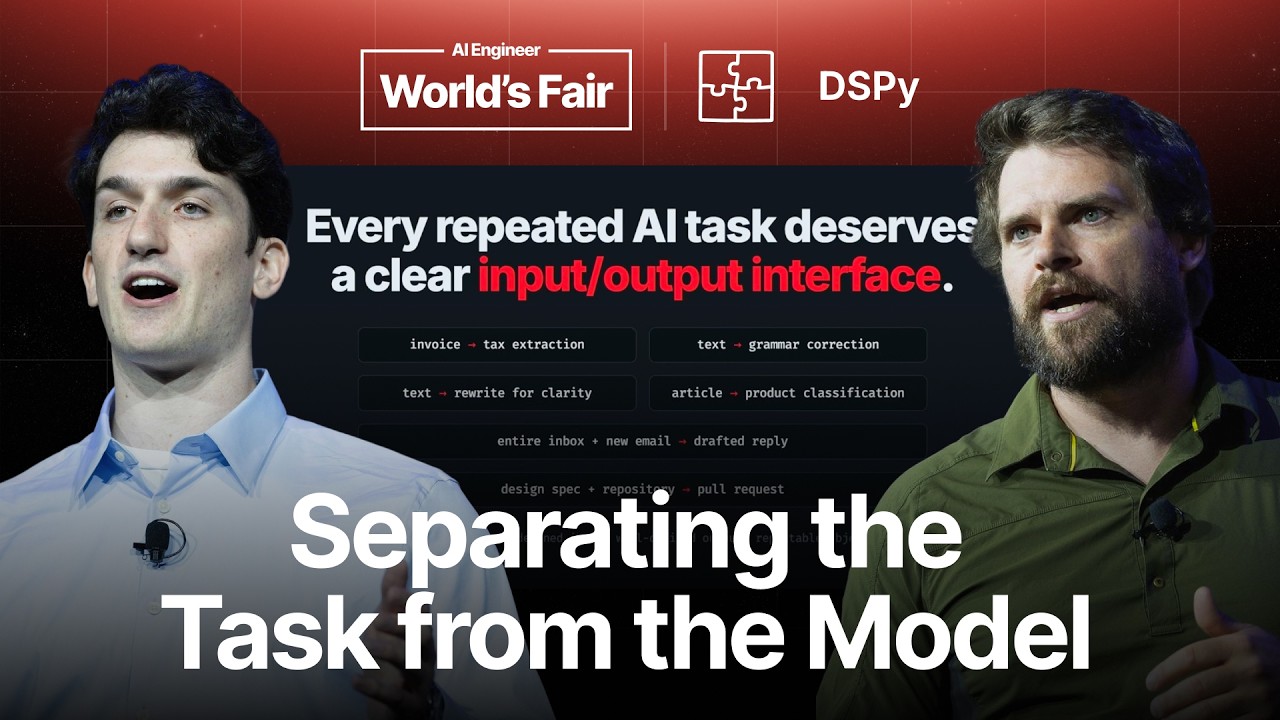
The Unreasonable Effectiveness of Separating the Task from the Model — Maxime Rivest, DSPy

The Unreasonable Effectiveness of Separating the Task from the Model — Maxime Rivest, DSPy

DSPy emphasizes separating task definition from model implementation using a "Signature" (inputs/outputs) to enable flexible, optimizable, and scalable AI programs. The framework relies on three pillars—instructions (specs), hard constraints (code), and examples (evals)—to fully specify tasks. DSPy 4.0 introduces DSPy Flex for learning program harnesses and Qualitative Learning for automated, feedback-driven evaluation refinement, offering significant benefits for enterprise applications and addressing "last-mile learning" for future AI systems.

Your Agents Need a Save Button - Hamza Tahir, ZenML

Your Agents Need a Save Button - Hamza Tahir, ZenML

Most AI agents lack a "save button" for persistent state, making debugging and optimization challenging. This talk introduces the concept of a durable runtime with checkpointing, allowing developers to replay agent executions, perform "what-if" analyses (e.g., swapping models, mocking tools), and conduct cohort-based evaluations using production data. The open-source tool Kitaru is demonstrated as a solution to build, debug, and improve agents at scale by capturing full execution state, not just traces.

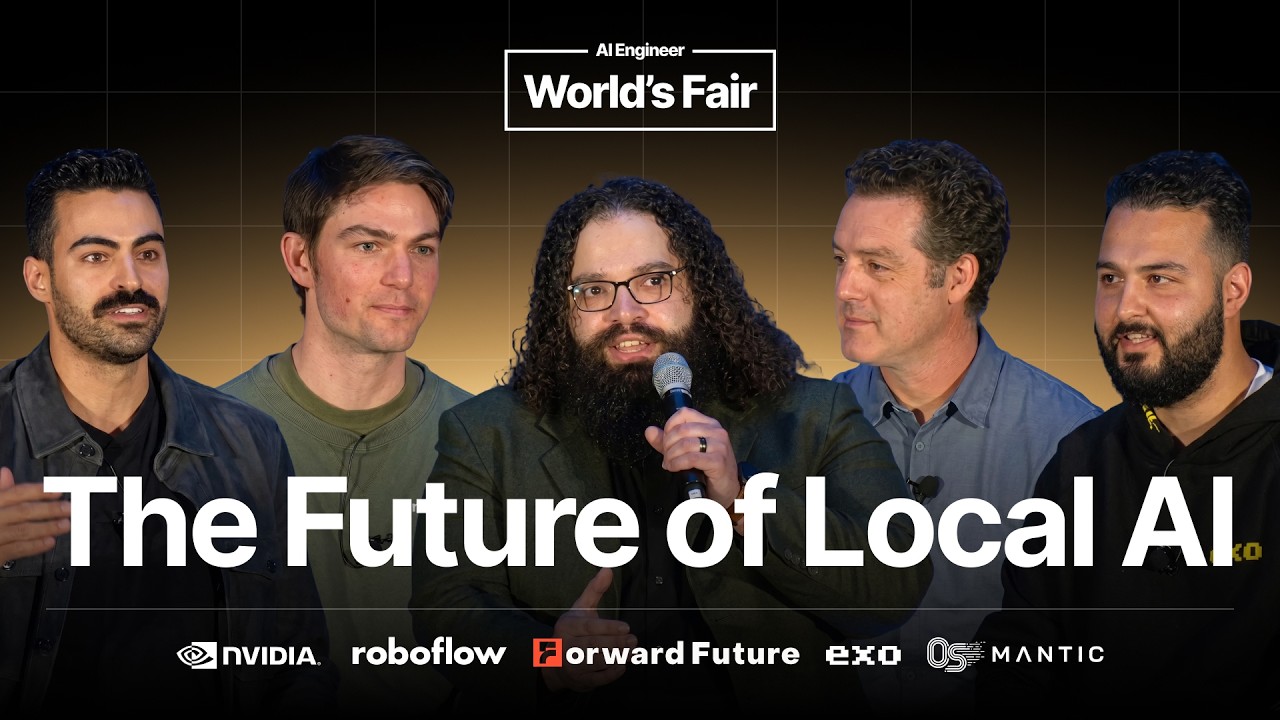
State of the Union: Why Local, Why Now — NVIDIA, Osmantic, Roboflow, EXO Labs, @matthew_berman

State of the Union: Why Local, Why Now — NVIDIA, Osmantic, Roboflow, EXO Labs, @matthew_berman

This panel discussion explores the inflection point of Local AI, driven by advanced models, improved hardware, and a robust ecosystem. Experts discuss how this shift addresses critical concerns around privacy, cost, sovereignty, and resilience, emphasizing the pivotal role of open-source AI and specialized models. They delve into technical optimizations, the evolution from generalized to specialized AI, and the challenges of making local AI accessible and performant for both enterprise and individual users.

You Might Not Need 50 Diffusion Steps — Ziv Ilan, Nvidia

You Might Not Need 50 Diffusion Steps — Ziv Ilan, Nvidia

Ziv Ilan from NVIDIA details how latency in video diffusion models can be drastically reduced to achieve real-time generation. He presents a layered approach combining dynamic quantization for memory and speed, chunk-based caching to skip redundant denoising computations, and, most critically, step distillation—training models to achieve high-quality output in significantly fewer steps. These techniques, packaged in the open-source FastGen repository, offer additive performance gains, enabling real-time video on a single Blackwell B200 GPU.

The Future of AI – Key Trends Shaping What’s Next • Ekaterina Sirazitdinova • YOW! 2025

The Future of AI – Key Trends Shaping What’s Next • Ekaterina Sirazitdinova • YOW! 2025

Ekaterina Sirazitdinova from NVIDIA provides a high-level overview of the latest trends shaping the future of AI, covering the evolution from early deep learning to the rise of agentic and physical AI, and diving deep into the critical optimization techniques required to deploy these powerful models efficiently.

Small Language Models are the Future of Agentic AI Reading Group

Small Language Models are the Future of Agentic AI Reading Group

This paper challenges the prevailing "bigger is better" narrative in AI, arguing that Small Language Models (SLMs) are not just sufficient but often superior for agentic AI tasks due to their efficiency, speed, and specialization. The discussion explores the paper's core arguments, counterarguments, and the practical implications of adopting a hybrid LLM-SLM approach.