How we built Grok Bot in a month | Roman Ugarte (SpaceXAI)
Roman Ugarte, a key figure behind Grok Bot, shares insights into its rapid development, emphasizing the strategic choice to build it as a separate, cloud-first product with bots having their own dedicated 'computers.' The discussion highlights a "colleague-pilled" product philosophy focused on full delegation and constant reinvention, enabling the creation of autonomous AI teammates for both work and personal life.
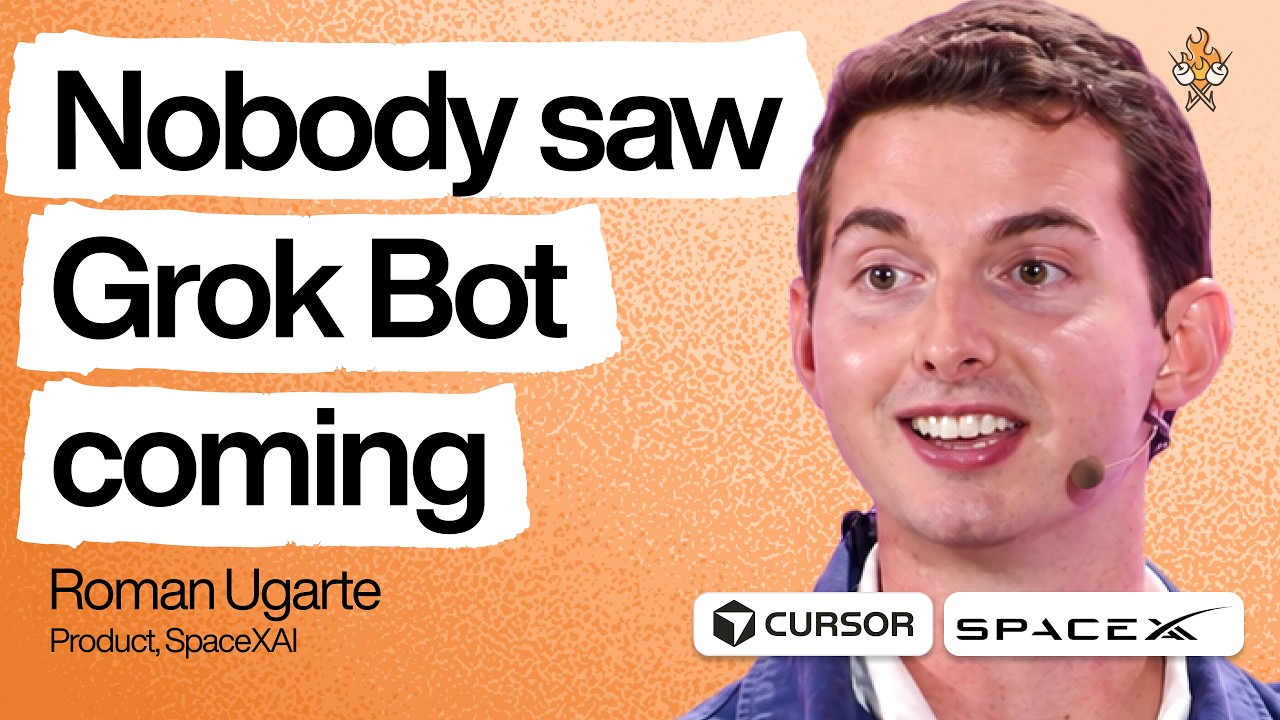
Roman Ugarte, who helped incubate and build Grok Bot at SpaceX AI, discusses the rapid development, core philosophy, and strategic decisions behind its success. Grok Bot was conceived as a knowledge-work agent, born from a desire to expand beyond developer-centric products. A small, isolated team developed the initial prototype from the first line of code to a working internal product in just four weeks.
Key Strategic Decisions and Development
Building from Scratch
A critical early decision was to build Grok Bot as a completely separate product rather than integrating it into Cursor. This allowed the team to create a clean, consistent vision for knowledge work without the baggage of existing product associations or cluttered interfaces, avoiding the “shipping your org chart” pitfall.
Manual Onboarding and User Feedback
Initially, Roman’s team manually onboarded 200-300 early users, including influential figures. This hands-on approach provided invaluable direct feedback, revealing user pain points and emerging patterns that were not evident during internal dogfooding. For instance, they observed users naturally developing a “chief of staff bot” pattern, where one primary bot delegated tasks to other specialized bots, which later informed product direction without explicitly imposing it.
Hiding Internal Mechanics
Unlike many AI tools that expose tool calls, chain-of-thought, or internal processes, Grok Bot deliberately abstracts these mechanics. The philosophy is that users don’t need to see every action, similar to how one wouldn’t micromanage a human colleague. The focus is on the bot just doing the task, providing progressive updates as needed, and maintaining a simple, clean interface. Feedback confirmed users preferred this approach over verbose internal logs.
“Unshipping” and Simplification
Between the internal beta and public launch (a mere three weeks), a significant effort was made to “unship” features and ruthlessly simplify the product. The team prioritized removing anything users didn’t actively need to think about. They adopted a philosophy of “Grok Bot can now” (referring to new capabilities) rather than “Grok Bot now has” (referring to new buttons or features), emphasizing impact over added complexity.
Core Product Philosophy and Architecture
Two Critical Early Decisions:
- Cloud-First Architecture: Grok Bot was designed from the ground up to be cloud-native, ensuring agents are persistent, always-on, and accessible from any device. This means bots don’t require the user’s local machine to be awake and can run independently, acting as an “entity that lives separately from your device.”
- Bots Have Their Own “Computer”: Grok Bot agents are given their own virtual computer, allowing them to interact with the digital world by clicking pixels, typing, and using tools just like a human. This addresses the limitation of APIs and enables full delegation for tasks that lack well-supported interfaces. This also prevents the inefficient and insecure practice of having AI agents share the user’s primary computer and credentials.
The “Colleague-Pilled” Framework
SpaceX AI’s product philosophy for Grok Bot is to treat AI as colleagues or teammates. When making product decisions, the team asks: “How would a human do this?” or “What would you want from your teammate in this situation?” This framework guides the development towards more natural, conversational interactions, such as anticipating the need for quick voice huddles for collaboration.
Vision: A Team of AI Colleagues
The ultimate vision for Grok Bot is to provide users with a team of AI bots that assist with both work and personal life. These bots are autonomous, require minimal micromanagement, and have access to the necessary tools to perform ambitious tasks. They are long-lived agents with persistent memory, learning and growing smarter over time, rather than being short-lived, single-session chat interfaces. This enables advanced use cases like bots running other bots (e.g., a QA tester bot using Grok Bot itself for testing).
Grok Bot as an Infovore and Chief of Staff
Users are leveraging Grok Bot to consume and synthesize vast quantities of information (e.g., social media mentions, internal communications) and proactively deliver critical insights or take action. This “infovore” capability can transform a bot into a “chief of staff” that guards the user’s focus, only paging them for truly urgent matters.
Business and Organizational Insights
SpaceX AI Pillars
SpaceX AI operates across three main pillars:
- Coding Products: Primarily Cursor and Grok Build, focusing on professional development surfaces.
- General Knowledge Work: Led by Grok Bot, aiming to transform how all knowledge workers interact with AI.
- Model Effort: Training the world’s smartest models with a strong focus on practical, useful AI rather than abstract superintelligence.
True Delegation: 100% vs. 90%
Roman emphasizes that an AI that completes “100% of the job feels categorically different from one that gets you 90% there.” Grok Bot aims for true delegation, where a task can be given to AI with full trust, freeing the human from constant oversight or intervention, an experience previously more common for engineers.
Speed and Startup Culture
The team maintains a rapid pace of execution, fostering a “startup feeling” even within a larger organization. Key cultural values contributing to this include:
- “Deleting the product”: A willingness to remove features and reinvent the product to adapt to evolving AI capabilities and user needs.
- “Just do the thing”: Empowering individuals to take initiative and fix problems without needing extensive permission.
Moats: Discovered, Not Planned
Cursor’s success in a highly competitive market, often against much larger players, highlights that moats are often discovered through relentless product development rather than planned. The strategy involves obsessing over building useful things today, pulling future capabilities into the present, and constantly updating beliefs to meet the rapidly changing AI landscape. This creates user trust and loyalty, which in turn generates distribution and data advantages.