AI’s third era: the rise of persistent AI coworkers | Tara Seshan (OpenAI’s product lead)
Tara Seshan, who leads product for Codex and ChatGPT Work at OpenAI, explores how AI is shifting knowledge work from rowing to steering, why ambition and human judgment are becoming key differentiators, how to build for models two to three months ahead, and how writing as thinking still matters. The conversation also covers OpenAI's founder-led culture, the design of Work mode, and practical uses like Sites and visualize.
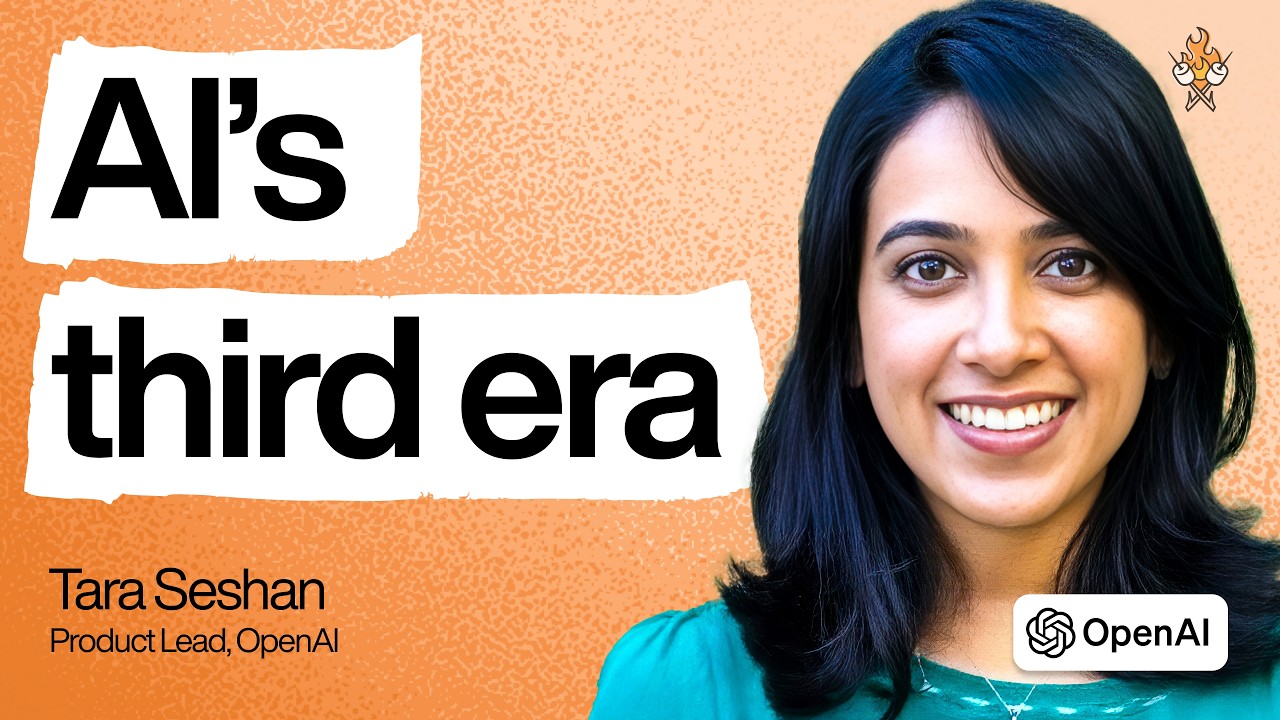
Tara Seshan on Codex, ChatGPT Work, and the Shift from Rowing to Steering
The Shift From Rowing to Steering
Tara opens with a framing of three eras of AI products: chat, then agents, and a third era of persistent co-workers who get things done alongside you. Her core claim is that the future of work looks more like steering than rowing. Agents will handle the execution (the “rowing”), while the human increasingly sets direction, makes opinionated calls, and interprets feedback and data. She notes that steering keeps moving up layers of abstraction, from writing a line of code, to directing a task, to setting goals, but that it still rests on a person deciding where the ship should point. She argues we underrate intuition and a deliberate picture of the future as sources of value, and that this opinionated, artistic element is what will differentiate people when everyone has access to the same tools.
She draws an analogy between software and film rather than real estate. Money put into software does not guarantee a good product, just as a large budget does not guarantee a great film. Authorship, taste, and something interesting to say are what matter. This ties to Marty Cagan’s point that the first idea for a product is rarely the one that ships; the team has to work through a process to figure out what it should actually be.
Writing, Thinking, and Hypothesis-Driven Work
A major thread concerns the PM job itself. Tara says that in a fast, emergent market, being empirical and prolific matters far more than being academic or theoretical. She describes moving away from long reasoning docs, which resemble a PhD thesis, toward getting something testable in front of users as fast as possible. The key skill becomes defining the core hypothesis, the single most important thing to test, which she links to the “big question” idea she attributes to Shishir Mehrotra. She frames the PM job as synthesizing understanding of users, market, and technology into the sharpest possible hypothesis, then running a fast, effective test and feeding results back into the loop. In her view, this loop is no longer just a PM concern; engineers, designers, data scientists, and engineering managers are all converging on it.
On writing, she separates writing as reporting, which she is happy to automate with models, from writing as thinking, which she insists on doing herself. She cites a manager’s advice to bring a doc to roughly 70 percent completion and then refine it with the people whose buy-in is needed, since polished finished ideas leave little room for collaboration. She also notes that long docs no longer signal thought, because anyone can generate one, so she now shares prototypes, mocks, and experimental results, and keeps docs mainly for her own thinking. Her guardrail against cognitive atrophy is to write the first draft and the substance herself, and to only use models for research, summarization, or pushback on ideas.
Ambition as the New Bottleneck
Tara argues that AI does not just automate existing tasks but widens the set of things people can attempt. The old “unicorn” who combined product sense, engineering, and design now has many more people with access to that capacity. She points to Patrick Collison’s list of unreasonably fast projects as a model: many of them existed before the tools, and now the set of achievable projects should grow dramatically. The hardest part, she says, is expanding one’s thinking and remembering to try the tool at all, which is a new habit to build.
This leads to a reframing of the PM role. Elevating others’ ambitions, reminding them what is possible, and asking whether the ceiling is higher than they assume is now a core part of the job. She calls out the team’s internal memes, “Is this maximally accelerated?” and “Are you mainlining it yet?”, as the twin tests of ambition and feedback tightness.
Building for Models Two to Three Months Out
A recurring principle is that building for current models fails, and building for where one hopes models will be in a year also fails. Only a two-to-three-month horizon works, and it requires tight coordination with research roadmaps to know which capabilities are being improved, such as coding or writing. She recalls Kevin Weil’s line that “this is the worst the models will ever be,” and treats it as both a cliché and an accurate, slightly absurd observation. Her practical implication is to get out of the model’s way in product constructs rather than over-engineering around present limitations.
OpenAI’s Culture and the Operating Model
Tara describes OpenAI as founder-led at the level of every individual. Top-down direction is limited, and people in each area act like founders close to the market. She was surprised that OpenAI is in fact “open”: strategy and product thinking quickly become public. She finds the speed from building to user contact unmatched. She also notes that the team behind the Codex app and desktop experience drove the product through intense dogfooding and tight iteration, and that the external change in perception came from the market catching up rather than from a change in internal operating mode.
On speed versus polish, she contrasts earlier companies, where polish was king, with the current moment, where shipping a transformative product early beats perfection. Iterating on the right signals, ideally before launch, matters most.
ChatGPT, Codex, and Work Mode
Tara explains the product landscape: ChatGPT chat, Codex, and Work mode. Her north star is that users should not have to choose between them, with the system picking the right harness and model automatically. Work mode is largely a UI layer over Codex, with coding-specific surfaces hidden, but it carries the same power. Corporate finance teams use it for complex financial models that previously required one expert. The separation exists to meet people where they are, but she states the goal is to merge these into one experience, since agents have transformed how developers work and should do the same for knowledge work.
She also addresses the consumer challenge of bringing agents to a billion chat users without requiring them to understand concepts like harnesses. Her view is that the third era of AI products will be persistent co-workers working collaboratively with people. The near-term task is introducing these agents to users who have never experienced them, in the easiest possible way.
Multiplayer Agents and the Infrastructure Behind Them
Tara describes a current habit of teams sharing screenshots of Codex threads in Slack, which she sees as unnatural. She envisions a multiplayer model in which people steer their agents together and agents coordinate with one another, with chat as a plausible interface. She stresses that practical infrastructure matters as much as intelligence: local agents have data access, while cloud agents need data connectors, cloud infrastructure, and reliability. An isolated agent is as useless as an isolated new hire who cannot access documents or Slack.
Roles Blurring and Where Humans Remain Valuable
Tara notes that startups and Stripe have long had few boundaries around roles, and that capability is only now catching up to that ethos. The key question is accountability: someone must own whether the product is used, wanted, high quality, and effective, regardless of their title. She admits she is still unsure whether losing the handcraft of a discipline, such as writing code by hand, costs people their craft, since parts of craft are being abstracted by models. She sees humans remaining essential for accountability, especially in regulated industries; for authorship and expression in what gets built; and for care, relationships, and collective decisions about ambition and learning.
Sites, Visualize, and Practical Uses
Tara describes building Sites, which she sees as a realization of malleable personal software, a dream attributed to Alan Kay. Sites can be generated from a prompt, hosted, shared privately or publicly, backed by data, and auto-updated. She has used them for a team game, a backpacking elevation route tracker, and presentations, which have largely replaced docs and sheets in her daily work. She also highlights the /visualize command in Codex for turning usage data and information into clear visual stories.
Knowledge Work Versus Coding
A useful distinction she draws is that code can be verified through tests and outputs, while knowledge work requires inspecting the process, inputs, citations, and reasoning. A deck showing 90 percent success is not believable without understanding how it was built. Product implications include showing in-progress work, citations, and reasoning in the thread UI, so that knowledge workers can see proof of work and collaborate with the model.
Sutter Hill and Product Marketing Fit
Tara’s time at Sutter Hill taught her that product-market fit is not a dark art but can be approached repeatably, and that product marketing fit, the positioning and narrative that precedes the product, is underrated. She now believes that a well-executed product marketing narrative can be the element that makes a company successful.
Lightning Round Highlights
She recommends William Finnegan’s Barbarian Days, which shows that one can be passionate about something without being good at it, and Anna Karenina, which she reread at several life stages and found to reveal different layers each time. She praises The Odyssey as a film about AI and the collapse of morality, and Rashomon as a model of creativity under constraint. She cites Tony Morrison’s essay on work, which says whatever the work is, do it well for yourself, and that you are not the work you do. Her Teal Fellowship experience was formative, and she recalls that the program’s 20-under-20 cohort included Dylan Field.