How OpenAI Built ChatGPT for Bankers and Analysts — Joseph Kim, OpenAI
Joseph Kim, who leads ChatGPT for Financial Services, explains the capability overhang, the gap between what models can do and the value professionals get from them at work. He covers the product built with Morgan Stanley and Evercore, why the team licensed and indexed financial data instead of relying on MCP connectors, how firm templates, charts, and citation viewers sit on the ChatGPT plugin platform, and his view of model progress, the threshold of usefulness, and three bets for finance in 2027.
Closing the Gap Between Model Capability and Real Work
Joseph Kim, who leads ChatGPT for Financial Services, centers his talk on what he calls the capability overhang: the distance between what models can do and the value professionals actually get from them day to day. ChatGPT for Financial Services launched about a month before the talk as a version of ChatGPT tailored to financial professionals, starting with investment banking and equity research. It was built with design partners Morgan Stanley and Evercore, and it aims to do for finance what Codex has done for software engineering.
What the Product Does
The team focused on three areas. The first is financial data, since the quality of the work is capped by the quality of the sources. The second is an interface that feels familiar to finance professionals, with ways to inspect source material, explore financial charts, and control which sources feed an analysis. The third is firm format. Financial work happens inside an organization, so the spreadsheets and presentations people produce have to follow firm-specific templates and standards.
Evidence From Codex Usage
Kim uses internal Codex data to illustrate the overhang. Engineers adopted Codex early, but finance, legal, and recruiting began the year with almost none of their AI output coming from Codex. By June, that share was around 90 percent. The sharpest inflection came around February and March 2026. Kim checked whether a new model had shipped at that point and found instead that the Codex desktop app had been released. His takeaway is that the product, not the model, unlocked the value for non-engineers, and that this is the opportunity in finance.
Licensing and Indexing Financial Data
The team found that existing MCP connectors for financial data suffered from latency, errors, and weak search quality. Instead, they licensed a large amount of financial data directly, covering financial statements, earnings transcripts, and market and private company data. They hosted it and built search indices on the same infrastructure as their web index. The product still uses MCP to give the model access, but owning the hosting and indexing gives more control over quality and reliability, and it allows post-training on these datasets.
Kim offers an analogy for the difference. MCP and skills are like handing a junior analyst an instruction manual. Post-training is like working with a senior analyst who has spent two decades with the data and knows its quirks. MCP and skills provide access and instructions, while post-training builds familiarity with the data itself.
Templates, Charts, and Citations
A template system gives users access to approved firm templates when generating Excel models and PowerPoint decks, which reduces the work needed to make an output ready for a team or client. Interactive financial charts let users explore stock prices and metrics inside the conversation as they work through an analysis. Citation viewers let people inspect the exact source passages and tables behind an answer, because in finance a number has to be traceable to its origin and its context.
Built on the Plugin Platform Developers Can Use
Kim emphasizes that these features were built on the ChatGPT plugin platform that is open to developers. MCP tools and connectors supply data, citation metadata and MCP apps let users inspect sources, MCP apps power the interactive charts, and skills combined with shared artifact tools guide financial workflows and generate Excel and PowerPoint outputs. Onboarding uses the native plugin onboarding experience. For builders, the implication is that unique data, an existing tool, or deep workflow expertise can be packaged as building blocks inside ChatGPT. Kim expects multiple billion-dollar businesses to be built purely as ChatGPT plugins, and he sees that opportunity growing as models improve.
Where Models Are Headed
Kim frames progress through three drivers: scaling compute, algorithmic improvement, and unhobbling, which means extracting more useful work from models. Pre-training scaling laws, which in 2022 and 2023 were the most visible driver, made performance surprisingly predictable. Researchers forecast GPT-4’s final loss and its coding eval performance before training finished. Algorithmic efficiency has also been steady, with one study finding that the compute needed to reach a given level of performance halved roughly every eight months. Reasoning, developed through reinforcement learning and post-training with more inference compute, became a second major driver in 2024 and 2025.
Kim also addresses concerns that once looked like hard limits. The feared data wall has been addressed through synthetic data, learning from verifiable rewards, and algorithms that extract more learning from each token. Context length has been tackled with sparse attention and compaction. He expects the trend lines to continue into 2027, with larger, more efficient, and more capable models, while acknowledging that alignment and safety remain difficult problems.
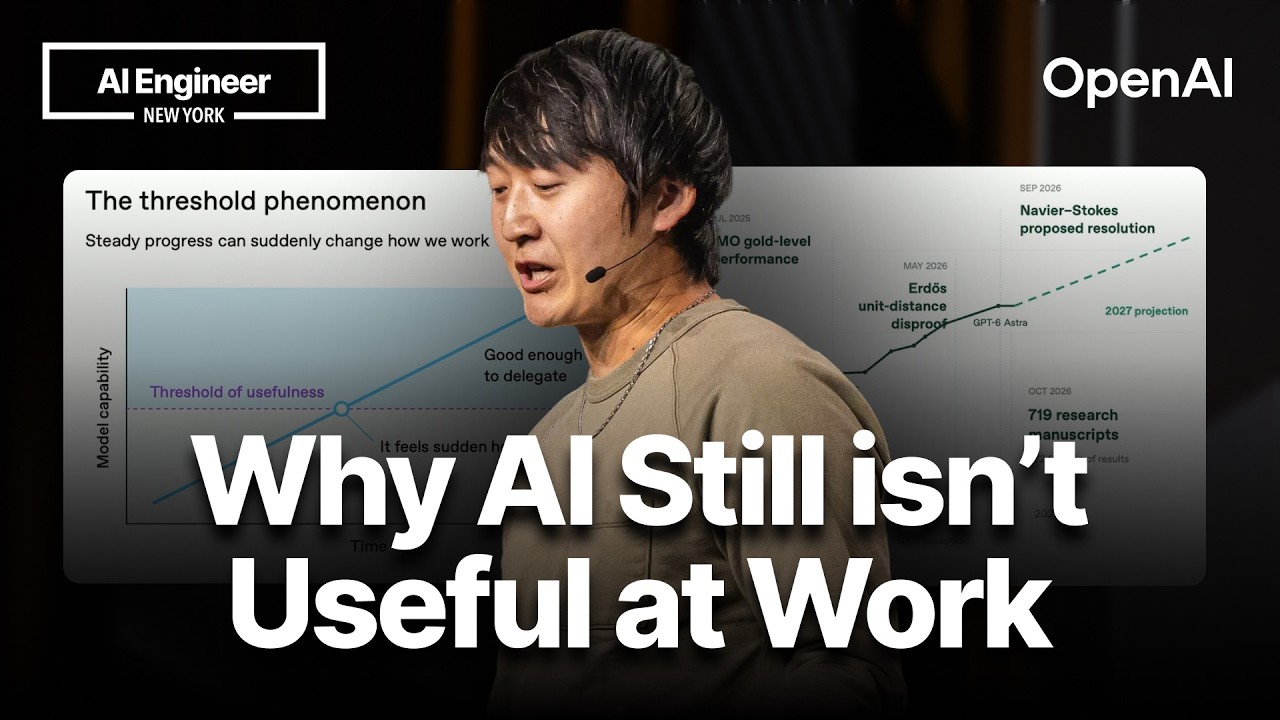
Mathematics serves as his illustration. In 2023, GPT-4 scored 700 out of 800 on the SAT math section. By 2025, an OpenAI model reached gold-medal level at the International Mathematical Olympiad. Early in 2026, an internal model disproved a conjecture that mathematicians had worked on since 1946, and another internal model proposed a solution to a Navier-Stokes Millennium Prize problem. Kim expects that if progress continues at the current pace, models will by the end of 2027 outperform leading human experts on a growing range of difficult tasks.
The Threshold of Usefulness
Kim argues that capability curves look gradual while the experience of work can feel sudden. Every task has a threshold of usefulness, the point where a model is reliable enough to save time, and that point depends on how much checking and review the task requires. Below the threshold, better answers and fewer mistakes may not change anyone’s practical assessment, because fixing the output still takes as long as doing the task yourself. Once the model crosses the threshold, review time becomes far smaller than the time saved, people start using it regularly, and eventually they delegate. The underlying improvement may be similar to the previous ones, but the progress has become useful. Because tasks have different thresholds, these moments will arrive at different times across different work.
Kim suggests a set of questions for builders: which capabilities are being underappreciated because they are not yet useful, where they might be in a year, and what product you would build if they became reliable enough to delegate. He also asks how the interface would change and what users would still need to control, review, or approve. Working on these design questions now means the right experiences will be ready when the threshold is crossed.
Finance-Specific Training
Kim describes two forces pushing financial work across the threshold. The first is a rising tide: general improvements in models, drawn from scaling and from transferable skills in mathematics, coding, and reasoning. The second is a set of waves on top. Kim’s team is investing heavily in finance-specific post-training to build on those broad capabilities. Over the next three months, the focus is financial reasoning, analysis of financial information, Excel modeling, and PowerPoint creation, which together make up much of a junior analyst’s daily work. Beyond that, the team plans to target the judgment of senior bankers, analysts, and investors, including synthesizing large amounts of information, forecasting earnings, assessing commodity prices, and evaluating investments. The stated goal is for models to match the best human experts on these tasks sometime in 2027.
Proactive, Persistent Agents
Kim sees the next form of unhobbling in proactive and persistent agents. Most AI interactions today begin when someone opens a conversation and issues a request. A persistent agent holds a goal, remembers relevant context, and keeps working in the background, making progress even when the user is not prompting it. Persistence also changes the way people work with an agent. Instead of learning new prompting workflows, a user can hand over a project, share context, and ask for an update, which is much closer to how people work with colleagues. That familiarity makes AI accessible to people who have not developed the specialized skills that current agents demand.
Three Bets for Finance in 2027
Kim closes with three expectations. First, people will rarely, if ever, rely on Excel and PowerPoint to build financial models or pitch decks. Second, AI financial analysts will feel like human coworkers, remembering preferences and context, taking ownership of assignments, following up proactively, and continuing to work while the user focuses elsewhere. Third, models will outperform the best human experts on economically critical forward-looking judgments, such as forecasting earnings and developing investment ideas. He leaves the audience with the question of what to start building today so they are ready for the thresholds the models will cross tomorrow.