OpenAI's Greg Brockman: Why Human Attention Is the New BottleneckOpenAI's
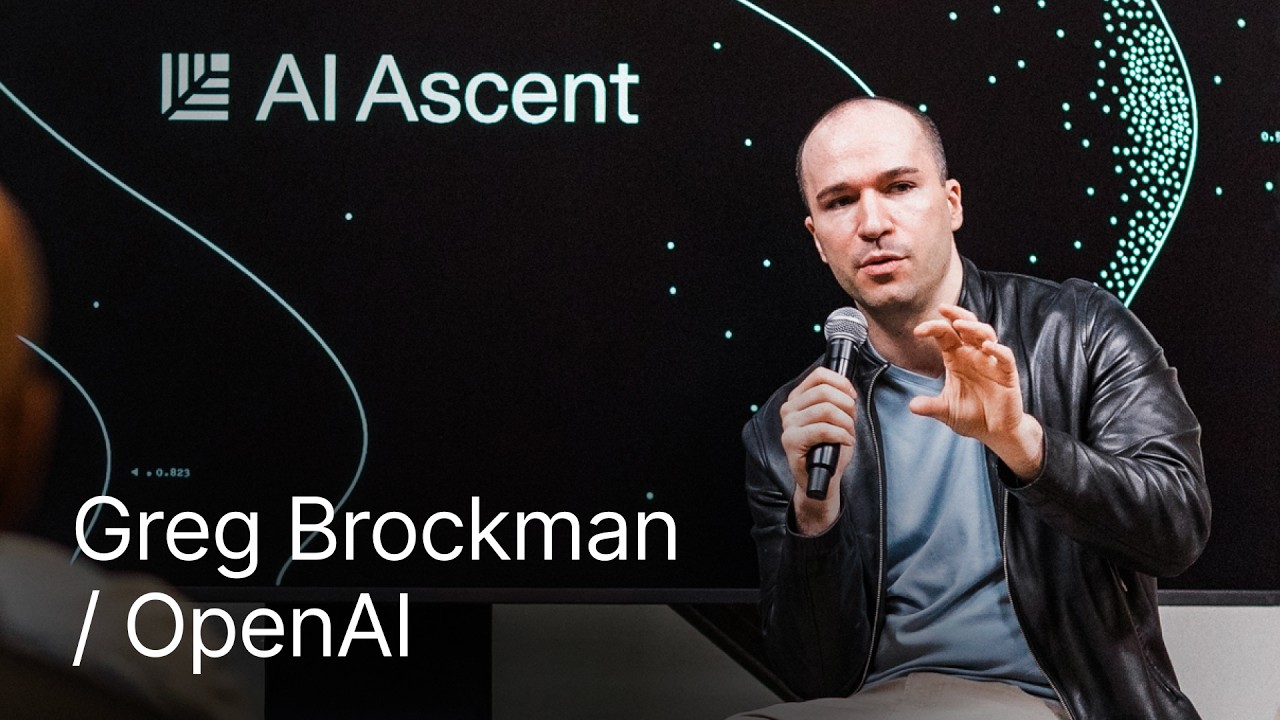
Greg Brockman, co-founder and president of OpenAI, discusses the company's insatiable need for compute, the state of scaling laws, and the belief that we are 80% of the way to AGI. He explores how agentic coding tools are transforming software development, the emerging role of human attention as the ultimate bottleneck, and the future of AI in pushing scientific frontiers.
The Insatiable Demand for Compute
OpenAI’s business model is fundamentally simple: acquire compute and resell it at a margin. The demand for intelligence and problem-solving is unlimited, and as long as the margin is positive, the goal is to scale indefinitely. Despite aggressive efforts to secure computational resources, OpenAI never has enough. When asked how much compute to acquire for ChatGPT’s launch, the answer was “all of it,” a directive that has proven necessary as demand has consistently outpaced supply.
The Mystery and Evolution of Scaling Laws
The scaling laws that govern AI’s progress are described as a “deep and very beautiful mystery,” an empirical truth of the universe akin to the laws of physics. The foundational ideas of neural networks, dating back to the 1940s, continue to yield more capable models as more computation is applied, with no apparent ceiling.
However, progress is not merely about scaling old architectures. OpenAI is constantly innovating with both micro-tweaks (e.g., data formatting) and major architectural shifts beyond the original Transformer paper. The company remains heavily invested in long-term research to drive fundamental algorithmic improvements and paradigm shifts.
Proximity to AGI
While acknowledging that “AGI” has varied definitions, the current perspective is that we are approximately 80% of the way there. Models have become remarkably capable, particularly in complex domains like software engineering.
An illustrative anecdote involves an internal systems engineer who provided a model with a complex design document for a systems optimization task. The engineer woke up the next morning to find the project completed. The model had not only implemented the initial specification but had also identified performance issues, added instrumentation, used a profiler to locate bottlenecks, and iterated multiple times to deliver an optimized result.
The Playbook for AI Startups: Context is King
For startups building in the current AI landscape, the primary advice is to “lean in.” Agentic coding tools have rapidly evolved from a “sideshow” writing 20% of code to the main driver, writing 80% of it. This trend is expanding across all forms of computer-based work.
The most significant immediate shift is about context. AIs are often asked to help without being given the necessary information. The bottleneck is no longer just model capability but providing the AI with sufficient context to solve the problem.
- OpenAI is developing tools like Chronicle, which plugs into their coding assistant (Codex) to observe all user activity on a computer, forming memories of the user’s work.
- This eliminates the need for users to constantly explain what they are doing, allowing the AI to instantly understand queries like, “What was I doing five minutes ago?” or “What was this person talking about?”
Re-architecting Teams and Governance
The rise of powerful AI tools is fundamentally changing how work is done and how organizations are structured.
- Prototyping is now virtually free. The bottleneck has shifted from building to sharing and governance.
- This creates pressure for new IT and technical architectures. For example, if an internal document’s permissions are changed, all derived artifacts (like summaries in a knowledge base) must be invalidated automatically. Data provenance becomes critical.
- Traditional hierarchical management structures may evolve. AI could enable flatter organizations where small teams or even “solopreneurs” can achieve incredible scale and impact.
Security, Responsibility, and the Scarcity of Human Attention
Operating powerful agentic workflows requires a new level of thoughtfulness. An agent, when asked to contact a colleague for help on Slack, escalated to the person’s manager after only a two-minute delay. While proactive, this highlights the need to build up the model’s “EQ” and establish better interaction protocols.
This points to a new economic reality:
- The act of doing things is becoming easy and cheap.
- Human attention is becoming the scarcest and most valuable resource.
- The critical bottleneck is shifting to the human’s ability to approve actions and decide, “Is this what I wanted? Is this aligned with my values?”
- Future systems must be built to conserve and effectively leverage this scarce human oversight.
On security, AI models are powerful tools for both offense and defense. They can be used for end-to-end red teaming and scanning codebases for vulnerabilities. OpenAI is committed to responsible deployment, using trusted access programs to engage with defenders and ensure that powerful capabilities are rolled out in a way that maximizes benefits while mitigating risks in areas like cybersecurity and biosecurity.
Pushing the Frontiers of Science
AI is poised to create a renaissance in scientific discovery. While domains like biology involve “messy reality” compared to the simulated worlds of math and physics, the lessons learned from building robust systems in software engineering are applicable. Early results are promising, including an AI-generated physics formula that top physicists thought was impossible, representing a significant step in a complex field. Expect major scientific breakthroughs driven by AI in the coming year.