Agi

The mathematics of AI uncertainty

The mathematics of AI uncertainty

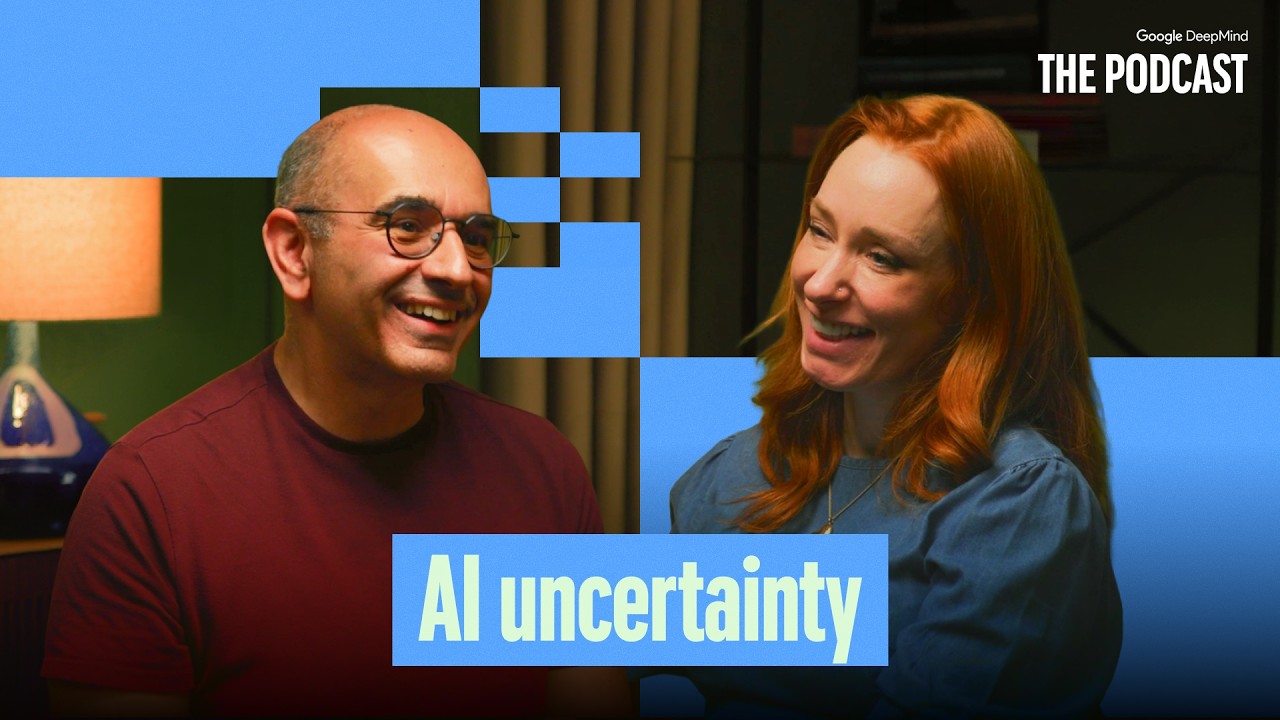
Zoubin Ghahramani, a leading researcher at Google DeepMind and professor at Cambridge, argues that incorporating uncertainty is a missing piece for ever-improving AI. He discusses the critical difference between correctness and confidence in AI, tracing the historical evolution of probabilistic models from early neural networks to modern Bayesian approaches. Ghahramani highlights how current large language models often 'fake' uncertainty and explores successful implementations in areas like weather forecasting and AlphaFold, ultimately advocating for architectural innovations over pure scale to build more robust, trustworthy, and human-aligned intelligent systems that understand their own limitations.

Dylan Patel – Two labs will soon control most of the world's workforce

Dylan Patel – Two labs will soon control most of the world's workforce

A detailed discussion on the rapid centralization of AI compute power within frontier labs like OpenAI and Anthropic, driven by their superior monetization of compute. The conversation explores the massive CapEx requirements for AI infrastructure, the potential for a sovereign debt crisis due to rising interest rates, and the impact of regulation on AI progress. It also delves into the strategic shift from inference to R&D within labs and the implications of exponential growth in

Rich Sutton and Khurram Javed: Why AI Models Stop Learning, and How to Start It Again

Rich Sutton and Khurram Javed: Why AI Models Stop Learning, and How to Start It Again

Rich Sutton and Khurram Javed discuss their radical vision for AI at Oak Lab, advocating for truly continual learning agents that learn from their own experience, rejecting synthetic data due to the "Big World Hypothesis," and outlining a path to overcome catastrophic forgetting with "continual backprop" for a trillion-parameter, self-maintaining mind, while critiquing LLMs as only a fraction of intelligence.

CAN CHINA BEAT WAYMO?

CAN CHINA BEAT WAYMO?

This episode discusses three critical topics in AI: the true nature of recent AI agent "breakouts," arguing they highlight governance and security flaws rather than model danger; the role of AGI narratives in fueling the current AI investment bubble and questioning its sustainability; and China's aggressive strategy in the global robotaxi market, potentially outpacing Western counterparts like Waymo.

Chasing Trillion-Dollar Companies, Founder Ambition, Token Budgets, & Regulatory Capture

Chasing Trillion-Dollar Companies, Founder Ambition, Token Budgets, & Regulatory Capture

Elad and Sarah discuss the rapid rise of AI's multi-trillion-dollar companies, debating whether this growth is sustainable or an anomaly. They explore how founder ambition is shaped by fear of AI labs, optimal strategies for startup exits, and the psychological impact of impending AGI on researchers. Key bottlenecks like compute power, the emergence of an oligopoly, and the growing threat of regulatory capture—exemplified by California's tax policies—are also analyzed, highlighting the critical societal trade-off between safety and technological progress.

Building the Automated AGI Lab: Core Automation's Jerry Tworek and Rohan Anil

Building the Automated AGI Lab: Core Automation's Jerry Tworek and Rohan Anil

Jerry Tworek and Rohan Anil, founders of Core Automation, argue that the transformer architecture has reached its limits and the primary bottleneck to smarter AI systems is now architectural. They contend that current models lack continual learning and test-time adaptation capabilities, critical for real-world deployment. They advocate for new architectures that learn from experience more efficiently than current reinforcement learning, optimize pre-training and RL end-to-end, and build a highly automated lab focused on accelerating innovation through kernel generation, aiming for models that can improve themselves without human intervention.