Agi

Sam Altman: "Never a Better Time to Do a Startup"

Sam Altman: "Never a Better Time to Do a Startup"

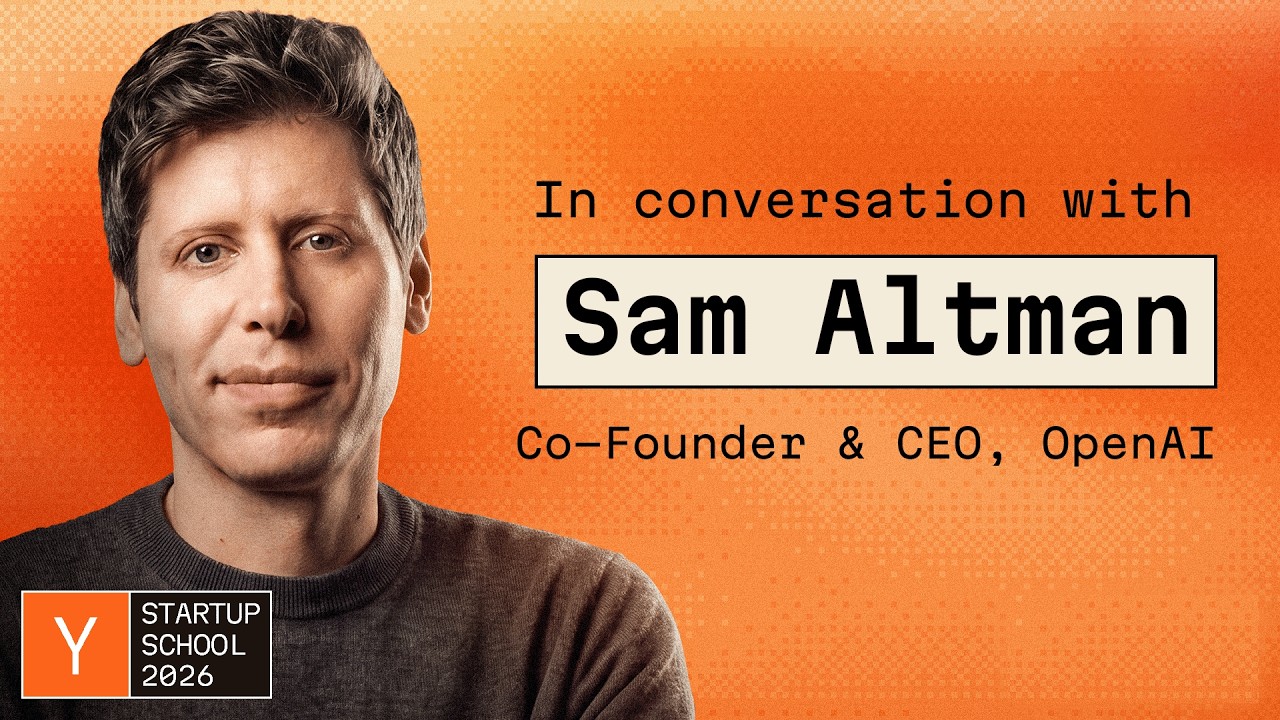
Sam Altman, co-founder and CEO of OpenAI, reflects on the evolution of startups from YC's first batch to the current AI-driven era. He discusses the unprecedented opportunities for ambitious founders, the critical role of startups in distributing AI's power, the importance of conviction against conventional wisdom, and the rapid advancements in AI models, while also addressing safety concerns and envisioning an optimistic future for human agency.

Coding Agents Are Secretly General Agents

Coding Agents Are Secretly General Agents

Jay Hack, head of AI at ClickUp, discusses the evolution of AI from early computer vision to generalist coding agents, highlighting how 'positive transfer' makes coding an 'AGI-complete' domain. He delves into the brutal economics of AI startups facing foundation model giants, ClickUp's strategy for convergence and first-party data as a moat, and the challenges of verifiability and catastrophic forgetting. The conversation also explores LLMs at the scientific frontier, the 'car wash test' revealing limits of world models, and speculative future applications like LLM resorts and game integration.

AI, Corporate Responsibility & Democratic Legitimacy: Extended Q&A • Joanna Bryson • GOTO 2025

AI, Corporate Responsibility & Democratic Legitimacy: Extended Q&A • Joanna Bryson • GOTO 2025

Joanna Bryson challenges popular AI assumptions, positing current generative AI as powerful tools for cultural knowledge compression, not autonomous intelligences. She emphasizes that AI's capabilities are nearing the human knowledge frontier, requiring focus on human coordination and governance. Bryson critically examines AI's impact on mental health and law, advocating for data-driven regulation and comprehensible systems. She calls for engineering activism, asserting human agency over technological determinism and stressing the importance of transparency and critical thinking in shaping AI's future.

AI Can't Learn The Way Humans Do - This Could Fix That

AI Can't Learn The Way Humans Do - This Could Fix That

This discussion explores world models as a promising path to solving sample efficiency in AI and achieving AGI. It contrasts deterministic control (Newtonian physics) with stochastic environments (RL), explaining the challenges posed by large action spaces in Go, self-driving, and robotics. The episode delves into how synthetic data, video diffusion models, and latent space architectures like JEPA are making world models practical, while also highlighting remaining open problems in physics modeling, real-time adaptation, and rich sensory integration.

Why AI Agents Don't Actually Understand You — Danielle Perszyk, Amazon AGI Lab

Why AI Agents Don't Actually Understand You — Danielle Perszyk, Amazon AGI Lab

Daniel from Amazon AGI Lab details a cognitive science-driven vision for human-aligned AI, focusing on collective intelligence, real-time interaction, and redefining reliability through user mind modeling. He emphasizes aligning AI representations with human cognition to foster generalization, prevent reduced human agency, and revolutionize areas like education, advocating for diverse AI systems and frontier research over immediate productization.

Understanding the inner thoughts of AI

Understanding the inner thoughts of AI

Neel Nanda, head of Google DeepMind's language model interpretability team, discusses the critical field of interpretability, likening it to the "neuroscience of AI." He explains why understanding the internal workings of "grown, not designed" neural networks is crucial for AI safety and scientific discovery. The episode explores cutting-edge techniques like Chain of Thought monitoring, mechanistic interpretability (steering and probing), and Sparse Autoencoders, highlighting their strengths and limitations in debugging, detecting deception, and uncovering hidden model objectives. Nanda emphasizes interpretability's role in building safe, aligned, and trustworthy AI as we approach AGI, acknowledging its pragmatic necessity despite inherent limits to full understanding.