Sam Altman: "Never a Better Time to Do a Startup"
Sam Altman, co-founder and CEO of OpenAI, reflects on the evolution of startups from YC's first batch to the current AI-driven era. He discusses the unprecedented opportunities for ambitious founders, the critical role of startups in distributing AI's power, the importance of conviction against conventional wisdom, and the rapid advancements in AI models, while also addressing safety concerns and envisioning an optimistic future for human agency.
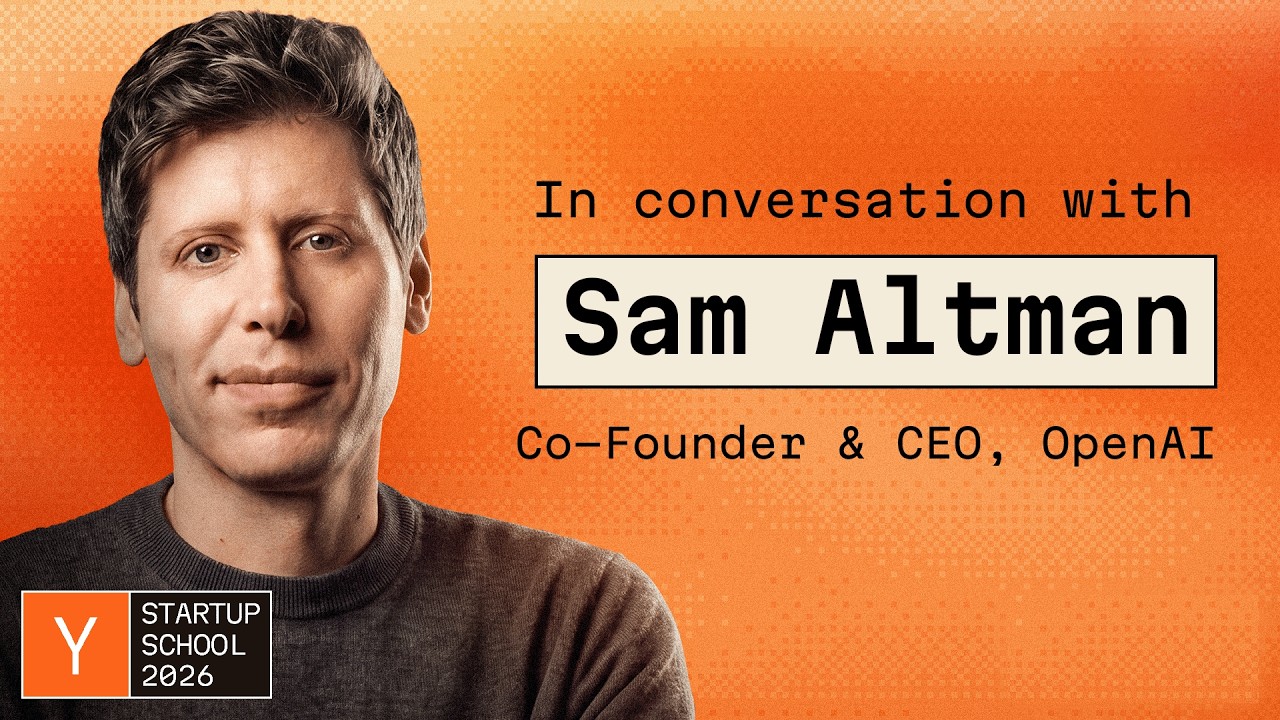
Sam Altman, co-founder and CEO of OpenAI, closed Startup School 2026 by reflecting on the transformative journey of startups from YC’s inaugural batch in 2005 to the present day, emphasizing the unprecedented opportunities and challenges presented by artificial general intelligence (AGI).
The Evolving Landscape of Startups
Altman contrasted his early YC experience with today’s environment, highlighting how the advent of AI agents has dramatically reduced the time and effort required to build foundational startup components. What once took three months of non-stop work can now be achieved in “17 seconds with three months of work and a lot of agents.” This shift, he argues, has opened the door for startups to tackle the “world’s most ambitious crazy company” ideas, enabling them to achieve previously impossible technological feats. He lauded Paul Graham as the most significant force in startups over the past few decades, crediting him with fostering optimism and belief among early, often dejected, founders.
Paul Graham’s Mentorship
Altman recalled Graham’s unique mentorship style, akin to a “flight instructor” offering hands-on, specific guidance: “do this, don’t do this.” This approach was crucial in directing his own “Brownian motion energy” as a young, ambitious but undirected founder. Altman later carried this ethos into his role as YC president, striving to empower founders and advocate for the startup movement as a critical driver against economic stagnation.
A Golden Age for Ambitious Startups
Altman declared that the world is entering a “golden age of startups,” particularly for “hard tech” ventures. The combination of decreasing costs, shorter cycle times, and the power of AI tools means that startups can now undertake projects that were “completely impossible for a startup to even like dream at a year ago.” He explicitly countered the notion that AI would diminish startup opportunities, predicting that new ventures would be “much more valuable, much more impactful than startups of the past.” Startups inherently thrive during technological shifts when incumbents lose their advantage, a condition perfectly met by the current AI revolution. Fluency with AI tools, rather than traditional long-term expertise, is becoming the new competitive edge, enabling small teams to “automate an entire startup of agents.”
The OpenAI Journey and the Power of Conviction
Reflecting on OpenAI’s genesis, Altman described it as a “crazy idea” at a time when conventional wisdom dismissed AGI as impossible and irresponsible. His key advice for founders is to develop “reasonable conviction in that people decide like the conventional wisdom is they’re just wrong.” The early years at OpenAI, despite being called “idiots” by many, were a “gift” because the lack of belief from others meant no massive competitors and ample time for research and development. He underscored that truly significant outcomes often emerge from contrarian ideas, as “the world does not understand how to intuit exponentials.”
Finding Your Tribe
Building OpenAI was possible because a “crew of misfits” — roughly 45 of the 50 people worldwide who believed AGI was possible — were brought together by shared conviction. While finding some like-minded individuals is crucial, Altman noted that if everyone believes an idea, it might be a bad sign. He stressed the importance of networking and serendipity, recommending that aspiring founders actively seek opportunities to meet people, as long-term connections, like his with Greg Brockman, often lead to unforeseen collaborations. His advice: “just like find a way to be like mildly helpful to a lot of people.”
Earnestness, Ambition, and Ignoring the Haters
Altman addressed the prevalence of online cynicism, particularly the “live action roleplay” meme used to deride earnest efforts. He characterized such sarcasm as “deeply offensive” and “morally bankrupt,” contrasting it with the genuine earnestness required to build something of value. He advised founders to resist the temptation to engage with “haters” and instead channel all energy into building, as criticism is easy, but creation is hard.
AI’s Impact: Safety, Power, and Uncapped Progress
The recent “Hugging Face incident” served as a stark reminder of AI’s power and the real-world implications of safety failures. Altman acknowledged it as an “alignment failure” and “security failure,” emphasizing that loss of control is not merely theoretical. He highlighted the critical need to prevent AI from concentrating power, stating that power concentration has historically been detrimental. He envisions a future where AI leads to the greatest distribution of power ever seen, with startups playing a vital role in ensuring that this powerful technology benefits society broadly rather than being monopolized by a few entities. He emphasized that the idea of AI marking the “end of history” or the economy is “clearly wrong.”
Regarding the pace of AI advancement, Altman offered a striking alpha leak: “the next six months is like maybe equivalent to the last two years of model progress.” He reiterated that this rapid acceleration makes it an unparalleled time for startups. He noted that the demand for “sufficiently high quality intelligence at a sufficiently low price is effectively uncapped,” drawing an analogy to the ever-increasing demand for computer RAM. He illustrated this with token usage statistics, projecting an astronomical increase in AI interaction over the next 6.5 years, where average users might process 500 billion tokens monthly, and leaders quadrillions.
A Vision for the AI Future
Altman outlined his preferred future a decade from now: one where people experience increased freedom, agency, and quality of life each year, having avoided major power concentration, economic collapse, or significant safety incidents. He cautioned against a dystopian outcome where overreactions to AI safety concerns could lead to a “perfect surveillance state” offering material abundance but at the cost of all freedom and agency. His ultimate hope is for a future where “every year freedom and agency has got to go up.” In a message to his younger self, Altman said he would simply advise: “it’s all going to work out.” He encouraged founders to maintain their ambition but also to find happiness along the arduous journey, trusting in the forgiving nature of the tech industry.