Raise the ceiling: how to scale intent, quality, and artistry with Al | Katie Dill (Stripe)
Katie Dill from Stripe discusses how the rapid advancements in AI risk leading to "zombie UI" – generic, uncared-for digital products. She draws parallels to post-WWII architecture, highlighting the dangers of building without intentionality or a clear point of view. Dill then offers four key recommendations for developers and designers to leverage AI not just for speed, but to create original, soulful, and user-centric products: defining a strong point of view, encoding quality standards directly into AI tools, embracing meticulous editing beyond the first AI-generated draft, and actively using AI to foster new forms of creativity and unique interfaces.
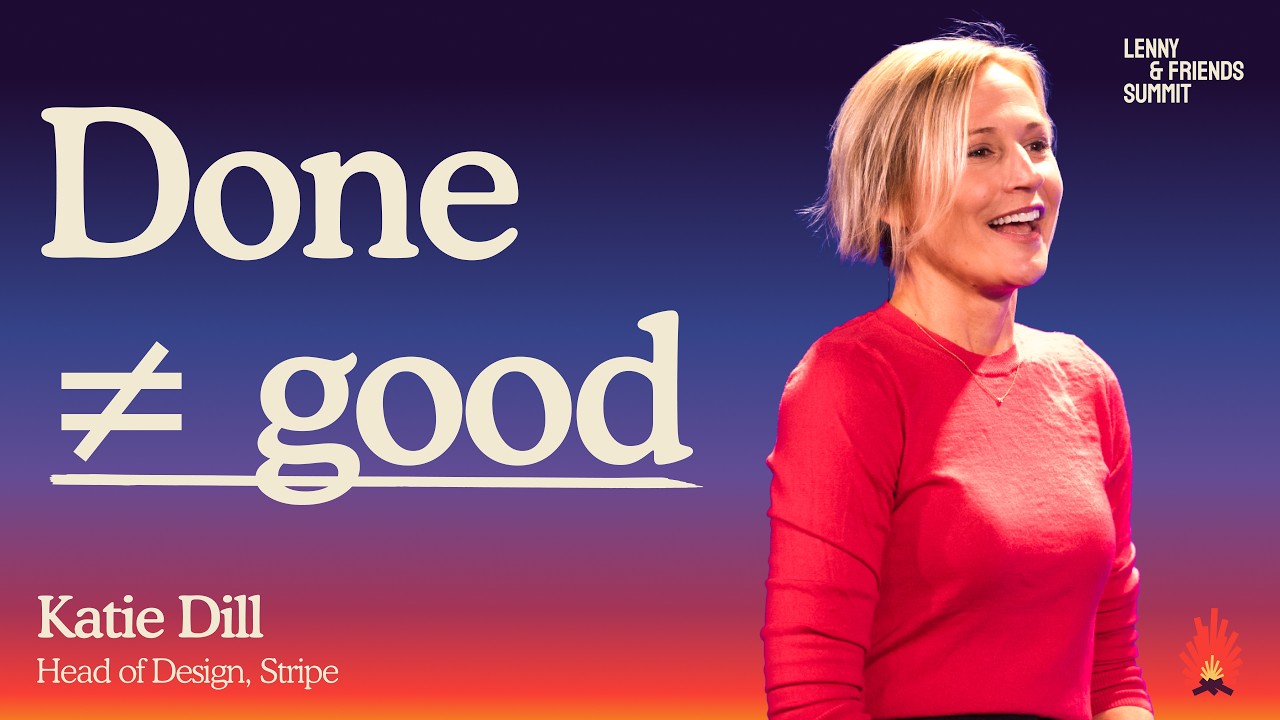
Katie Dill, from Stripe, begins by drawing a parallel between the post-World War II building boom and the current AI building boom. After WWII, an urgent need for construction led to the widespread, uncritical copying of modernist styles, resulting in generic, soulless buildings—what she terms “zombie buildings.” These structures, often seen in banks or commercial spaces, lacked differentiation, context, and care for the user.
Today, AI makes building incredibly easy and fast, enabling small teams to achieve what once required large ones. However, this speed comes with three “watch points” that risk creating “zombie UI”:
- LLMs provide the most probable answer: AI excels at generating what’s popular or historically successful, but struggles with originality or specificity to a brand or user context. This leads to generic outputs, like a Korean barbecue website that looks like any other software company’s site.
- The temptation of “done”: AI-generated outputs often appear polished and finished prematurely, similar to a microwave burrito that is quick but poor quality. This superficial completeness can mask a lack of genuine problem-solving or differentiation.
- Disposable work: The ease and speed of AI-assisted creation can lead to a perception of disposability, where long-term responsibility and maintenance are overlooked.
These watch points combine to create monotonous, vacant, or uncared-for digital experiences—“zombie UI.” Dill emphasizes that users spend half their waking lives on screens and crave software that feels cared for, exhibiting personality, attention to detail (like the date in a calendar tab), and an understanding of user context (e.g., the Link Agent Wallet).
To counter this and build products with care and “soul” using AI, Dill offers four recommendations:
-
Have a Point of View:
- If you don’t define your brand, users, and what you care about, AI will impose a generic, past-looking perspective. This point of view forms the basis of your standards.
- Meticulous craft, exemplified by Stripe’s commitment to “optimism” in every detail, is crucial. Dill introduces the term “Pepsi bubbling” to describe going one level deeper than what the customer can see, ensuring attention to minute details.
- The quality standard for AI-made products should be the output itself, not how it was made. Developing this involves observing user needs, noting what signals good or bad design in the world, and drawing inspiration from diverse fields.
-
Encode Your Standards into the Machine:
- With AI agents and generative UI, human designers won’t always be in the loop. Design systems must evolve from merely scaling consistency to scaling intent.
- Dill references Gutenberg’s printing press system, which was both extensible and opinionated enough to mimic handmade quality. Similarly, modern design systems must be robust enough to guide AI.
- Stripe developed a CLI built on its design system that provides full templates and flows, not just components, making the AI more “obedient” and ensuring coherent product behavior by embedding standards directly into the means of production.
-
Refuse to Confuse “Done” with “Good” (Embrace the Editor’s Role):
- AI accelerates building, allowing 20 ideas to be prototyped in a week. However, the quality filter, which used to be distributed throughout the product development process, now largely occurs post-build, making it harder to say no.
- The role of an “editor”—someone who assesses the end-to-end user experience and ensures coherence—becomes paramount. This means unlearning that “built means done” and “done means good.”
- Great art, Dill notes, is characterized by unexpected details, deeper meaning, and continuous themes—areas where AI often falls short (producing “AI slop” where details don’t matter).
- She cites an example of an animation that required 56 iterations to achieve true beauty, demonstrating how AI can open up possibilities but still requires human scrutiny and refinement.
-
Unleash Creativity and Artistry:
- AI is not just a tool for manufacturing monotony; it’s the greatest creative catalyst we’ve ever had. It’s an opportunity to differentiate and invent new interfaces and aesthetics beyond current chat, chart, and CLI paradigms.
- Just as multi-touch enabled new interactions and synthesizers new sounds, AI allows for entirely new forms of creativity.
- Stripe uses AI to amplify creative teams, such as fine-tuning details in human-marbled artwork. To foster this, improve AI inputs with specific, branded prompts, push outputs beyond the first draft, and use adversarial agents for critique.
- Culturally, leaders must protect “the strange” and give teams room to explore. AI lowers the cost of creation; this saving should be reinvested into making truly special products, raising the ceiling of what’s possible rather than just the floor.
Dill concludes by contrasting the generic post-war boom with Gothic architecture, which John Ruskin admired for its unique, cared-for details. She argues that the current AI boom presents a choice: create digital “zombie buildings” or embrace a creative renaissance, making products that are powerful, solve user problems, and show the unique hand and care of their makers.