Where AI products go next: voice, agents, and self-driving software | Tara Sesha and Nan Yu (OpenAI)
A live talk from the Lenny and Friends Summit with OpenAI's Tara Seshan and Nan Yu and host Claire Vo on building AI products when both technology and user expectations change rapidly. Topics include shipping imperfect features (the ChatGPT "toggle"), the 2 to 3 month model-capability horizon, enterprise absorption limits, single versus multi-agent design, platform layering with computer use as a fallback, working with research through evals, direct user relationships, and predictions for voice, proactive agents, and hardware.
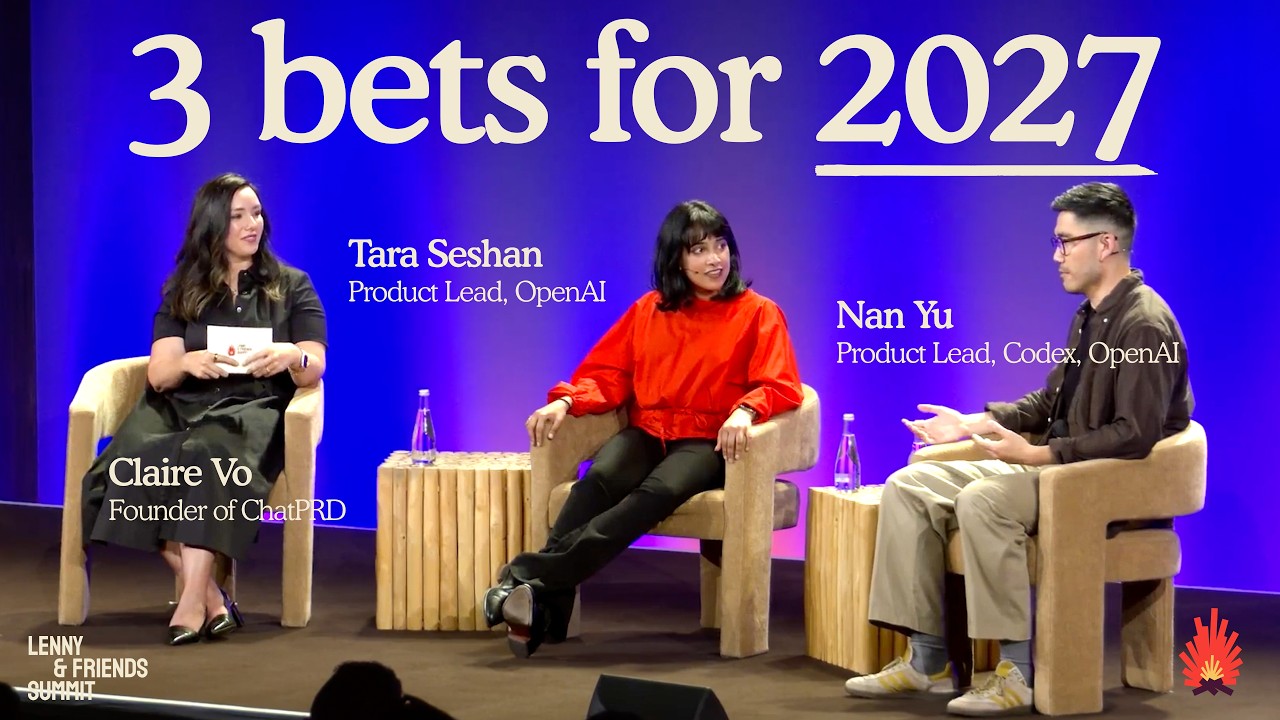
The conversation opens with the “toggle” as a lens on AI products: every AI product has two faces, and the speakers use the ChatGPT toggle that switches between old and new agentic experiences as a running example of shipping something imperfect on purpose. Tara describes how her instincts, shaped by a polished Stripe background and a perfectionist upbringing, have had to shift from “how do you get it perfect a priori” to “how do you ship and iterate as fast as possible.” The core justification is that empirical evidence from real users beats any amount of theorizing, and that the agentic harness needed to reach a billion-plus ChatGPT users quickly, even if the toggle is not the ideal end state.
Shipping imperfect things and keeping users with you
Claire pushes on what gets deprecated and what survives. Tara’s answer is that users tolerate change when there is a coherent story they can follow, along with some transparency about what is happening behind the scenes. The toggle is a useful case: there is an obvious next step (no toggle at all), and the journey from A to B matters more than the intermediate artifact. Done well, a team can change a lot without burning bridges.
The quality bar and the 2 to 3 month horizon
Tara lays out the internal bar she uses. First, is the feature additive, unlocking real value? Second, does it survive internal dogfooding: do people retain, find it delightful or surprisingly great, and does it unlock a new use case of the models? Third, and in her view most important right now, is it aimed at where the models will be in two to three months, avoiding both overreliance on the present and futuristic features that are unusable today. The test is whether the product is out of the model’s way.
Capability overhang and enterprise absorption
Nan argues the binding constraint is not what the model can do but how well people can absorb what is offered. There is a gap between model capability and user uptake, and that gap is the real bottleneck. Claire raises the common B2B claim that customers, success teams and sales teams cannot absorb the rate of change. Tara concedes the pace feels breakneck to enterprises, but argues that staying on the frontier is necessary, since enterprises still mostly use chat while the agent shift was happening, and competitors could leapfrog. Her principle: build what users need, not what they say they need.
Single agents versus many agents
Claire contrasts a single persistent identity (her long-running assistant) with many specialized agents (dozens of task bots). Nan argues the most successful designs map onto human cognition: people can manage a team, but not 40 separate threads at once, so agents should be grouped into bundles, often through a “chief of staff” agent that orchestrates the others. Tara frames the question as tactical rather than philosophical: data access, permissions, whether the agent uses a service account or the user’s credentials, how memory is segmented across contexts such as private channels. In her view the use case determines the answer, and thinking through edge cases is the work.
Two sides of the craft
Claire identifies two halves of agent design: the human side (empathy, understanding mental models, inception) and the systems side (architecture, platform components, edge cases). Nan agrees these are classic product management principles, “the old principles in disguise,” but adds a third ingredient: relentlessness. Trying things, failing, and iterating is required, and the clock speed has simply accelerated. Tara jokes that the chief of staff agent is telling the others to throw spaghetti at the wall.
Platforms, ecosystems, and the last mile
On the ecosystem question, Tara describes ChatGPT as a platform with native functionality plus extension points for first- and third-party developers: plugins, hooks, and additional interfaces. She rejects a binary between building in-house and living in third-party apps. Instead, capabilities should be layered, with computer use as a fallback when a structured tool or connector is missing. Nan emphasizes the last mile: a product that gets 99 percent there and then fails is worse than one that never starts, because it breaks the promise. Computer use may be slow or token-expensive, but it tends to finish the task. Her design ideal is the user as a guest in your home: the product should anticipate needs and provide for them gently.
Working with research
Tara admits working with research was entirely new to her coming to OpenAI, unlike working with engineering. Her advice for product people is to bring very specific use cases, clear descriptions of user goals, and sample sessions showing what happened and why the model failed. Writing evals is central: once a prompt and skill set achieves the desired outcome, that becomes the target to post-train into the model. Trust is earned gradually before research will engage deeply on evals.
Planning horizon
Claire asks how far ahead product leaders should plan. Tara says two to three months is the working horizon: multi-year predictions are usually wrong, but building only for today means being left behind. She notes the planning problem varies by business. Stripe’s payments market has forces that can be modeled in bull, base, and bear cases, while OpenAI’s business is much harder to predict in the same way.
What still matters and what is newly table stakes
Nan says onboarding matters far more now, because people have to understand what an offering does before they can benefit from it. Tara emphasizes that users need to predict what an agent will do, especially as it acts semi-autonomously. Privacy and data use must be legible. The usual PM craft still applies, but empirical testing with users and moving faster matter more than ever.
Direct user relationships
Tara argues that being reachable to users is becoming a norm, not an exception, especially for a consumer product used by everyone. Direct contact is how product people learn what users want, which is what gives them value to research. Nan notes that engineers and developers give terse feedback, and agentic experiences produce subtle problems that require follow-up questions: what did it say, what was the context, did the user get frustrated. A deeper relationship with users yields insight that broad metrics cannot.
Predictions for the next year
Tara bets on voice, which she says has changed how she works and has dramatically reduced tech support for her family, since speaking is the most natural interface and the models are finally good at it. Nan predicts self-driving or proactive products that help users past the empty input box problem, since intelligent products should be able to operate themselves to ease onboarding. Claire predicts hardware that replaces the laptop, a small always-available assistant. The session ends with a playful note on which of these forecasts will prove right.