Co-Engineering: The New Era of Human-AI Collaboration
Kiriti Badam from OpenAI introduces 'co-engineering,' a new paradigm where humans and AI agents collaborate as teammates in the software development lifecycle. He outlines key principles for effectively integrating AI agents into enterprise workflows, focusing on context management, security, and iterative improvement.
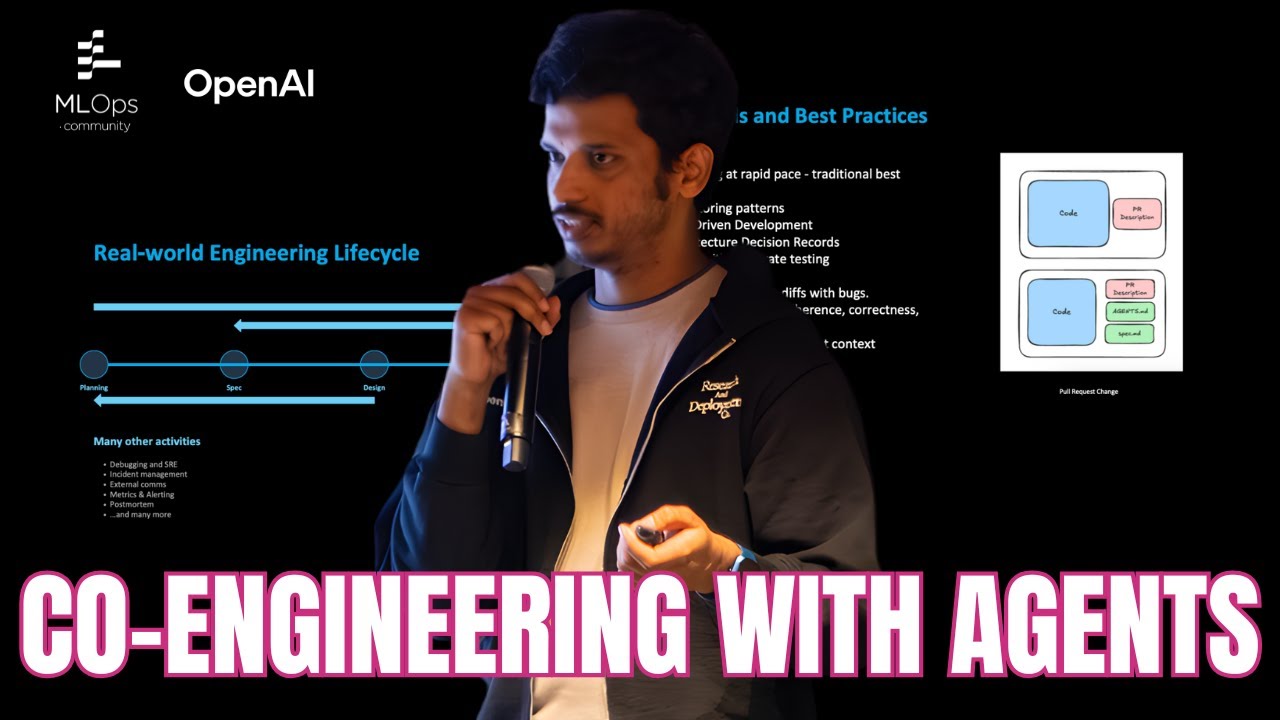
The Shift from AI Tools to AI Teammates
The paradigm of software development is evolving from simple, single-file code completion to a more integrated, agentic workflow. This new era, termed co-engineering, involves treating AI agents as junior engineers embedded within various development processes. While agent-driven coding is powerful for greenfield projects, it faces significant hurdles in enterprise environments due to legacy code, security constraints, and performance requirements. The goal of co-engineering is to bridge this gap by establishing principles and a mindset for effectively collaborating with AI agents on production-grade software.
Core Principles of Co-Engineering
To successfully integrate AI agents into complex workflows, it’s crucial to adopt a set of guiding principles. This isn’t about a “prompt template book,” but a strategic approach to collaboration.
-
Build Deliberate Context: LLMs are stateless. The quality of their output depends entirely on the context provided. It is essential to feed them high-signal information and avoid “context bloating” by dumping large, irrelevant files.
- System Knowledge: Use files like
agents.mdto provide context that isn’t present in the code itself, such as repository interconnections, deployment processes, architectural decisions, and style guidelines. - System Contracts: Maintain specifications (e.g.,
spec.md) that outline system contracts and behaviors. This is critical for large-scale refactoring projects to ensure consistency. - Avoid Context Bloat: Be explicit about the task. Don’t expect an agent to succeed by giving it dozens of files. Use commands to clear the context window when switching tasks and leverage sub-agents to delegate and minimize context.
- System Knowledge: Use files like
-
Be Opinionated and Iterative:
- Guide, Don’t Ask: Instead of asking an agent for broad advice like “refactor my entire codebase,” guide it with a clear, opinionated plan. Ask for specific improvements, craft a plan, and then use the agent to implement it.
- Iterate and Expand: Start with simple tasks and gradually expand the agent’s scope. Observe failure patterns and continuously refine the context and tools you provide.
-
Maintain Security and Control:
- Use Guardrails: Implement
allowanddenylists for commands and require explicit user approval for critical actions. Never give an agent write-access to a production database. - Leverage Version Control: Always use version control tools like
gitandgit worktrees. Agents have been known to delete files when they can’t make tests pass, and version control is your safety net. - Run in Sandboxes: Always run agents in dry, sandboxed environments with the least privilege necessary before applying changes.
- Use Guardrails: Implement
-
Develop Effective Evaluations:
- You don’t need massive evaluation sets. Instead, develop a “sense of taste” by creating a small, curated set of 10-15 examples specific to your enterprise needs.
- For a code review agent, use a list of Git diffs from past bugs and check if the agent can identify them.
- For a code-writing agent, evaluate its adherence to style guides, instruction following, and its ability to pass CI and pre-commit checks.
Applying Co-Engineering Principles in Practice
These principles are not abstract; they apply directly to different stages of the software lifecycle.
In Coding:
The focus is on providing rich, targeted context through documentation and system contracts. Traditional software engineering wisdom—good documentation, clear variable names, and documented architectural decisions—is no longer just “good to have”; it is mandatory for making AI agents effective.
In Debugging and SRE Workflows:
The same principles apply but with additional context sources.
- Observability Context: To build a useful AI SRE agent, provide it with access to logs, metrics, and traces through well-defined tools.
- Preventing Context Overflow: Log queries can return thousands of results, overflowing the context window. Build tools and APIs that provide summaries or aggregates to the LLM instead of raw data.
- Incident Hygiene: Create a knowledge base for the agent by summarizing preliminary analyses, post-mortems, and runbooks and storing them in a vector store for easy retrieval.
The Future is Collaborative and Multi-Surface
The surfaces for interacting with AI agents are expanding and becoming interoperable. Products like OpenAI’s Codex offer IDE extensions, a CLI, and the ability to run tasks in the cloud. This enables powerful new workflows, such as starting a task on a phone, pulling it into a CLI at the office, and letting the agent write the pull request, review it, and suggest its own fixes—all while keeping the human in the loop.
Ultimately, humans must remain in command, setting the intention for the code and the system. The key is to lay the groundwork now because the models will only get better, soon enabling agents to handle complex features from end to end over hours-long sessions. As Kiriti Badam states, “context is the currency,” and it must be spent carefully. The essence of co-engineering is to engineer alongside agents, translating improving model capabilities into faster, more effective engineering teams.