What Is RAD? Why It Matters in the Age of AI Coding
This video explores how James Martin's 1991 Rapid Application Development (RAD) methodology, with its emphasis on rapid prototyping, iterative development, and user feedback, offers a robust framework for contemporary AI coding and "vibe coding" workflows. It highlights how AI agents accelerate prototyping but introduces new challenges regarding production readiness and security. The solution proposed is spec-driven development, where human expertise formalizes requirements and verifies AI-generated code based on insights gained from early prototypes, ensuring quality and mitigating risks.
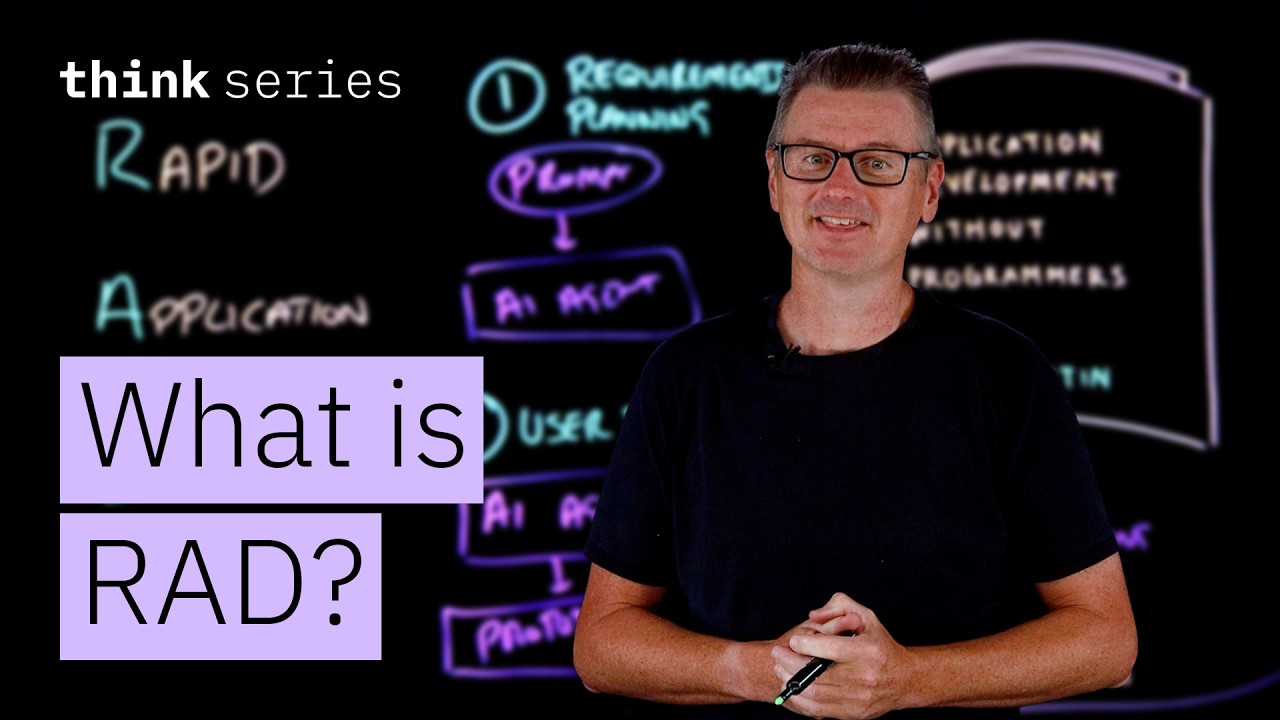
The video explores the striking relevance of Rapid Application Development (RAD), a methodology formalized by James Martin in 1991, to contemporary AI-driven software development, particularly “vibe coding” and the use of AI agents. Martin’s 1982 book, “Application Development Without Programmers,” foreshadowed current trends, where AI agents can rapidly generate functional applications.
RAD, in contrast to the Waterfall approach prevalent at its inception, prioritizes speed, iterative development, and continuous user feedback. It is structured into four key phases:
- Requirements Planning: This initial phase is intentionally lightweight. It involves defining the problem, identifying target users, outlining desired features, and noting any constraints. The core tenet here is that users often don’t fully articulate their needs until they interact with a tangible product. In the context of AI coding, this phase effectively translates to the initial “prompt” provided to an AI agent.
- User Design: A team rapidly constructs a clickable prototype, which is then presented to actual users. The goal is to identify and rectify any flawed assumptions early in the development cycle, when changes are still inexpensive. Critically, this prototype is considered a “keeper,” forming the foundation upon which the final product will be built. With AI agents, this means the agent generates a working application directly from the prompt, allowing immediate user interaction and feedback loops.
- Construction: The actual application functionality is developed in short, iterative cycles, with testing and feedback integrated continuously rather than deferred to the project’s conclusion. An AI agent, in this phase, generates the necessary components like data schemas, workflow logic, and notification systems.
- Cutover: This final phase involves deploying the application to production, migrating data, and training end-users. The philosophy dictates that the refined prototype ultimately evolves into the production-ready system.
Historically, RAD didn’t achieve widespread adoption because the code generators and Computer-Aided Software Engineering (CASE) tools of that era lacked the sophistication to build complex applications. However, the advent of modern AI agents has revolutionized this, making it possible to generate functional applications from plain language descriptions within minutes. This rapid prototyping capability makes RAD’s four-phase structure exceptionally well-suited for AI development.
An illustrative example is the “expense approval app” often “vibe coded.” Here, the initial prompt serves as the requirements plan. The AI agent generates a prototype (User Design), which users review, providing feedback (e.g., “confusing approval screen,” “AI slop purple background”). The agent then iteratively refines the prototype. The agent simultaneously handles “Construction” by generating data schema and logic. When the prototype is deemed satisfactory and ready for “Cutover,” the question arises: Is AI-generated code truly production-ready?
The challenge with deploying AI-generated prototypes directly to production lies in potential critical omissions. For instance, an AI might not automatically implement a rule preventing an employee from approving their own expenses, leading to vulnerabilities. Studies indicate that a significant proportion, around 45%, of AI-generated code samples contain security weaknesses.
The solution harkens back to James Martin’s original, complete vision for “Application Development Without Programmers,” which involved two core components: a precise specification (spec) and subsequent code generation. While AI agents excel at the latter, the former—a robust, human-vetted specification—is crucial. This “spec-driven development” involves formalizing discoveries made during prototyping into a comprehensive spec, encompassing business rules, acceptance criteria, and critical security requirements (e.g., “nobody ever approves their own expenses”). A security expert reviewing this spec could identify missing rules that might not be apparent during prototype interaction. Once a rule is documented in the spec, it becomes a mandatory test for the generated code.
Therefore, while the prototype remains a “keeper,” what ultimately transitions into production is not just the code, but “everything the prototype taught us which is captured in that spec.” This validates the enduring strength of RAD’s methodology: plan lightly, prototype early, build in short cycles, and rigorously verify before deployment. The role of programmers, though evolving, remains indispensable, shifting towards defining precise specifications and critically verifying the output of AI agents, ensuring quality and security. James Martin’s vision of “Application Development Without Programmers” thus requires a “second sign-off” from human expertise to truly achieve production-grade software.