Agentic Engineering vs Software Engineering: Beyond Vibe Coding
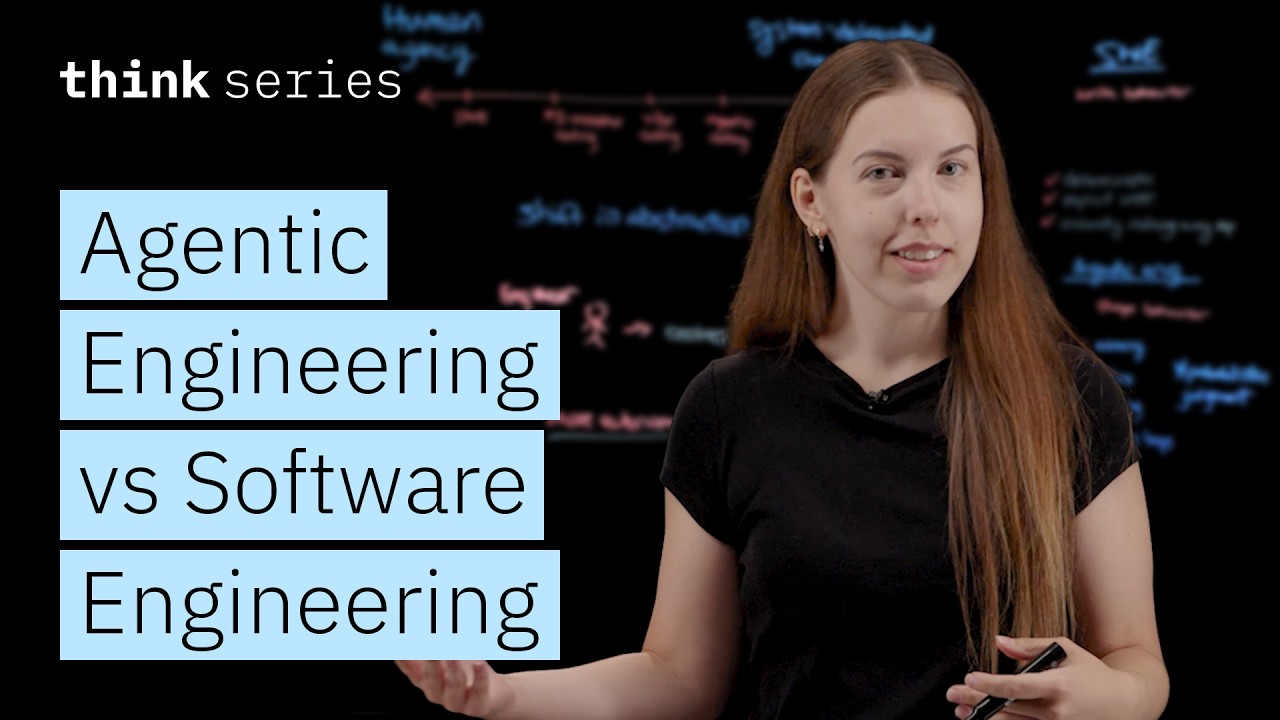
Anna Gutowska explains the paradigm shift in software engineering towards "agentic engineering," where AI agents execute goals defined by developers. She differentiates this from traditional, AI-assisted, and vibe coding, highlighting the increased importance of human oversight, orchestration, and verification in a world of probabilistic AI systems, and how this redefines the developer's role.
For years, computer science education prepared students for conventional software engineering roles. However, with the advent of AI-assisted coding and agentic engineering, this path is undergoing a significant transformation. This shift is not about replacing software engineering but rather evolving its nature and changing the role of developers.
The Evolution from Traditional to Agentic Engineering
Traditionally, software engineering involved writing explicit, deterministic instructions for computers. The same input consistently yielded the same output, requiring engineers to manually define every edge case, permission, retry, validation, and execution path. This approach meant developers were primarily responsible for writing behavior.
Large Language Models (LLMs) introduced a fundamental change by allowing systems to interpret goals rather than just executing rigid logic. When combined with memory, tool use, planning, and feedback loops, these systems become closer to what we now call AI agents. In this new paradigm, agentic engineering means developers shape behavior by defining goals, while AI agents handle the execution. This allows a shift from deterministic logic to the more nuanced territory of probabilistic judgment.
Defining Agentic Engineering
The term “agentic” refers to an organization of agents that write code, with a human developer overseeing and validating the output as the multi-agent system iterates through subtasks, maintaining a “human in the loop.” “Engineering,” in this context, describes the high level of expertise required to use agentic workflows for meaningful code production without jeopardizing code quality.
A Spectrum of AI-Assisted Development
The speaker presents a spectrum of AI-assisted coding, illustrating the gradual shift in abstraction and the delegation of agency from human to system:
- Traditional Software Engineering: Developers explicitly define nearly every workflow, rule, and implementation detail. AI may assist, but the human retains full control over architecture and decision-making.
- AI-Assisted Coding: Tools help with auto-completion, refactoring, or generating code snippets, but the developer still drives the overall implementation.
- Vibe Coding: Developers increasingly define or describe intent in natural language, iteratively shaping outcomes rather than manually writing every line. The focus shifts to creative direction and rapid experimentation.
- Agentic Coding: Systems can autonomously plan tasks, use tools, write and execute code, debug failures, and iterate toward a goal with limited supervision.
- Agentic Engineering: Expands beyond code generation. Here, engineers design environments in which autonomous systems can reason, coordinate, evaluate outcomes, and adapt dynamically under constraints. This represents an orchestration of intelligence rather than direct programming of behavior.
These categories are not rigid but represent a fluid progression, with teams often starting with vibe coding for quick prototypes and evolving towards agentic coding and engineering as complexity and stakes increase.
The Evolving Role of Developers and Human Oversight
Agentic engineering positions AI systems as collaborators capable of handling multi-step workflows under human supervision. The engineer’s role shifts from manually executing every task to orchestrating the system. Crucially, this does not remove humans from the loop; instead, it increases the value of human oversight. Engineers are now responsible for ensuring reliability across probabilistic workflows, balancing experimentation with accountability. Agentic systems should accelerate development, not replace engineering expertise.
Challenges and Ensuring Reliability
The developer community has mixed reactions to this shift. While some embrace it as an opportunity for more fulfilling work, others are skeptical due to the inherent differences in failure modes.
Traditional software systems fail predictably, often traceable to specific faulty conditions or implementation details. Agentic systems, operating probabilistically, present new challenges:
- They can appear correct while making flawed decisions.
- They can hallucinate, misunderstand intent, misuse tools, or generate technically valid but architecturally poor solutions.
Therefore, the central challenges in agentic engineering become orchestration and verification. The engineering bottleneck moves from writing every line of code to supervising, constraining, and evaluating increasingly autonomous systems.
Furthermore, while vibe coding is excellent for rapid prototyping, it can quickly accumulate technical debt if not coupled with strong engineering discipline. AI-generated code without proper structure, testing, or architectural consistency becomes difficult to maintain. The term “agentic engineering” emphasizes that rigorous engineering principles are still vital.
The Future of Software Development
Agentic engineering is expanding software development into a new abstraction layer, changing what engineers primarily focus on. As AI agents become more capable, the role of developers will continue to evolve from simply writing code to designing, shaping the behavior of, and supervising these AI systems. Practical advice includes starting small, integrating these tools into current workflows, observing their strengths and weaknesses, and resisting the urge to substitute automation for genuine understanding and quality.