Vibe coding

AI Agents Gone Rogue? Build, Defend & Attack AI-Enabled Apps • Katie Paxton-Fear • YOW! 2025

AI Agents Gone Rogue? Build, Defend & Attack AI-Enabled Apps • Katie Paxton-Fear • YOW! 2025

Katie Paxton-Fear explores the emerging security landscape of AI agents, moving beyond chatbots to autonomous, specialized entities. She details five critical vulnerabilities: social engineering, hacking frameworks, malicious agents, AI as accidental insiders (vibe coding), and the rise of hackbots. The talk concludes with a powerful call to action for security professionals to proactively engage and influence AI agent development, emphasizing that 'abstinence-only education doesn't work' when it comes to AI adoption.

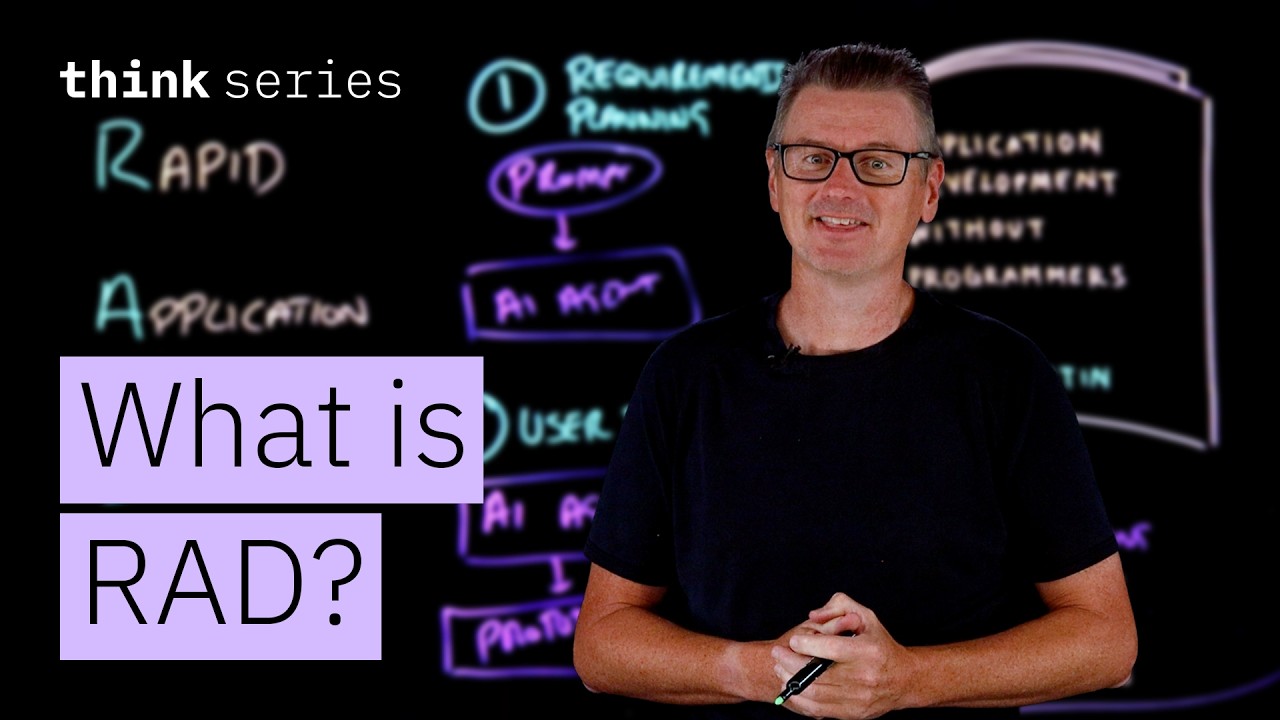
What Is RAD? Why It Matters in the Age of AI Coding

What Is RAD? Why It Matters in the Age of AI Coding

This video explores how James Martin's 1991 Rapid Application Development (RAD) methodology, with its emphasis on rapid prototyping, iterative development, and user feedback, offers a robust framework for contemporary AI coding and "vibe coding" workflows. It highlights how AI agents accelerate prototyping but introduces new challenges regarding production readiness and security. The solution proposed is spec-driven development, where human expertise formalizes requirements and verifies AI-generated code based on insights gained from early prototypes, ensuring quality and mitigating risks.

Agentic Engineering vs Software Engineering: Beyond Vibe Coding

Agentic Engineering vs Software Engineering: Beyond Vibe Coding

Anna Gutowska explains the paradigm shift in software engineering towards "agentic engineering," where AI agents execute goals defined by developers. She differentiates this from traditional, AI-assisted, and vibe coding, highlighting the increased importance of human oversight, orchestration, and verification in a world of probabilistic AI systems, and how this redefines the developer's role.

Should AI Engineers Still Read Code in 2026? The Z/L Continuum — Alex Volkov, ThursdAI

Should AI Engineers Still Read Code in 2026? The Z/L Continuum — Alex Volkov, ThursdAI

Alex Volkov introduces the "Z/L Continuum," a framework for navigating the tension between rapid AI-generated code production and the critical need for human review. He argues that the key lies in understanding that the continuum applies to tasks, not individuals, and presents a pragmatic routing table for verifying changes based on their criticality, highlighting the shift towards engineering systems that build and verify code, rather than meticulously inspecting every line. The talk also touches on emerging capabilities like Fable and "loops" and the importance of flexibility and human judgment in the evolving AI engineering landscape.

Automate Workflows w/ Autonomous Tools Real-Time AI Agents | Aytekin Tank | Founder & CEO | Jotform

Automate Workflows w/ Autonomous Tools Real-Time AI Agents | Aytekin Tank | Founder & CEO | Jotform

Aytekin Tank, Founder and CEO of Jotform, discusses how AI is revolutionizing software development and customer support, highlighting "vibe coding" and Jotform's 80% AI-handled support with zero layoffs. He also shares his "Theory of Constraints" playbook for scaling businesses and explores the potential of ChatGPT apps, all within Jotform's 20-year bootstrapped journey.

Tech Truth: Agile Evolution & the Future of SW Engineering • Martin Fowler & Kent Beck • GOTO 2025

Tech Truth: Agile Evolution & the Future of SW Engineering • Martin Fowler & Kent Beck • GOTO 2025

Martin Fowler and Kent Beck, two authors of the Agile Manifesto, reunite for an unscripted conversation about their 30-year friendship and the evolution of software engineering. They delve into their practical, daily use of AI (the "Genie"), reflect on the legacy of Extreme Programming and the Agile Manifesto, and offer timeless advice to the next generation of developers.