OpenAI's always-on agents, 700+ math manuscripts & HackerRank's AI interviewer
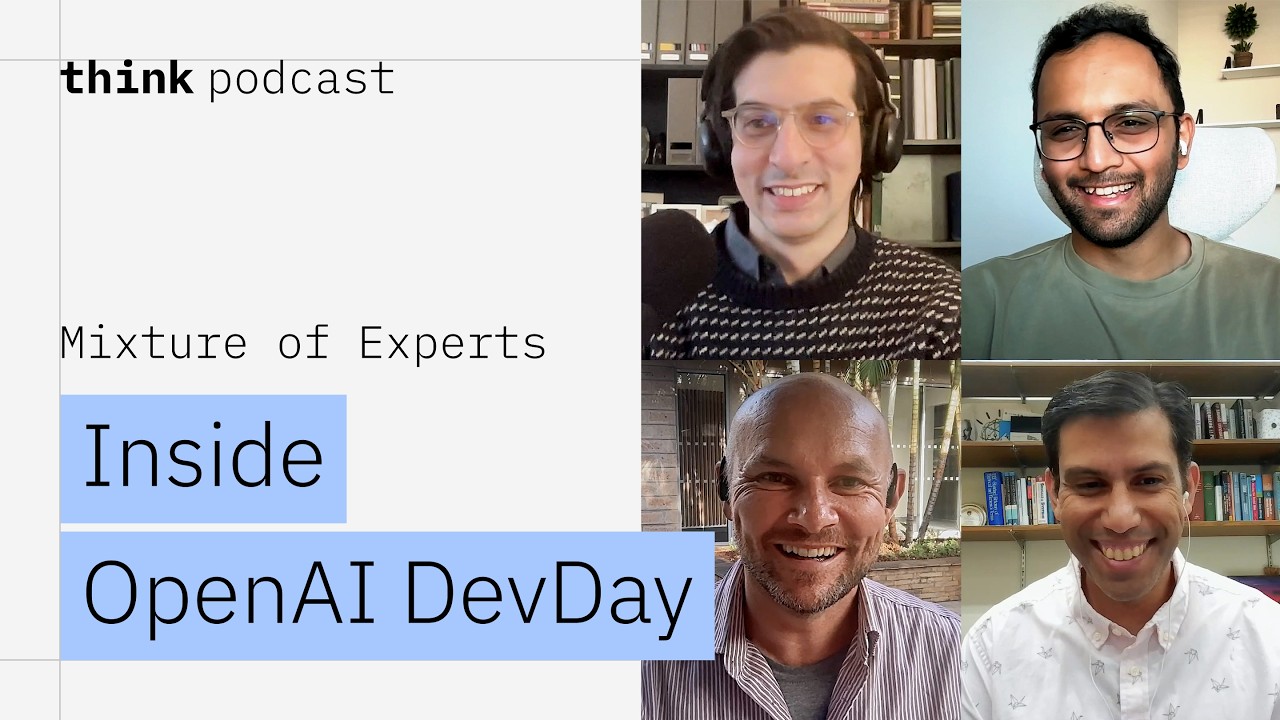
The panel covers OpenAI's Dots and the wave of persistent AI agents, OpenAI's release of hundreds of AI-generated math manuscripts and what it means for human mathematicians, and HackerRank's Chakra AI interviewer and its implications for fairness and evaluation. The episode closes with an explainer on mixture of experts architectures and the difference between open-weight and open-source models.
Persistent agents and the ’never logs off’ push
David Zax opens with OpenAI’s DevDay, where the company introduced Dots, a durable agent that can be handed ongoing responsibilities. The panel frames it as the latest entry in a wave that includes Meta’s Muse and the OpenClaw agent that surfaced roughly nine months earlier and spread into users’ text messages.
Utsav Dholakia, who attended DevDay, describes the energy in the room and sees OpenAI’s advantage in its ecosystem: a household name from ChatGPT, developers already embedded in its tools, and a cloud environment built around Codex. He found Dots good at sustaining conversation and managing tasks, but his real test is delegation. Can you hand off work and truly forget about it? If the agent keeps returning for permission or clarification, ‘you’re not truly delegated.’ He also asks how an agent handles competing tasks when told to stop just one of them. He suggests that whether these products move AI beyond the chat box for the broader public is something to judge over the next couple of months.
Kush Varshney is more skeptical of the cartoonish design and the near-simultaneous releases of Dots, Muse, and Tab. He reads them as copying among firms that have invested so heavily that little room is left for imagination. Skyler Speakman argues the companies are aiming at a less technical audience, so the cute design is deliberate, and that cuteness makes the concerns raised by OpenClaw less salient. He notes that outlets usually skeptical of Meta were surprisingly positive about Muse, a sign that people may be lowering their guard as capability impresses them. The group leaves open whether these agents are genuinely safer or simply ‘defanged.’
AI-generated mathematics at scale
OpenAI released more than 700 AI-generated math manuscripts on GitHub, covering roughly 370 families of results. This came days after Meta reportedly had mathematicians produce six research papers through its AI chat interface. The panel had already covered OpenAI’s claim that a model it was testing had made progress on Navier-Stokes, one of the Millennium Prize problems, so the direction of this release was not surprising. The volume was.
Kush frames mathematics as a journey of understanding built on axioms and postulates, and admits he did not grasp what research really was until graduate school. Skyler notes that Terence Tao and others argue contributions must be understood by humans by definition. Skyler is less certain of that position. A counterexample settles a conjecture regardless of whether it was found by brute force or intuition, and the field can then move on. For him, the more interesting frontier is when AI will pose new questions instead of answering ones humans have asked for decades.
David’s concern is the bottleneck. Human attention is finite, and verifying this volume of output could turn into a treadmill of humans sorting through AI-generated material. Kush responds that the role of mathematicians may shift toward interpreting what AI produced for everyone else, which is already the purpose of science in general. He argues that tools revealing structure beyond human cognitive reach, including high-dimensional phenomena our brains are poorly suited to compute, could be a gain rather than a threat.
HackerRank’s Chakra and AI-driven interviews
HackerRank, founded in 2012, has pivoted toward AI with Chakra, an interviewer for coding assessments. Candidates may use AI during the session, which discourages cheating in a separate tab. Chakra observes how they work with the tool and asks behavioral questions about their choices. The product reportedly ran around half a million beta interviews over six months and has been used by large firms such as Capgemini.
Utsav questions how comparable the results are when each candidate’s AI-assisted output differs and the AI may steer the session in different directions. He acknowledges that human interviewers also vary, but argues the AI adds another random factor. The real test, in his view, is whether the system gives humans a sound rubric for judging candidates.
Kush draws on IBM’s responsible technology work, noting that vendors have increasingly taken bias seriously and that fairness reports are worth requesting. He argues that widening access to interviews is itself an ethical good for candidates who are not well connected. David quotes CEO Vivek Ravisankar, who claims ‘AI is way less biased than humans if tuned properly.’ The panel broadly agrees with the principle, and Skyler adds that machine bias is easier to detect and correct than human bias. Skyler finds the technology dystopian in a hiring setting but more promising in education, where it could reveal whether students truly learned by how they interact with AI, rather than relying on essays that have lost much of their value as evidence.
Kush closes the segment by suggesting that using AI well, to fill gaps and extend one’s capabilities, may become a skill employers screen for. The panel agrees it must be both learned and evaluated.
Explainer: mixture of experts and open weights
David, who describes himself as a non-technical listener, asks for a clear explanation. Kush uses a spreadsheet analogy: the parameters in a layer are like tabs, and each expert is a tab that specializes in different things. A gating function, or router, is learned during training and decides which experts to activate for a given input. Nothing is assigned in advance to math, style, or any other domain. Because only some experts are active at a time rather than all parameters, inference is faster. Current architectures usually keep experts siloed, but Kush notes that alternatives exist, such as Capsule Networks from Geoffrey Hinton and routing networks explored at IBM Research.
On open weight versus open source, Kush explains that weights are the entries of the matrices multiplied at each layer. Releasing them lets someone download the model, but it does not supply the compute needed to run it, the training data, or the training recipe. Open source, by contrast, covers the fuller process, including training code and data. David summarizes that openness comes in degrees, and Kush agrees: releasing numbers alone is open weight, while transparency about how the model was grown is what moves toward open source.