Lobster Trap: OpenClaw in Containers from Local to K8s and Back — Sally Ann O'Malley, Red Hat
This talk presents a container-first methodology for developing, distributing, and managing AI agents. Using a stack of Podman for local development and Kubernetes for scalable deployment, this approach transforms personalized agent setups from messy collections of files into reproducible, secure, and portable container images that can serve as a team-wide baseline. The session covers practical techniques for secrets management, state persistence, and automated setup, highlighted by a real-world example from an Nvidia team using this pattern for model evaluations.
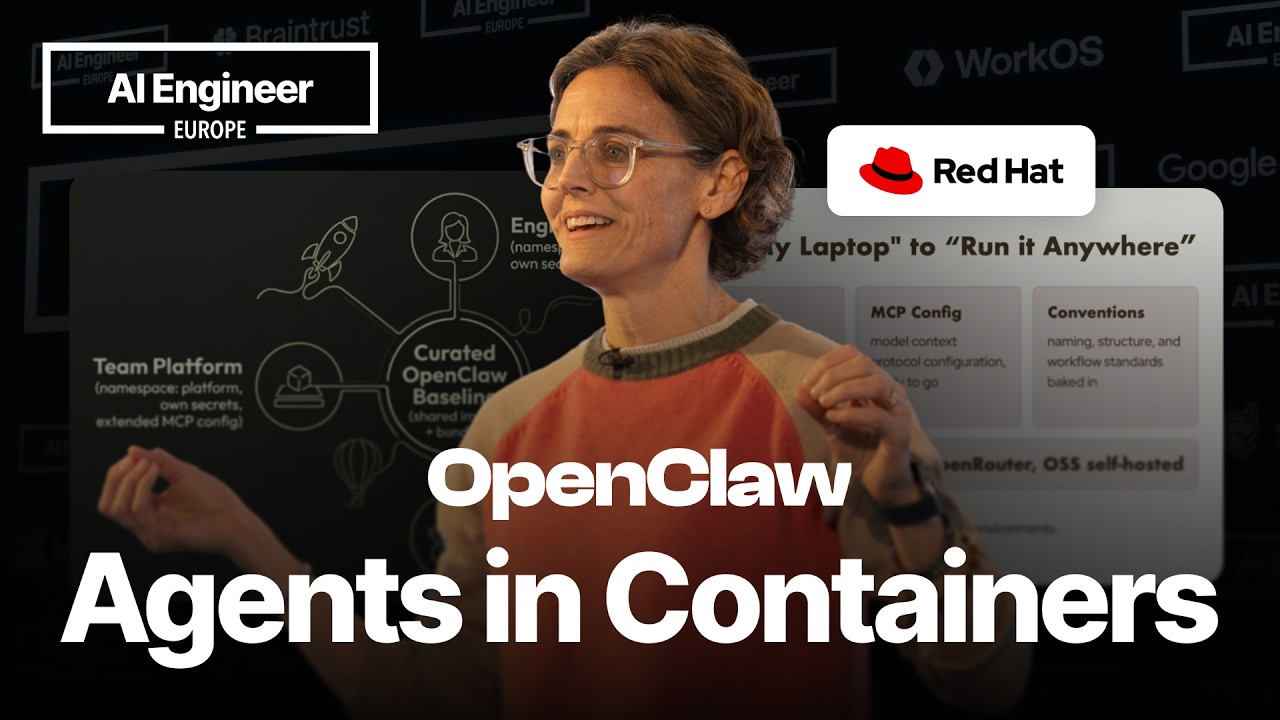
The conventional method of sharing an AI agent setup—exchanging a collection of Markdown, configuration files, and YAML—is inefficient and prone to errors. A more robust solution is to adopt a container-first approach, packaging the entire agent environment into a single, portable container image. This allows anyone to spin up a fully configured sub-agent in seconds, whether locally with Podman or at scale on Kubernetes, turning a personal setup into a reproducible baseline for an entire team.
The Case for Containerizing AI Agents
Running AI agents inside containers offers a clean, predictable, and secure environment, abstracting away OS-level quirks and dependency issues. The primary benefits of this approach include:
- Reproducibility: A container image encapsulates the agent and all its dependencies, ensuring it runs identically everywhere.
- Portability: The same image can be run on a local laptop (x86, Mac) or in a cloud environment like Kubernetes without modification.
- Isolation & Security: Containers provide a natural sandbox, limiting the agent’s access to the host system. You must be explicit about what resources (files, network ports) are exposed.
- Simplified State Management: By backing the container with volumes (Podman/Docker volumes or Kubernetes PersistentVolumeClaims), the agent’s state is neatly contained, which simplifies backup and recovery strategies. For instance, a nightly backup can be run with a simple
systemdservice. - Clean Configuration: An entire agent directory, including custom tools, skills, and MCP servers, can be mounted into the container at startup, ensuring the agent is immediately ready to work.
A Practical Stack: Podman and Kubernetes
The recommended stack uses Podman for local development and Kubernetes for production or team-wide distribution, leveraging the same container image throughout the entire lifecycle.
A key real-world example of this pattern in action is an engineering team at Nvidia. The team, comprising about ten engineers, runs their own individual OpenClaw agents in Kubernetes to perform model evaluations. This containerized workflow proved so efficient that it accomplished work that previously required six additional engineers, freeing up the team to focus on more creative and innovative tasks.
Advanced Secrets Management
A critical aspect of running agents securely is managing API keys and other credentials. This setup employs a two-layer approach to prevent secrets from being exposed in logs or configurations:
- Host-Level Secrets: On the local machine,
Podman secretsprovide a secure way to store API keys. In a cluster environment, Kubernetes Secrets serve the same purpose. - In-Container Secret References: Inside the container, the agent configuration doesn’t store the secret directly. Instead, it uses OpenClaw’s
secret reffeature. The configuration contains a pointer to the secret, which in turn references the secret managed by the container runtime (Podman or Kubernetes). This double-layered abstraction ensures that sensitive keys are never hardcoded or directly visible within the application’s environment.
A Vision for Enterprise Adoption
This container-based methodology provides a powerful model for onboarding and standardizing agent use within an organization. A team can maintain a curated, baseline OpenClaw image that comes pre-configured with:
- Company-approved MCP servers and authentication methods.
- Team-specific skills and tools.
- Access to shared resources like Google Drive.
New hires can instantly pull and run this standard image, receiving a fully functional, compliant agent on day one. From there, they can personalize their instance by adding their own sub-agents and configurations. This model fosters team standards, creates a portable environment, and makes the onboarding process highly reproducible, replacing the ad-hoc process of manually copying and configuring a colleague’s setup.